
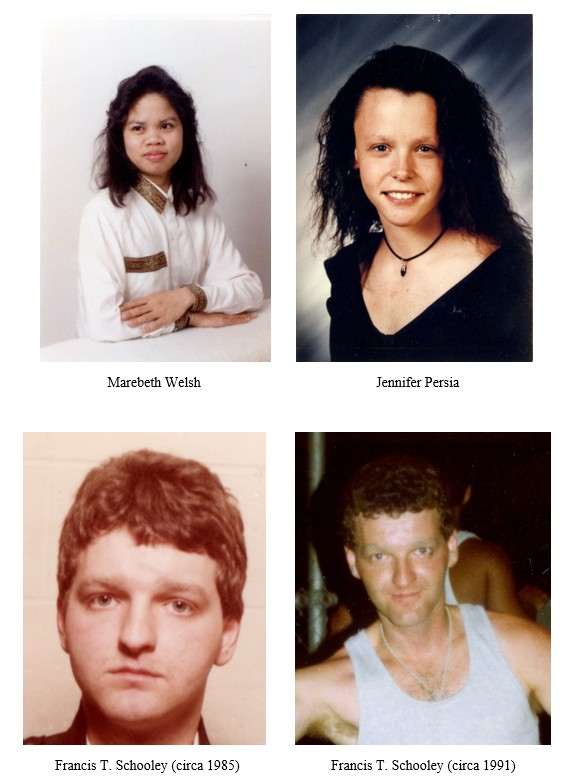
Camden County, NJ – DNA evidence has led to detectives identifying a Mantua Township man as the suspect responsible for the murder of two young women in the 1990s, announced Camden County Prosecutor Grace C. MacAulay.
Francis T. Schooley, who died in 2000 at the age of 39, has been linked through DNA evidence to the murders of 24-year-old Marebeth Welsh of Woodlynne in 1993 and 16-year-old Jennifer Persia of Magnolia in 1994.
“Thanks to remarkable advances in DNA technology and diligent detective work, we have finally been able to bring answers to two families who have waited decades for justice,” said Prosecutor MacAulay. “These cases never left the minds of our investigators, even as the years passed. We must commend Sergeant Dennis Convery and Detective Daniel Crawford for their unwavering commitment to the truth. No matter how much time passes, we will continue to pursue justice for every victim.”
While individual detectives in the Homicide Unit have always pursued cold case investigations as time allowed, the Camden County Prosecutor’s Office established a full-time, dedicated Homicide Cold Case Unit in January 2024. This group of investigators is tasked with focusing on investigations that have the potential to be furthered through advances in DNA testing and genetic genealogy.
“The Borough of Magnolia and the Magnolia Police Department have remained committed to honoring Jennifer’s memory,” said Magnolia Police Chief John Huston. “Our hearts are with her family, and while the results of this investigation cannot bring her back, we hope it offers them a measure of peace. Jennifer’s murder deeply stunned the entire Magnolia community. Residents can take some comfort in knowing that both the Camden County Prosecutor’s Office and the Magnolia Police Department remain steadfast in their pursuit of justice and will continue working tirelessly until cases like this are solved. For those who wish to pay their respects, Albertson Park in Magnolia features a gazebo dedicated to Jennifer Persia—a place where the community can gather, reflect, and keep her memory alive.”
Probable Cause Statement
On Sunday, November 14, 1993, at approximately 4:24 a.m., members of the Camden Police Department located a deceased female, later identified as Marebeth Welsh. Welsh was found lying prone on the sidewalk along the 300 block of Jackson Street in Camden, New Jersey, with blood coming from her nose. Welsh wore a black and red checkered long sleeve thermal shirt and pink and blue checkered pants. Welsh was found with no shoes, a sock on her right foot but no sock on her left foot. The back of her clothing was dry despite rain as late as approximately 3:30 a.m. that morning. The crime scene strongly suggested she had been placed at that location following the homicide. Welsh was pronounced deceased at 6:28 a.m.
Also on November 14, 1993, Doctor Robert Segal of the Camden County Medical Examiner’s Office conducted a post-mortem examination of Marebeth Welsh. Dr. Segal determined that Welsh’s cause of death was strangulation, and the manner of her death was homicide. Dr. Segal also found signs of a sexual assault.
At the time of the homicide, Marebeth Welsh was estranged from her husband and living with two (2) males in a residence located on the 200 block of Cypress Avenue Woodlynne, New Jersey. Investigators collected a comforter from the second-floor rear bedroom that Welsh resided in. The comforter later tested positive for blood in presumptive testing.
The New Jersey State Police (NJSP) Forensic Science Bureau conducted an analysis of the case evidence and found that Marebeth Welsh’s shirt, underwear, and the swabs collected from her body tested positive for spermatozoa. The Federal Bureau of Investigation (FBI) later conducted additional DNA analysis which showed that the DNA profiles obtained from cuttings of Welsh’s shirt and underwear did not match the dried blood samples of five (5) males from whom blood samples were obtained, including Marebeth Welsh’s estranged husband and the two (2) males she resided with. The FBI concluded that none of those five (5) males could have contributed to the DNA profiles obtained from Welsh’s shirt and underwear.
On Monday, April 4, 1994, at approximately 8:45 p.m., members of the Magnolia Police Department responded to the 100 block of Jefferson Street in Magnolia, New Jersey, in reference to an unconscious female. Upon arrival, officers located Jennifer Persia lying supine on the floor of the living room suffering from multiple stab wounds and a cloth ligature around her neck. Persia was later transported to the Camden County Medical Examiner’s Office where she was pronounced deceased by Dr. Robert Segal at 11:53 p.m. A post-mortem examination was conducted by Dr. Segal who determined Persia’s cause of death to be multiple incised wounds to the neck and chest, ligature strangulation, as well as multiple sharp and blunt injuries. The manner of her death was homicide.
At the crime scene, investigators from the Camden County Prosecutor’s Office and Magnolia Police Department located blood evidence, specifically blood from Persia’s socks, the lower-level door towards the rear exit of the residence, and the master bedroom closet. The FBI Laboratory conducted an analysis of the blood evidence which showed that the blood was from an unknown male contributor. The DNA profile was later entered into the Combined DNA Index System (CODIS) with no results for a match.
In February of 2021, a sample of the DNA was forwarded to Parabon Nanolabs for Investigative Genetic Genealogy testing. On Monday, April 2, 2021, Parabon Nanolabs provided results for the Genetic Genealogy testing which indicated that the closest match to the DNA profile was to a second cousin once removed or a third cousin. Parabon Nanolabs also provided a name for a possible contributor to the DNA profile, but that possible contributor was found to be deceased. Detectives interviewed the siblings and a child of the possible contributor and obtained buccal swabs from them. The FBI Laboratory conducted kinship analysis testing which showed that the possible contributor suggested by Parabon Nanolabs could not have contributed to the unknown DNA profile.
In August of 2025, Marebeth Welsh’s shirt and underwear were resubmitted to the NJSP Office of Forensic Sciences (OFS) for additional DNA analysis. The analysis showed that one (1) unknown male contributor was identified on a portion of stain (sperm fraction testing) from Welsh’s shirt and underwear. That DNA profile was subsequently entered into CODIS. A CODIS hit was soon received which showed that the DNA profile obtained from Welsh’s shirt and underwear was a match to the unknown male DNA profile obtained from blood found at the scene of the homicide of Jennifer Persia.
As a result of investigative genetic genealogy testing and additional interviews, a suspect was developed and tentatively identified as Francis T. Schooley. It should be noted that Schooley was found to be deceased. Through interviews, it was determined that Schooley had performed past construction work at the residence of Persia’s stepfather and at Sterling Auto Shop, which was partially owned by Persia’s stepfather. Furthermore, Schooley was part owner of a mini race car that was sponsored by Sterling Auto Shop. Additionally, detectives spoke with a sibling of Schooley who was shown a photograph of Marebeth Welsh. That sibling reported seeing Welsh and Schooley together in the past.
On Tuesday, January 27, 2026, detectives met with a parent of Schooley and obtained multiple buccal swabs. On Friday, January 30, 2026, detectives met with a sibling of Schooley who also provided multiple buccal swabs. These swabs were forwarded to Parabon Nanolabs, the FBI Laboratory, and the NJSP OFS for kinship testing. During the week of Monday, March 9, 2026, reports from Parabon Nanolabs, the FBI Laboratory, and NJSP OFS were reviewed.
A report from Parabon Nanolabs showed that Schooley’s parent shared more than 3500 centimorgans (cM) of autosomal DNA with the source of unknown male DNA profile. A centimorgan is a unit of genetic measurement, and a parent/child relationship is typically between 3300 and 3700 cM. The Parabon Nanolabs report showed that the amount of centimorgans in this case was exclusively consistent with a parent/child relationship.
The kinship analysis from the NJSP OFS showed that it was at least 4.8 million times more likely that the source of the DNA profile was a child of Schooley’s parent than if the source of the DNA profile and Schooley’s parent were unrelated. The report further showed that it was at least 150,000 times more likely that the source of the DNA profile was a full sibling to the brother of Schooley than if the source of the DNA profile and the brother of Schooley were unrelated. The kinship analysis from the FBI Laboratory showed that it was approximately 170 times more likely that the source of the DNA profile was a child of Schooley’s parent than if Schooley’s parent and the source of the DNA profile were unrelated.
Following this analysis, the Camden County Prosecutor’s Office Homicide/ Cold Case Unit determined there was sufficient probable cause to show that Francis T. Schooley was the source of the unknown male DNA profile obtained from evidence located at the scene of Jennifer Persia’s murder and on the clothing of Marebeth Welsh. Schooley would be charged in both of these cases, were he still alive.