THE HOLT FILES: PART TWO

1980s Federal UDAG Program: Did It Help Gloucester City?

William E. Cleary Sr. | CNBNews

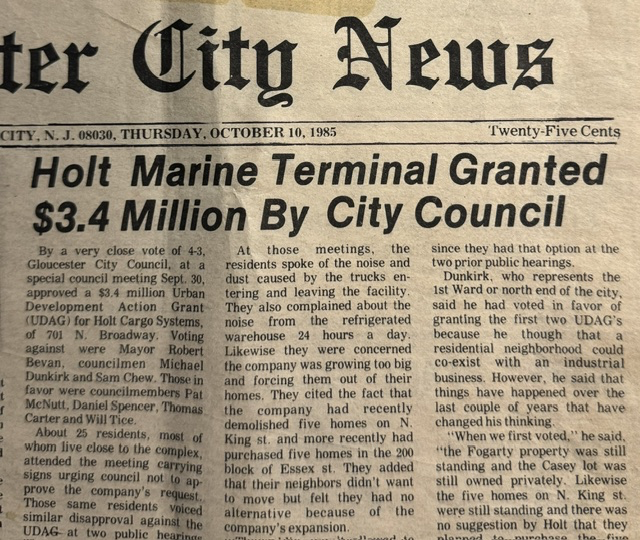
The Urban Development Action Grant program was introduced to Gloucester City residents in 1984. People living near the marine terminal at the time were against the idea from the very start. Several public meetings hosted by the mayor and council were held beginning in 1984. At those meetings, residents spoke about why they were against the expansion of that facility. At the time the Holt Family was just beginning to build their monstrous facility.

Gloucester City News article written by William E. Cleary Sr., published October 10, 1985

That program was promoted in 1978 by President Jimmy Carter. The purpose was to help distressed cities attract private investment, create jobs, and redevelop blighted industrial or commercial areas. UDAGs were awarded competitively and required substantial private‑sector participation. HUD’s regulations describe the program’s core mission as assisting cities facing severe economic distress by stimulating economic activity needed for recovery. 

The public’s objections included:

Continue reading “THE HOLT FILES: PART TWO”

Herbert (Herb) Boulden, 86, of Brigantine, Formerly of Brooklawn

Herbert (Herb) George Boulden, 86, of Brigantine, formerly of Brooklawn, passed away on Saturday August 8, 2026. Herbert was born in Camden NJ to the late Herbert and Mary (Duranovitch) Boulden. Herb was a Gloucester High Class of 1958 graduate, where he played football and track & field.

Herbert was an avid fan of the Phillies and Eagles. He was formerly a season ticket holder of the Phillies. He enjoyed all sports.

Herb served for six years(1962-1968) with the Armed Forces of the United States of America. Herbert Boulden received an Honorable Discharge from the Army National Guard of New Jersey and from the Reserves of the United States Army.

He was an passionate Gloucester City High School Sports fan, and he enjoyed watching high school football games. For many years he participated in the Independence Blue Cross 10 Mile Broad Street Run.  

Herbert was a member of the Sheet Metal Workers Union Local 19 for 33 years before retiring.

He loved reading newspapers and he enjoyed karaoke. He loved Brooklawn, Gloucester City and his retirement home in Brigantine. Herbert and his wife Rosemarie were snowbirds who traveled to South Florida each winter.

He was a lifelong member of the Gloucester City Mustangs Club and he enjoyed years of traveling with his family.

Hebert is survived by his beloved wife Rosemarie (Rickie) (nee Spadora), his son Scott Herbert Boulden and his wife Deanne (nee Mills) and his daughter Natalie Alessio and her husband Randy Alessio. He is also survived by his brother Joseph Boulden, his grandchildren Francesco and Gianni Alessio and Scott and Samantha Boulden and her fiancé Michael Buonanno, his niece Jennifer Boulden and great nieces Sophia and Cecilia Morquecho.

Relatives and friends are invited to attend the Life Celebration for Herbert on Thursday August 27, 2026 at the Brigantine Elks Lodge, 400 West Shore Drive, Brigantine. Welcome visitation starts at 11 AM. Service and Words of remembrance will be at 12 Noon followed by military honors, then food and refreshments.

To honor Herb, you are welcome to wear your favorite sports team apparel or Hawaiian shirt.

In lieu of flowers, the family kindly requests donations to Children’s Hospital of Philadelphia at give2.chop.edu.

Family services by Keates-Plum Funeral Home, Brigantine.

THE HOLT FILES: From a 1981 Wetlands Violation to Today’s Battle Over a $1 Lease

William E. Cleary Sr. | Cleary’s Notebook News

Since 1993, Holt has been leasing this land under the Walt Whitman Bridge for a $1 a year. The marine terminal was fined $30,000 for illegally dumping the fill into the Newton Creek, which flows into the Delaware River.

The Gloucester City News 1981 archive photos revealed the fill dirt and concrete used by Tom Holt Sr.,to fill in the Newton Creek swampland under the Walt Whitman Bridge near Collings Road. He was asked by this reporter why he didn’t wait for approval. “Paying the fines was cheaper than waiting for permits that may take months to obtain legally.

Holt was fined $30,000 by federal and state agencies for violating the law. Besides the fines, the court stipulated that he would have to build a park at his marine terminal for the public to view the Delaware River. Within the last couple of months, that park across from Freedom Pier was demolished and replaced with a stack of containers. It is not known if the Holt Family was permitted to remove that park.

The 1981 Case: Holt Fills Protected Wetlands Without a Permit

GLOUCESTER CITY NJ (AUGUST 6, 2026)–In early 1981, federal regulators charged Holt Hauling and Warehousing Systems with illegally filling in federally protected wetlands along Newton Creek, a tributary of the Delaware River. The company had expanded its storage yard by dumping dirt and construction material into tidal wetlands without obtaining the required permits from the U.S. Army Corps of Engineers.

The federal complaint made clear that Holt’s actions violated both the Clean Water Act and the Rivers and Harbors Act. A consent order filed in U.S. District Court required Holt to pay a civil penalty and restore portions of the damaged wetlands. The case was one of the earliest examples of federal environmental enforcement on Gloucester City’s industrial waterfront.


The reporting by the Gloucester City News editor and publisher at the time captured the scale of Holt’s ambitions. At the same time portions of Newton Creek were being filled in two massive container cranes—purchased in Germany—were floated across the Atlantic on barges and escorted up the Delaware River by the U.S. Coast Guard. As those barges passed under the Delaware Memorial Bridge, we were aboard a Coast Guard vessel documenting the arrival. It was a dramatic moment that symbolized Holt’s rapid expansion, much of it built on land created by backfilling marsh and riverbank.

The Same Land, Four Decades Later: A New Legal Fight


(Gloucester City News archives; photographer Tom Casey, December 17, 1981)

The wetlands Holt filled in 1981 are not just a historical footnote. They are the same tract of land at the center of a major dispute today between Holt Logistics and the Delaware River Port Authority (DRPA).

WHAT HAPPENED TO THE PUBLIC PARK THAT HOLT WAS MANDATED TO BUILD?

CNBNews photo–The arrow points to the location of a small public park that Thomas Holt was ordered to build as part of a court order levy against the shipping tycoon in 1982 for illegally filling in the Newton Creek swampland under the Walt Whitman Bridge near Collings Road. It is not known if the Holt family violated that1982 court order by removing it to make room to store more containers. byoder Holt.The cothe

Since 1993, Holt has leased the land beneath the Walt Whitman Bridge for $1 per year—a symbolic arrangement created during a different era of port operations. But the New Jersey Office of the State Comptroller (OSC) recently forced a settlement with DRPA after determining that the lease was not in the public’s financial interest.

OSC’s involvement triggered a renegotiation of the lease, and Holt is now fighting efforts to raise the rent to market value.

Holt argues that:

  • The land was created by their own backfilling, not by the DRPA.
  • The property is inaccessible without crossing Holt’s surrounding private land.
  • Therefore, the DRPA should not charge market‑rate rent for land Holt claims it effectively built and maintained.

The DRPA and OSC counter that:

  • The land is public property.
  • The $1 lease has deprived taxpayers of fair revenue for decades.
  • Any future agreement must reflect the true value of the waterfront acreage.

This dispute has become one of the most consequential port‑related negotiations in South Jersey in years.

(Gloucester City News archives; photographer Tom Casey, November 4, 1982)

Why the 1981 Case Matters Today

The connection between the 1981 wetlands violation and the current lease battle is direct and undeniable:

  • The land Holt filled illegally in 1981 is the same land they now claim to have “created” and therefore deserve to lease cheaply.
  • Holt’s long history of aggressive expansion—sometimes pushing past regulatory boundaries—helps explain why state oversight agencies are now scrutinizing the $1 lease.
  • The OSC’s intervention signals a shift: public agencies are no longer willing to accept decades‑old arrangements that favor private operators over taxpayers.

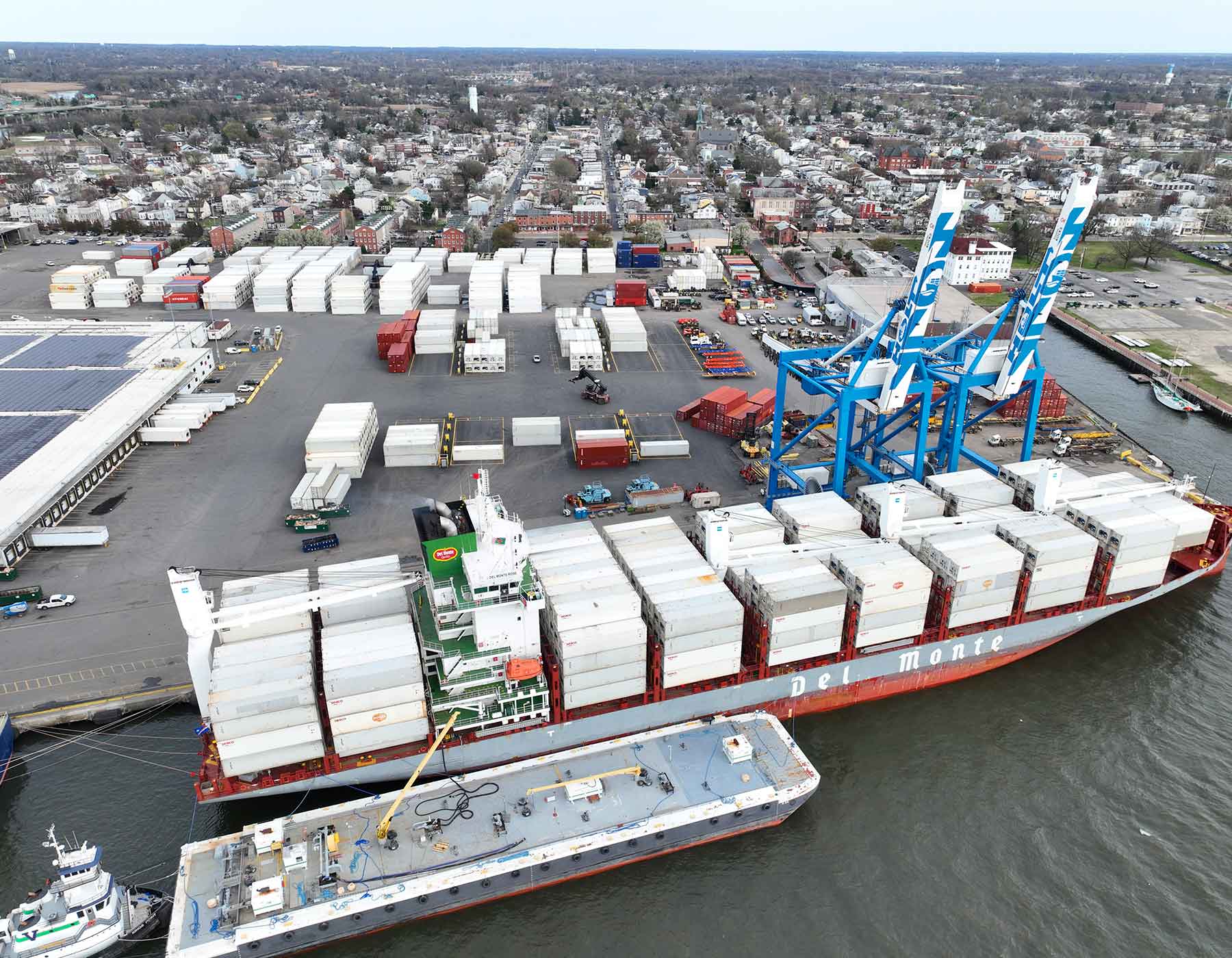
This recent photo taken at the foot of Monmouth Street shows cranes that are standing on land that was once covered by the Delaware River. Holt filled in the river in 1981.

The reporting by the Gloucester City News in the 1980s provides essential historical context. It shows that Holt’s relationship with the Gloucester City waterfront has always been complicated—marked by ambition, conflict, and a willingness to reshape the landscape to suit its operations. It also revealed that Holt wasn’t afraid of violating environmental rules if, in the end, he would benefit financially by doing so. When he ordered his employees to start filling in the swampland under the Walt Whitman Bridge before receiving the necessary permits, he said it was cheaper for him to pay the fines than sit around waiting for the approval of the permits needed to proceed with filling in the Delaware River.

On June 20, 1983 Thomas J. Holt, the president of the Holt Hauling and Warehousing System, promised Gloucester City Councilman Thomas Carter that his company would not expand its marine terminal any further than the foot of Monmouth Street. According to a AI search Holt Logistics began leasing the former U.S. Coast Guard station at Freedom Pier in 1988 following the base’s closure. The building was was located a block from Monmouth Street. Subsequently, the building was restored and renovated to serve as their corporate headquarters in the early 2000s.

THE POWER OF THE HOLT FAMILY

AUGUST 2026-The Holt family’s influence over regional port operations surfaced again this week. According to reporting in The Philadelphia Inquirer, Holt Logistics successfully blocked Hanwha — the Korean shipbuilder currently operating on a 110‑acre site in South Philadelphia — from expanding into the Paulsboro Marine Terminal. Hanwha officials said the Paulsboro site would have solved their space constraints and positioned the company to compete for major U.S. Navy contracts. With the deal halted, Hanwha is now shifting its search to southern states along the Atlantic Coast.

HANWHA PLANNED A $5 BILLION SOUTH JERSEY INVESTMENT

Hanwha has pledged to invest $5 billion in U.S. shipbuilding once it secures a suitable location. The Paulsboro facility, previously used for offshore wind‑mill construction, became available after President Trump canceled the federal wind program, prompting the tenant to vacate last December. Hanwha agreed to assume the lease — until Holt Logistics intervened.

Holt refused to approve the arrangement and filed suit to block it. After months of lobbying and legal maneuvering, Hanwha abandoned its Paulsboro plans and is now entertaining offers from southern states eager to attract a portion of the company’s multibillion‑dollar investment.

Paulsboro Mayor John Giovannitti estimates that fewer than 50 workers are present at the port on a typical day. The borough sublets the terminal to Holt, which paid $1.6 million last year to operate the facility. Leo Holt, whose century‑old company manages terminals in Gloucester City and South Philadelphia, said he is not entirely opposed to manufacturing at Paulsboro — but only under conditions acceptable to Holt Logistics.

New Jersey taxpayers have already invested heavily in the Paulsboro port, borrowing and spending more than $500 million to build the wharf, highway ramps, and supporting infrastructure intended to attract large employers. Hanwha’s departure underscores how much control Holt continues to wield over the future of that publicly financed facility.

Some parts of this article were writted with the help of AI, which can produce inaccuracies.


https://law.justia.com/cases/federal/district-courts/FSupp/513/435/1613155


Two Arrested in Gloucester City Charged with Alleged Roles in Prostitution Scheme

TRENTON — Attorney General Jennifer Davenport and the Division of Criminal Justice (DCJ) announced today that two people were charged with racketeering, kidnapping, human trafficking, and other crimes in connection with their alleged roles in a prostitution scheme.

Continue reading “Two Arrested in Gloucester City Charged with Alleged Roles in Prostitution Scheme”

Lundy’s Prison Sentence Postponed, The Reason Unknown

William E. Cleary Sr. | CNBNews

GLOUCESTER CITY, NJ (July 14, 2026)-The former doctor office of Edward Lundy has been placed on the market. Lundy pleaded guilty in April to illegal distribution of opioids. After the court proceedings, law enforcement announced that he would be sentenced in May. 

Clearys’ Notebook has contacted the New Jersey Attorney General’s Office along with the Federal Bureau of Investigation (FBI), trying to find out why Lundy’s sentence has been postponed. Our most recent contact with those departments was last week. Neither the AG’s office nor the FBI has returned our phone calls or answered our emails. 

Continue reading “Lundy’s Prison Sentence Postponed, The Reason Unknown”

CNBNEWS: July Cheers and Jeers

Camden County awarded Audubon Family Park a $25,000 grant for upgrades and maintenance, supporting safer and more accessible recreation for local families. 

UPDATE: A Salem County Sheriff’s Office sergeant is facing charges after prosecutors allege he left two K-9 partners in a hot vehicle for seven hours, resulting in their deaths. …


The Salem County Prosecutor’s Office was notified of the deaths of Rip and Boomer, who died together while on duty on Friday. The dogs were brought to an emergency veterinary hospital in Delaware, where they were pronounced dead, Miller told NJ.com. The circumstances of their deaths were not disclosed.

Read More: Investigation underway for K9 deaths in Salem County | https://nj1015.com/salem-county-k9s-deaths/?utm_source=tsmclip&utm_medium=referral

Audubon is part of the newly launched 34‑mile LINK Trail, a major regional project that will give residents a safe, scenic route for walking, biking, and running. Construction on the Audubon–Haddon Heights segment began in March and is expected to finish by year’s end. 

We have $50,000 plus to purchase a new truck for the Gloucester City UEZ director. Yet, the Police Administration Building, the Municipal Building, and the Water Department storage tanks are all in need of painting. At the water works, one of the glass windows is broken, plus a broken-down trailer bed has been lying beside the property for a decade or more. The mayor and council are well aware of these maintenance issues.

The nonprofit umbrella group continues to energize civic life, celebrating the grand opening of the Audubon Historical Society Museum and organizing community events that strengthen local pride. CHEER- So happy that those driving E-bikes and E-scooters will have to be licensed and wear a safety helmet. Plus they need to have insurance. 

Continue reading “CNBNEWS: July Cheers and Jeers”

Another Marijuana Store Arrives in Gloucester City

This will be the second cannabis dispensary to open in Gloucester City. The first, BluLight, operates out of the former O’Donnell’s Bar and Restaurant at 401 North Broadway.

Residents living near the former Pat’s Select Pizza say they’ve complained for months about the tall weeds surrounding the property, calling it an eyesore. Behind the building sits a pile of trash. One neighbor told CNBNews, “Hopefully, now the property will be maintained.”

In 2020, New Jersey voters approved a statewide referendum legalizing adult‑use cannabis. Of the state’s 564 municipalities, 211 allow some form of licensed cannabis business, and more than 160 specifically permit recreational retail sales. Local zoning rules vary widely, meaning not all “opt‑in” towns allow every type of cannabis license, according to reporting by The Patch.

BluLight Dispensary

New Jersey’s legal marijuana industry now includes more than 300 dispensaries statewide, but because many towns banned retail sales, these businesses are clustered in municipalities that embraced the new market.

Gloucester Township: A Case Study in Cannabis Revenue

Gloucester Township, which has five dispensaries, has publicly touted the financial benefits. Under state law, 2% of each cannabis sale goes directly to local taxes.

Township Council President Orlando Mercado reported that cannabis retailers generated $38,960.60 in local sales‑tax revenue in 2024. That figure jumped to $232,753 in 2025, he said during a council meeting. Gloucester Township began permitting licensed recreational dispensaries in 2021, one year after the statewide referendum. The first shops opened in the summer of 2023.

The following cannabis retailers are currently operating (from oldest to newest:

  • MPX NJ: opened summer 2023 at 581 Berlin-Cross Keys Rd., Sicklerville
  • HoneyGrove: opened summer 2023 at 1337 Blackwood-Clementon Rd., Clementon
  • Flower & Flame: opened March 2024 at 601 College Dr., Blackwood
  • Blackwood Wellness: opened last September at 816 N Black Horse Pike, Blackwood
  • Quality Cannabliss: opened last month at 1610 N Black Horse Pike, Blackwood

A sixth dispensary, Unity Rd., was approved by local officials two years ago, but it hasn’t been built. It will be located at 2751 Sicklerville Rd.

Recent Highlights at Gloucester Catholic

Continue reading “Recent Highlights at Gloucester Catholic”

8 Plead Guilty to Illegal Gambling, Money Laundering, Tied To Mafia

TRENTON — Attorney General Jennifer Davenport, the Division of Criminal Justice (DCJ), and the New Jersey State Police (NJSP) announced that eight people today admitted their roles in a racketeering, gambling, and money laundering operation. Between October 2025 and June 2026, 27 other people have previously pleaded guilty with respect to their conduct in the gambling enterprise.

The defendants were among 42 people who have been indicted since the initial arrests in April 2025 following a two-year investigation into illegal gambling, loansharking, extortion, and money laundering tied to the Lucchese crime family.

“The guilty pleas we accepted today represent another important step in dismantling this criminal enterprise and holding the individuals involved accountable,” said Attorney General Davenport. “Organized crime has no place in New Jersey. For decades, the Attorney General’s Office has been a leader in rooting out organized crime in New Jersey, and we continue to play that important role to keep New Jersey safe.”

“We remain dedicated to pursuing justice and protecting the public by disrupting criminal enterprises wherever they operate,” said DCJ Director Theresa L. Hilton. “The pleas in this case mark significant progress, but our work will continue as the remaining cases move through the judicial process.”

“By pleading guilty, the defendants have formally accepted responsibility for participating in a criminal enterprise that caused significant harm to individuals and communities,” said Jeanne Hengemuhle, Acting Superintendent of the New Jersey State Police. “Illegal gambling operations exploit vulnerable people, money laundering fuels further criminal activity, and racketeering networks undermine the safety and stability of our neighborhoods. This outcome is a direct result of the exceptional work of State Police detectives, whose ability to trace the financial trails, uncover the enterprise’s structure, and follow the evidence wherever it led built a comprehensive and compelling case. Their work not only brought those responsible to justice but also reinforces our ongoing commitment to protecting the public and safeguarding the integrity of our communities.”

The defendants pleaded guilty before Superior Court Judge Ralph E. Amirata in Morris County to their respective roles in operating illegal poker games and an online sportsbook in association with the Lucchese crime family.

According to documents filed in this case and statements made in court, the gambling operations include social clubs that housed live poker games and gambling machines, as well as an extensive online sportsbook operated through several websites based outside of the United States. Each poker club was operated by high-level managers who delegated day-to-day operations to managers who were present during poker games. Managers collected monetary dues called “rent” from poker hosts for permitting the games to occur and oversaw employees who worked in the clubs. Poker hosts were responsible for recruiting their own players, supplying food and drink for the games, and financially staking the game. The host, also known as the “house,” made a profit off the games because the dealer took a percentage of the monies bet by the players as a profit for the house for each hand played (also known as a “rake”). The dealers were paid by the hosts or were working off a prior gambling debt owed to the hosts of the game. The clubs also housed gambling machines that players could use while waiting for a seat at a live poker game.

The online sportsbook was operated by “agents” — who, before the advent of computerized betting, would have been known as “bookies” – who created accounts on sports gambling websites based in foreign countries. These agents managed “packages” – groups of individual bettors. Sub-agents and agents were responsible for the gambling winnings and losses of bettors in their packages and kicked up a portion of the criminal proceeds to the high-level management of the enterprise. The high-level management made operational decisions, settled disputes, and used threats to collect overdue debts. The enterprise also used websites to facilitate illegal online sports betting. The websites, through the individuals that own, operate, and control them, are one part of this criminal enterprise controlling illegal gambling activities in northern New Jersey and other areas. The websites allow traditional organized crime members and associates to use the internet and current technology to engage in the same criminal acts that traditional organized crime has engaged in since the 19th century.

The leadership of the New Jersey-based faction of the Lucchese family allegedly oversaw the gambling activities and received a portion of the criminal proceeds. The investigation resulted in the identification of $4.79 million in suspected criminal proceeds. Members of the criminal enterprise used multiple shell corporations and legitimate businesses to conceal their illegal gambling proceeds.

George Zappola, Joseph R. Perna, and John G. Perna are high-level managers of the criminal enterprise and allegedly members of the Lucchese Crime Family. All three pleaded guilty to second-degree racketeering in exchange for recommended sentences of seven years in state prison.

The guilty pleas today included the following:

  • Wayne D. Cross, a Lucchese associate, pleaded guilty to third-degree promoting gambling in exchange for a recommended sentence of five years in state prison.
  • Michael P. Frasso, 48, of Cedar Grove, New Jersey was a sportsbook agent and pleaded guilty to second-degree racketeering (seven years recommended), third-degree failure to pay income tax (three years recommended), and third-degree corporate misconduct (five years recommended), for an aggregate recommendation of 15 years.
  • Frank Imparato, 46, of Saddle Brook, New Jersey was a poker club manager and pleaded guilty to third-degree conspiracy (four years recommended).
  • Joseph Gossweiler, 41, of Florham Park, New Jersey was a sportsbook sub-agent/poker club manager and pleaded guilty to third-degree conspiracy to promote gambling in the third degree (364 days probation recommended)
  • Peter Norcia, 50, of Toms River, New Jersey, was an agent on the sportsbook and pleaded guilty to third-degree conspiracy to promote gambling (four years recommended).
  • Café Gio was a corporation used by Frank Imparato to facilitate illegal gambling and pleaded guilty to second-degree conspiracy (penalty of $250,000).
  • Frasso Trucking was a corporation used by Michael and Gerard Frasso to conceal gambling proceeds and pleaded guilty to second-degree conspiracy for anti-money laundering profiteering (penalty of $250,000).
  • CJW Development and Consulting was a corporation used by Wayne Cross to conceal gambling proceeds and pleaded guilty to second-degree conspiracy for anti-money laundering profiteering (penalty of $250,000).

Charges are still pending against seven remaining defendants, and they are presumed innocent unless and until proven guilty in a court of law.

Deputy Attorney General Heather Hausleben is prosecuting the case for DCJ. The case was investigated by Detective Sergeant Michael Gallant of the New Jersey State Police. Attorney General Davenport thanked the FBI New Jersey – Newark and Red Bank, FBI New York City, U.S. Marshals, Federal Probation, and the Department of Corrections Special Operations Group for their valuable contributions to the investigation.

Four-Hour Power Outage in Gloucester City

UPDATED

UPDATE: The power outage was not the reason why electricity was loss in the Riverview Heights section of the city, according to a spokesperson for Public Service Electric and Gas.

Kathy Hennessy Riley, PSE&G Corporate Communications, said the cause was weather-related. “I wanted to clarify that the traffic light pole that was struck at Broadway and Market Street was not the cause of the local power outage that affected the Riverview Heights section of the City on Monday night.

The outage, which affected approximately 2500 customers, was weather-related. Crews worked to safely identify and address the issue and restore service to affected customers as quickly as possible.”


GLOUCESTER CITY, NJ (CNBNews) (June 22, 2026)--The traffic light at Broadway and Market Street is apparently the cause of the local power outage that affected the Riverview Heights section of the City. The local police did not report how the light was knocked over. Neither did they release any information on whether there were any injuries. Businesses and residents lost electricity around 2 PM. It was restored at 6 PM.

Traffic lights along Broadway from Kohler Street to Market Street were offline. Many of the businesses along that stretch of highway closed their doors due to not having air conditioning. Residents living in the Carpenter Square Apartments were also affected.

Public Service Electric and Gas first notified customers that the electricity would be restored by 7 PM.  Service was restored at 6:10 PM.

Photo by CNBNews reporter Kathy Cleary Underwood

The traffic light at Broadway and Market Street was struck by either a car or a tractor-trailer. Work crews from Public Service Electric and Gas were at this location for several hours. Residents and businesses lost electricity around 2 PM today. Electric was restored around 6 PM. Local police released no information to the media about the incident.