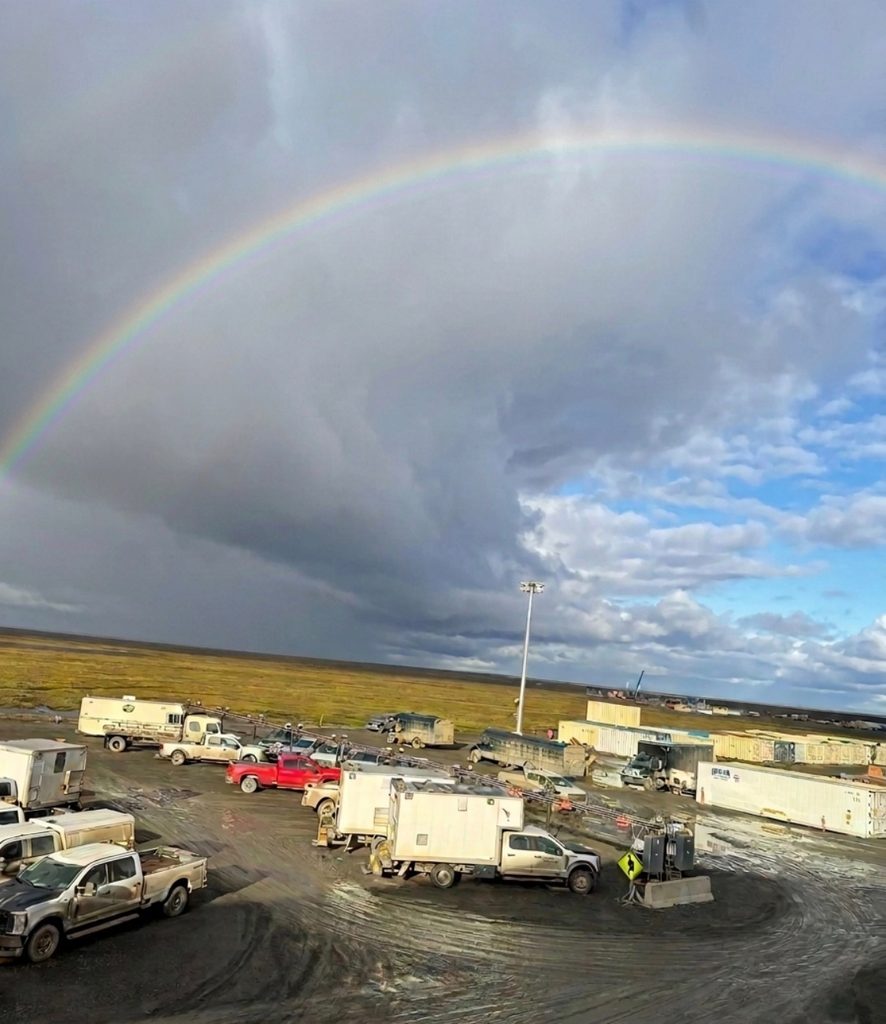
NUIQSUT VILLAGE, ALASKA (CNBNews)– Adam Tussey Sr. recently photographed a rainbow hovering over Nuiqsut Village while working nearby. Tussey is employed by Tanco Engineering as operations manager.
ILA, TEAMSTERS & AND HOLT BATTLE FOR THE GLOUCESTER TERMINAL
Gloucester City, NJ (October 11, 2026) – In 1994, the Holt family tried to dramatically lower operating costs at their newly expanded Gloucester Marine Terminal in South Jersey. At the time, Master Contract wages for ILA dockworkers were significantly higher, and the union imposed strict work rules. According to the SocialistWorker.org newspaper, Holt bypassed the ILA entirely and signed a collective bargaining agreement with Teamsters Local 676, a New Jersey-based union that primarily represents truck drivers and warehouse workers, not deep-sea dockworkers. Under this new setup, Holt paid Teamster workers roughly $15 per hour to unload cargo and fruit ships. This wage was roughly half of the total compensation and benefits package the ILA required at the time.
When Thomas Holt Sr. quietly signed a deal with Teamsters Local 676 to unload the Scandinavian Reefer at the Gloucester Marine Terminal, word instantly leaked across the river. To the International Longshoremen’s Association (ILA), this wasn’t just a lost contract; it was an act of war that threatened to break their decades-long monopoly on the Delaware River ports.
GLOUCESTER CITY, NJ (September 27, 2026)— As industrial logistics hubs expand along the Delaware River waterfront, the critical trade operations of marine container terminals come at a severe cost to adjacent residential neighborhoods. For frontline communities living under the shadow of heavy port infrastructure in South Jersey, the environmental footprint is defined by a continuous influx of air, water, noise, and land pollution.
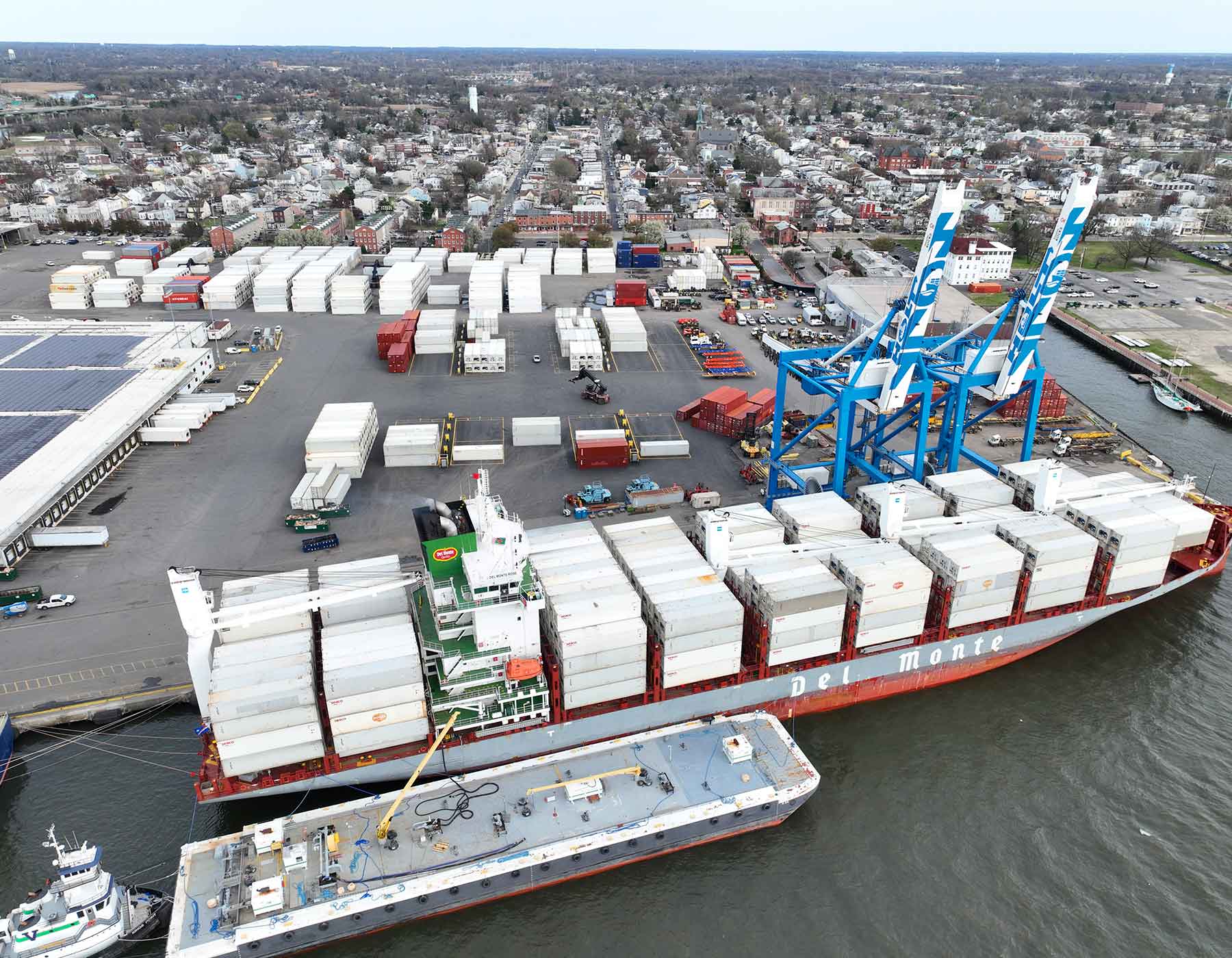
The Gloucester Marine Terminal (photo courtesy of Holt Logistics)
The intersection of private shipping infrastructure and state operations forms the backbone of this regional economic engine. Headquartered right here at the Gloucester Marine Terminal on King Street, the family-owned Holt Logisticshas been a dominant maritime force since 1926. Today, the company also acts as a primary private operator for major assets owned by the state-run South Jersey Port Corporation (SJPC), including Pier 5 at the Broadway Marine Terminal in Camden and the newer Paulsboro Marine Terminal. While these public-private partnerships handle millions of tons of cargo annually and drive regional logistics growth, their round-the-clock operations concentrate localized environmental hazards directly in residential backyards.
The 1996 Waterfront Lease Controversy
Nowhere is the complex and highly transactional relationship between Gloucester City and its largest corporate tenant clearer than in the history of the 1996 ninety-nine-year lease agreement.
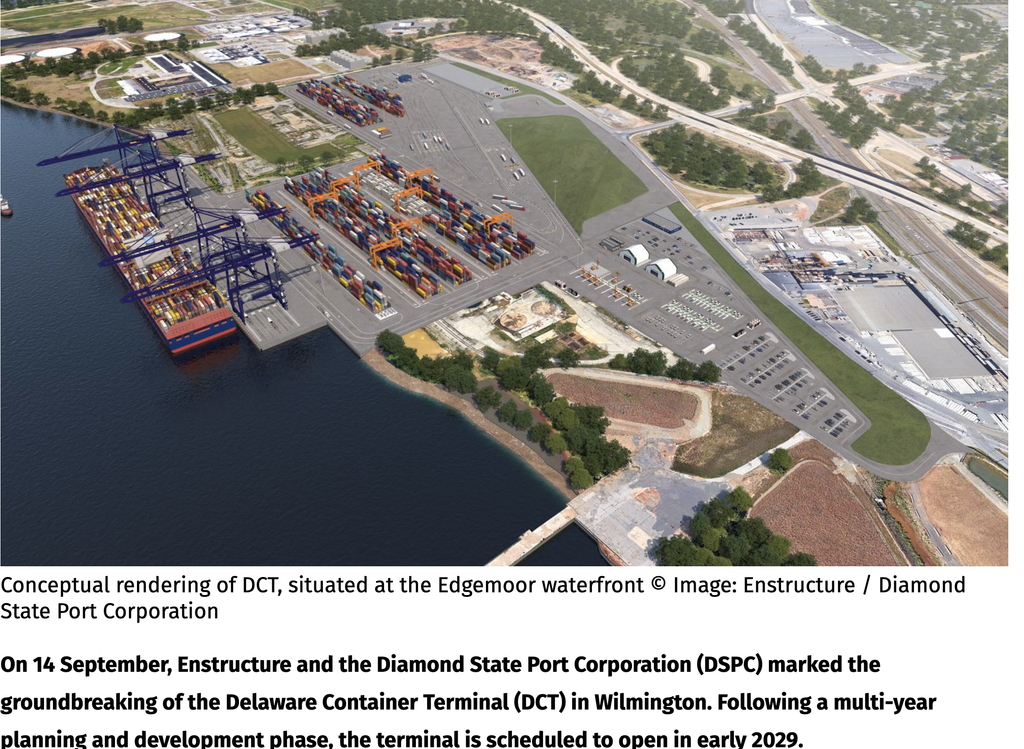
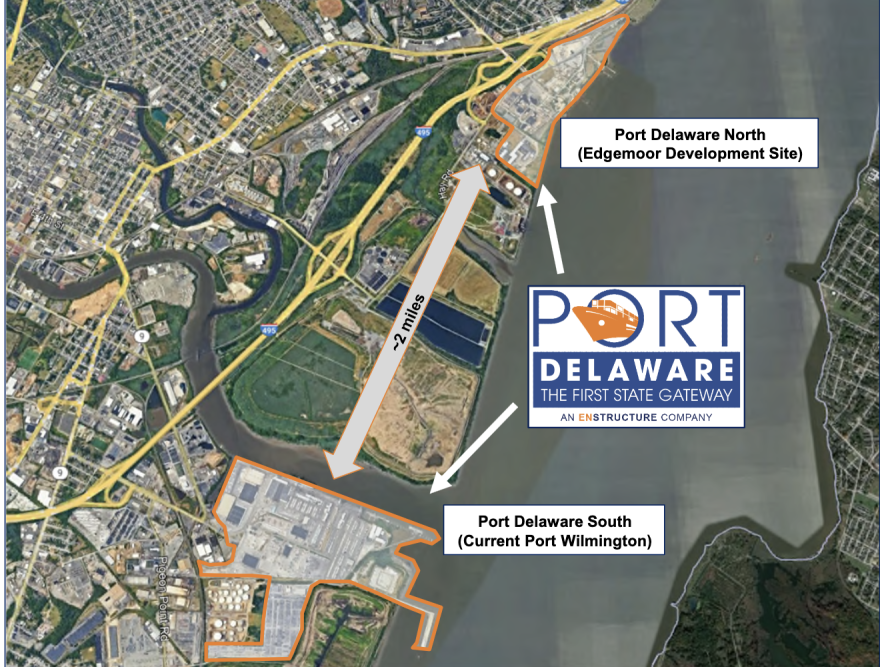
WILMINGTON, DELAWARE (September 18, 2026)–Located at the former Edgemoor industrial site, DCT will handle containers, retail goods and perishable commodities, nearly doubling container capacity across the Delaware River port complex. The terminal will also provide ocean carriers and cargo owners with access to Class I rail services and major highways, including I-495, I-95, I-295, the New Jersey Turnpike and the Pennsylvania Turnpike.
Gloucester City, NJ (August 26, 2026)–More and more I am finding it so difficult to deal with businesses, utility companies and those in the medical field online. The wait time to talk with someone can be an
hour or more. In some cases you can’t talk to anyone. Instead you are switched to a chat-line that seems to lead nowhere. The frustration of navigating these systems is overwhelming. Most recently, we wanted to change our cellphone provider. What an ordeal this has become. After countless hours, we still haven’t been able to get that dilemma solved.
We had been with Verizon forever, and although the service was reliable, the cost for our mobile phone plan had become exorbitant. Tired of paying such high bills, we decided to switch to Consumer Cellular based on some recommendations. Unfortunately, the phone reception was abysmal, making it difficult to use the service effectively. Our next choice, based on further research and consumer feedback, was T-Mobile.
BAD MOVE
On June 7, 2026, I spent over an hour applying for a T-Mobile senior citizen 55 and over mobile account for my wife and me. The following day, I printed out the seven-page contract that I signed electronically. As I reviewed it, I was shocked to discover that I was billed $639 for an iPhone 17e that T-Mobile had advertised as being free as part of their promotion for new customers. Katherine the T-Mobile rep that I chatted with the day before emphasize several time that phone was free; “On us,” she wrote.
Image of the proposed container terminal in Edgewood, Delaware.
JEER—Affiliates of Gloucester City-based Holt Logistics Corp. filed a lawsuit last month seeking to block project approvals granted by the U.S. Army Corps of Engineers for Delaware’s proposed container terminal in Edgemoor, a working-class community along the Delaware River just northeast of Wilmington. In 2024, Philadelphia port interests successfully persuaded a federal judge to invalidate a Corps permit authorizing the same project. Critics contend that the latest lawsuit is intended primarily to prevent the emergence of a new competitor.
CHEER— Delaware’s taxpayer-owned Diamond State Port Corporation requested new approvals, which the Army Corps granted in April. Massachusetts-based Enstructure has announced it is moving forward with the $669 million Edgemoor container terminal project, located on the site of a former DuPont chemical plant. The development is expected to create thousands of construction, warehouse, and longshore jobs for the region.
JEER— Earlier this year, Holt Marine Terminal successfully blocked a South Korean shipbuilding company from establishing operations at the Paulsboro Marine Terminal. The Paulsboro Marine Terminal is owned by the South Jersey Port Corporation (SJPC), a state entity, and operated by Holt Logistics Corp. through its subsidiaries, Gloucester Terminals LLC and Paulsboro Waterfront Development LLC. The influence the Holt family wields in the shipping industry is undeniable. To many outside observers, that level of power raises serious concerns.
CHEER— According to a 2025 economic impact study by the Shipping Association of New York and New Jersey, the port industry supported nearly 580,000 jobs in 2024, generated approximately $18.1 billion in tax revenue, and accounted for $57.8 billion in personal income and $163.7 billion in business income throughout the region. It would be interesting to see whether an independent organization conducting a similar study would reach the same conclusions.
JEER— Why was the Holt Dynasty placed in charge of the Paulsboro facility? In hindsight, that decision appears misguided. The family has accumulated enormous influence and wealth throughout the region’s port industry. Based on recent events, it seems the Holt Family is intent on controlling port operations along the Delaware River, from Wilmington, Delaware, to the Packer Avenue and Gloucester City terminals.
Critics argue that such dominance stifles competition and free enterprise.
Consider what has happened along the Gloucester City waterfront and in the neighborhoods bordering the massive terminal. Increased noise, pollution, declining property values, and the deterioration of quality of life on the city’s west side are consequences many residents attribute to giving the Holt organization broad authority with limited oversight.
CHEER— It was exciting to see a family of deer last week at Johnson Boulevard Jogging Park. The journey those animals must have made to reach that location without being struck by a car or truck is remarkable. Credit goes to Mother Nature’s resilience and adaptability. (CNBNews photo credit)
JEER— A Barnegat woman accused of operating a boat while intoxicated during a Memorial Day crash that killed her son has been released pending trial. The 59-year-old faces charges including second-degree death by vessel, operating a vessel under the influence, and reckless operation of a vessel stemming from the May 25 incident.
Above architect drawings of the townhouses. Terraces are at the front of the buildings on the fourth floor. Photo Credit: Developer’s plans submitted to the Camden Planning Board
CHEER-George Norcross III, along with his partners, has proposed to build 78 high-end townhouses near the Camden City waterfront. TAP INTO CAMDEN reported that the group is scheduled to go before the City’s planning board next month. Eighteen of the townhouses are projected to sell for about $500,000. possibly mixed-use residential/commercial project could be the development of the former Riverfront State Prison site on the north side of the Ben Franklin Bridge.
JEER-In November the Holt Logistics and Cresmont Limited Partnership filed another civil action against the City of Gloucester and the Gloucester City Planning Board. The Holt and Cresmont lawsuit is an attempt to stop the construction of two large multi-use buildings at the former US Coast Guard property on King Street. The Coast Guard abandoned the property in 1986 and moved into a new base on the Philadelphia side of the river. According to a rumor, Holt is against the development because the buildings would block his office view of the river.
Mark Matthews, editor of the 42 Freeway blog, and former Cleary’s Notebook News reporter, remarked that Holt Logistics, wanted to revoke the redevelopment designation of the property in an effort to invalidate the project’s approvals. This would be their third complaint regarding the Redevelopment Plan.
The Gloucester City project, known as Meridia on the Pier, is proposed for 101 South King Street. The development would transform approximately 4.5 acres of undeveloped waterfront land—extending into the Freedom Pier area—with two large mixed-use buildings.
CHEER—Peggy Grow, a Seeing Eye Trustee, Puppy Raiser, volunteer, and Heritage Society member, has raised 15 puppies with her husband, Steve, since starting as a volunteer in 2003. She also volunteers at the Chester Campus, where the next generation of Seeing Eye puppies are born, and she assists with Town Walks, where puppy raisers can watch the puppy they raised work with an instructor in harness. She stated, “I love being part of an organization that strongly advocates for the rights of people who are blind. The staff is deeply dedicated to this mission, which allows volunteers to feel supported in all ways. It is an honor to be a part of a community that is always teaching, creating, and sharing. If you would like more information about planning a legacy gift to support The Seeing Eye’s future work, you can visit legacy.seeingeye.org or contact Lauren Knolmayer at lknolmayer@seeingeye.org.”
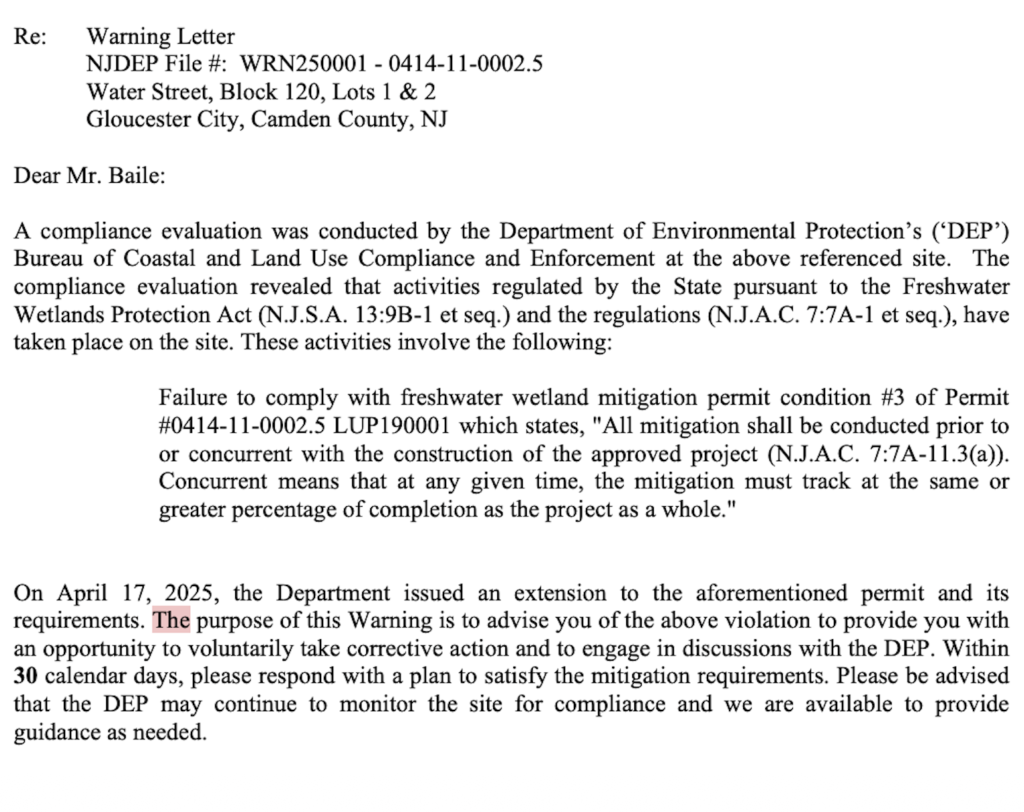
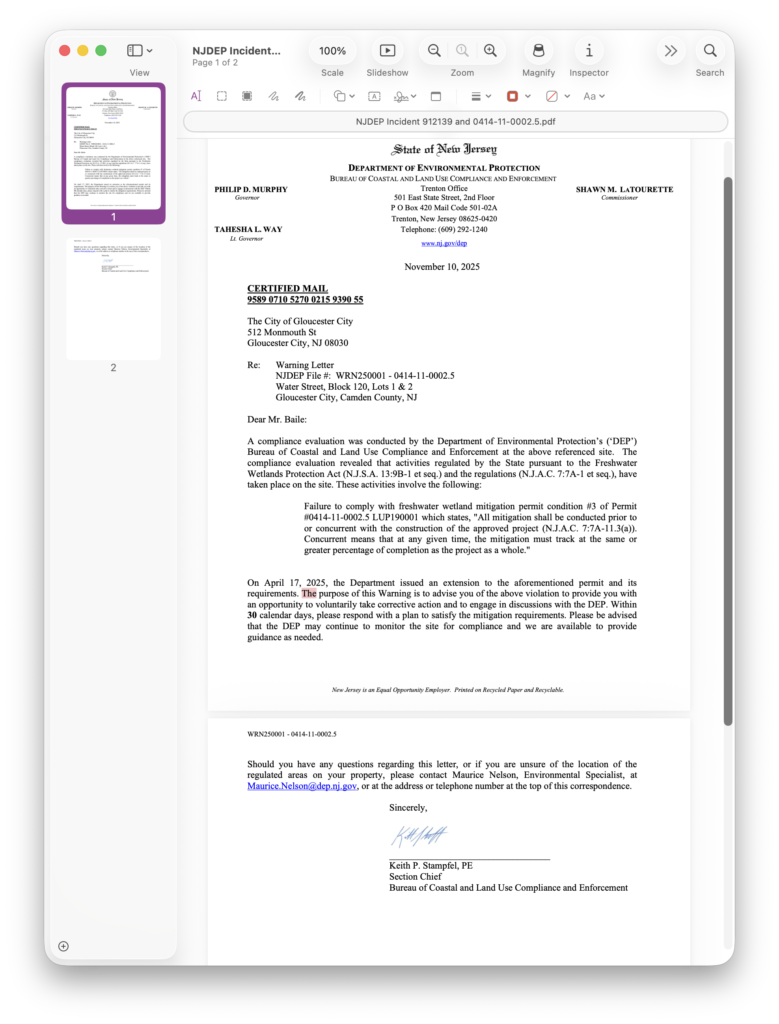
GLOUCESTER CITY, NJ (August 13, 2026)— The New Jersey Department of Environmental Protection (NJDEP) has issued an official Warning Letter to Gloucester City, putting local officials on a ticking clock over significant environmental violations at a controversial waterfront property. The state’s action comes as the city finds itself tangled in parallel legal and financial crises over the future of its Southport redevelopment zone.
According to state records, a compliance evaluation by the NJDEP’s Bureau of Coastal and Land Use Compliance and Enforcement revealed that the city completely bypassed critical environmental obligations at 850 Water Street (Block 120, Lot 2). To rectify the violation, the state is ordering the city to purchase $2.6 million in wetland mitigation credits.
The Timeline of the Violation
State environmental rules dictate that local infrastructure development cannot come at the permanent cost of South Jersey’s natural ecosystems. Under New Jersey Administrative Code (N.J.A.C. 7:7A-11.3(a)), developers are bound to a strict timeline when modifying protected environments: any required wetland mitigation must be built or restored prior to or alongside the main construction.
State regulations require that environmental restoration track at the exact same or greater percentage of completion as the construction project itself. The state asserts that Gloucester City continued its build-out on Water Street while neglecting to advance the necessary environmental counter-balances, violating Condition #3 of Permit #0414-11-0002.5 LUP190001.
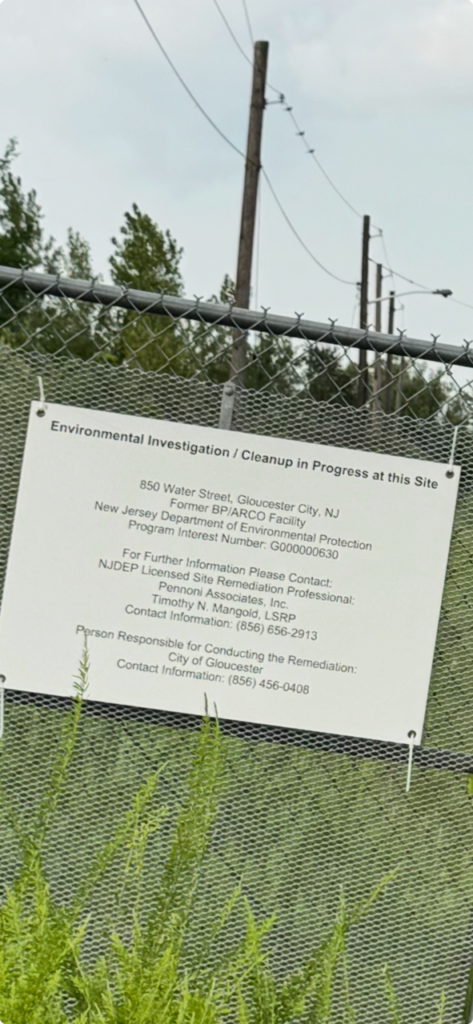
ATLANTIC RICHFIELD/ARCO was located at 850 Water Street 50 years ago. Across from that company was NJ Zinc, also known as Gloucester Titanium, and Gulf and Western.
The state had previously granted the city an extended grace period to rectify the matter, which expired on April 17, 2025. Because that deadline passed without a resolution, the state escalated the enforcement action under file number WRN250001.
Historical Context: From Oil Terminal to Brownfield
The 9-acre parcel at 850 Water Street holds deep historical weight for the Gloucester City waterfront. Situated in the city’s industrial Southport area, this parcel was home decades ago to the Atlantic Richfield Company (ARCO) / BP oil terminal site.
Following the cessation of oil operations, the territory sat vacant for over 30 years as a highly contaminated industrial brownfield, locked in stagnant, unproductive conditions due to heavy environmental liabilities. The entire 121-acre Southport district was heavily plagued by modern industrial hazards, including metals, PCBs, PAHs, and radiological contamination.
In 2008, the NJDEP officially designated Southport as a Brownfield Development Area (BDA), allowing the city to clean up, cap, and safely reconstruct the defunct industrial shoreline. A landmark three-party settlement agreement between Gloucester City, BP/ARCO, and the NJDEP eventually cleared the way for remediation and groundwater cleanup.
Broken Contracts and a $10.5 Million Lawsuit
The Cannabis Connection: High Stakes on Water Street
Public records reveal the high-stakes battle over 850 Water Street was about much more than organic waste compost. In 2019, Gloucester City leadership passed Resolution R123-2019 and companion measures to deliberately alter the Southport zoning rules.
Their goal was to clear the path for a massive, vertically licensed medical marijuana cultivate-and-retail facility directly on Block 120, Lot 2. D’Antonio’s firm sought to sublease the territory to cannabis operators. When the city tore up the contracts, it didn’t just kill a recycling facility—it extinguished a multi-million dollar cannabis enterprise, supercharging the current $10.5 million civil suit again
With the industrial scars of the ARCO era slowly being erased, the city aggressively sought out redevelopment partners. The original vision for 850 Water Street was centered on a groundbreaking green energy initiative: a world-class, fully enclosed organics recycling and composting facility designed to transform regional food waste into renewable energy and high-quality compost.
The city initially partnered with Gloucester City Organic Recycling, LLC (GCOR), an entity spearheaded by environmental entrepreneur Rocco D’Antonio. D’Antonio’s waste-to-energy firm, operating under the project banner Oren, spent substantial time remediating the site, pulling out contaminated debris tanks and raising the entire 10-acre site four feet out of the floodplain to clear the path for groundbreaking.
However, the relationship between the municipality and the redeveloper completely soured. Citing contractual breaches, failures to act, and conflicts of interest, the Gloucester City Mayor and Common Council terminated their agreements with GCOR and formally cut ties with all entities owned by D’Antonio.
The messy breakup triggered severe legal retaliation. Believing the city wrongfully broke its contract, D’Antonio filed a massive $10.5 million lawsuit against Gloucester City. That major litigation is currently working its way through the New Jersey court system, hanging over municipal administrators as a catastrophic secondary financial threat.
Sourcing the Credits: A Public Expense
The $2.6 million credit demand introduces an immediate hurdle for local leaders. When a project impacts a delicate local wetland ecosystem, the law requires that an equivalent portion of nature be built, enhanced, or protected elsewhere. Because Gloucester City failed to perform this remediation work directly on or near the Water Street property, the state allows the purchase of third-party “credits” as a fallback.
These credits are managed by approved regional Wetland Mitigation Banks—dedicated parcels of land where private environmental firms or state agencies have already successfully restored expansive wetland tracts. Sourcing these credits is difficult, as there are currently no active, privately run freshwater wetland mitigation banks physically located within the borders of Camden County.
State mitigation tracking relies heavily on Watershed Management Areas (WMAs) rather than county lines. To satisfy the mandate, Gloucester City must secure credits from a facility whose approved service area covers WMA 18 (Lower Delaware), such as the regional Oldmans Creek Mitigation Bank operating nearby in Salem County.
If regional private credits are entirely sold out, the city will have no choice but to pay into the state’s In-Lieu Fee Program, sending millions in public funds directly to the state’s Freshwater Wetlands Mitigation Council to fund state-managed restoration programs far away from Gloucester City. Because the city is a public entity, a $2.6 million mandate—compounded by the defense costs of a $10.5 million developer lawsuit—represents a severe blow that could deeply strain the local municipal budget.
NJDEP Considering Daily Fines Against Gcity
The clock is officially running for Gloucester City Mayor Dayl Baile and his city council. The state’s warning letter mandated that the city must respond with a definitive, actionable compliance plan to satisfy the outstanding mitigation requirements within 30 calendar days of the notice.
Inquiries regarding the enforcement file are currently being routed through NJDEP Environmental Specialist Maurice Nelson. City leaders have not yet publicly detailed whether they intend to absorb the multi-million dollar credit purchase, appeal the state’s calculations, or how the ongoing litigation with Oren and Rocco D’Antonio will impact the final layout of the Southport waterfront.
According to our source, The $2.6 million is not a fine. It is the cost of wetland credits the City would need to purchase from wetland banks (private companies) to satisfy their permit obligations.
Allegedly, the City has been claiming they didn’t have the funds which was not true. They have been sitting on $2.75 million to do this work since they passed Bond Ordinance 2012-003 on February 16, 2012, specifically to do the work.
Both the NJDEP and the Army Corp of Engineers know the City is not being truthful as they have all the City’s documents Including former mayor Spencer’s testimony that they were aware they needed to do the work and confirmed they always had the money.
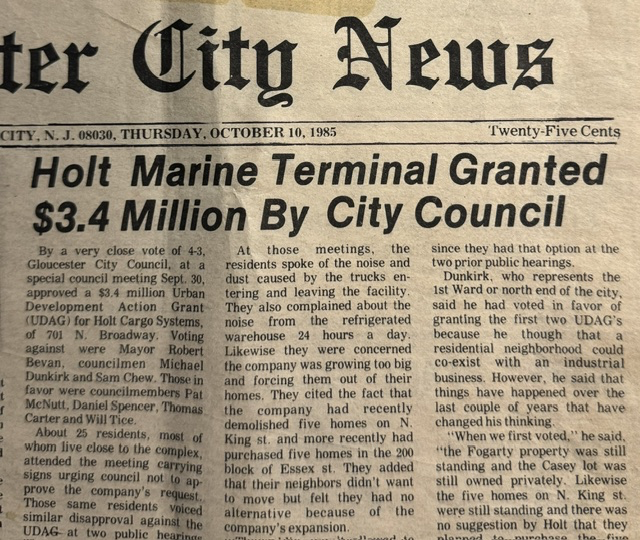
1980s Federal UDAGProgram: Did It Help Gloucester City?
William E. Cleary Sr. | CNBNews
The Urban Development Action Grant program was introduced to Gloucester City residents in 1984. People living near the marine terminal at the time were against the idea from the very start. Several public meetings hosted by the mayor and council were held beginning in 1984. At those meetings, residents spoke about why they were against the expansion of that facility. At the time the Holt Family was just beginning to build their monstrous facility.
Gloucester City News article written by William E. Cleary Sr., published October 10, 1985
That program was promoted in 1978 by President Jimmy Carter. The purpose was to help distressed cities attract private investment, create jobs, and redevelop blighted industrial or commercial areas. UDAGs were awarded competitively and required substantial private‑sector participation. HUD’s regulations describe the program’s core mission as assisting cities facing severe economic distress by stimulating economic activity needed for recovery.
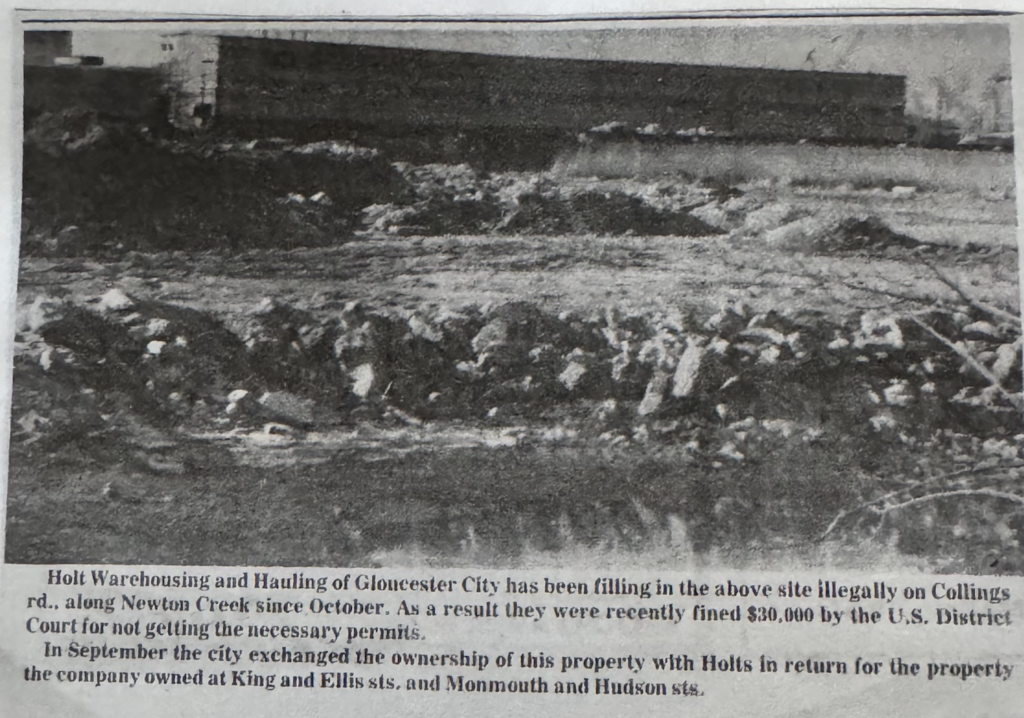
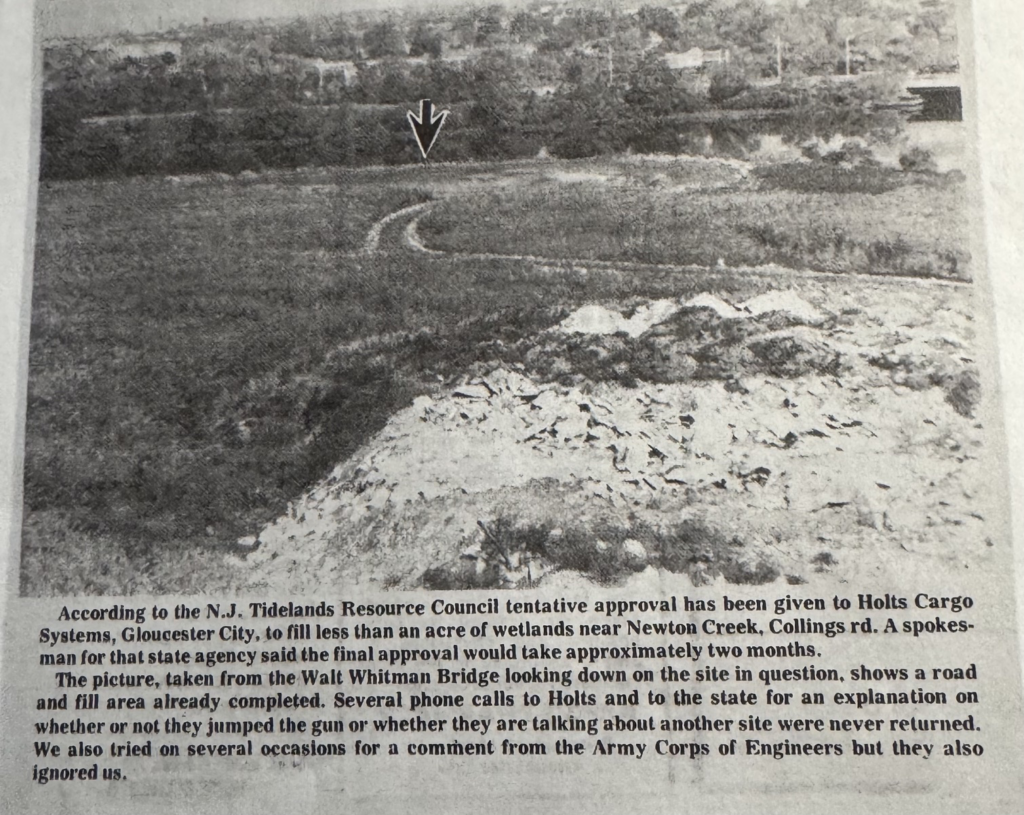
Since 1993, Holt has been leasing this land under the Walt Whitman Bridge for a $1 a year. The marine terminal was fined $30,000 for illegally dumping the fill into the Newton Creek, which flows into the Delaware River.
(Gloucester City News archives; photographer Tom Casey, February 5, 1981)
The Gloucester City News 1981 archive photos revealed the fill dirt and concrete used by Tom Holt Sr.,to fill in the Newton Creek swampland under the Walt Whitman Bridge near Collings Road. He was asked by this reporter why he didn’t wait for approval. “Paying the fines was cheaper than waiting for permits that may take months to obtain legally.
Holt was fined $30,000 by federal and state agencies for violating the law. Besides the fines, the court stipulated that he would have to build a park at his marine terminal for the public to view the Delaware River. Within the last couple of months, that park across from Freedom Pier was demolished and replaced with a stack of containers. It is not known if the Holt Family was permitted to remove that park.
The 1981 Case: Holt Fills Protected Wetlands Without a Permit
GLOUCESTER CITY NJ (AUGUST 6, 2026)–In early 1981, federal regulators charged Holt Hauling and Warehousing Systems with illegally filling in federally protected wetlands along Newton Creek, a tributary of the Delaware River. The company had expanded its storage yard by dumping dirt and construction material into tidal wetlands without obtaining the required permits from the U.S. Army Corps of Engineers.
The federal complaint made clear that Holt’s actions violated both the Clean Water Act and the Rivers and Harbors Act. A consent order filed in U.S. District Court required Holt to pay a civil penalty and restore portions of the damaged wetlands. The case was one of the earliest examples of federal environmental enforcement on Gloucester City’s industrial waterfront.
The reporting by the Gloucester City News editor and publisher at the time captured the scale of Holt’s ambitions. At the same time portions of Newton Creek were being filled in two massive container cranes—purchased in Germany—were floated across the Atlantic on barges and escorted up the Delaware River by the U.S. Coast Guard. As those barges passed under the Delaware Memorial Bridge, we were aboard a Coast Guard vessel documenting the arrival. It was a dramatic moment that symbolized Holt’s rapid expansion, much of it built on land created by backfilling marsh and riverbank.
The Same Land, Four Decades Later: A New Legal Fight
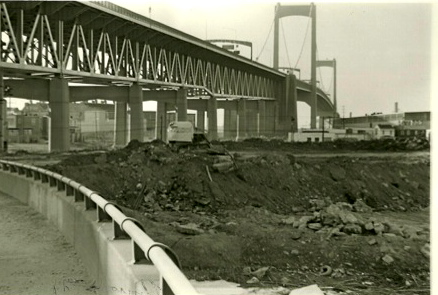
(Gloucester City News archives; photographer Tom Casey, December 17, 1981)
The wetlands Holt filled in 1981 are not just a historical footnote. They are the same tract of land at the center of a major dispute today between Holt Logistics and the Delaware River Port Authority (DRPA).
—
WHAT HAPPENED TO THE PUBLIC PARK THAT HOLT WAS MANDATED TO BUILD?
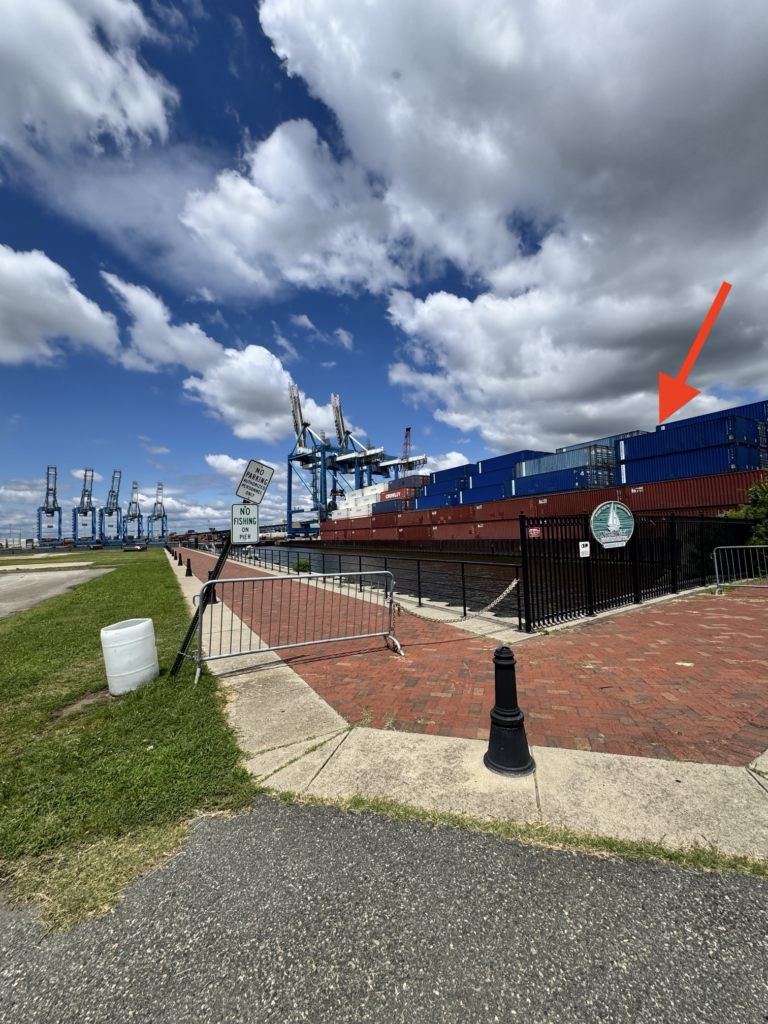
CNBNews photo–The arrow points to the location of a small public park that Thomas Holt was ordered to build as part of a court order levy against the shipping tycoon in 1982 for illegally filling in the Newton Creek swampland under the Walt Whitman Bridge near Collings Road. It is not known if the Holt family violated that1982 court order by removing it to make room to store more containers. byoder Holt.The cothe
Since 1993, Holt has leased the land beneath the Walt Whitman Bridge for $1 per year—a symbolic arrangement created during a different era of port operations. But the New Jersey Office of the State Comptroller (OSC) recently forced a settlement with DRPA after determining that the lease was not in the public’s financial interest.
OSC’s involvement triggered a renegotiation of the lease, and Holt is now fighting efforts to raise the rent to market value.
Holt argues that:
The land was created by their own backfilling, not by the DRPA.
The property is inaccessible without crossing Holt’s surrounding private land.
Therefore, the DRPA should not charge market‑rate rent for land Holt claims it effectively built and maintained.
The DRPA and OSC counter that:
The land is public property.
The $1 lease has deprived taxpayers of fair revenue for decades.
Any future agreement must reflect the true value of the waterfront acreage.
This dispute has become one of the most consequential port‑related negotiations in South Jersey in years.
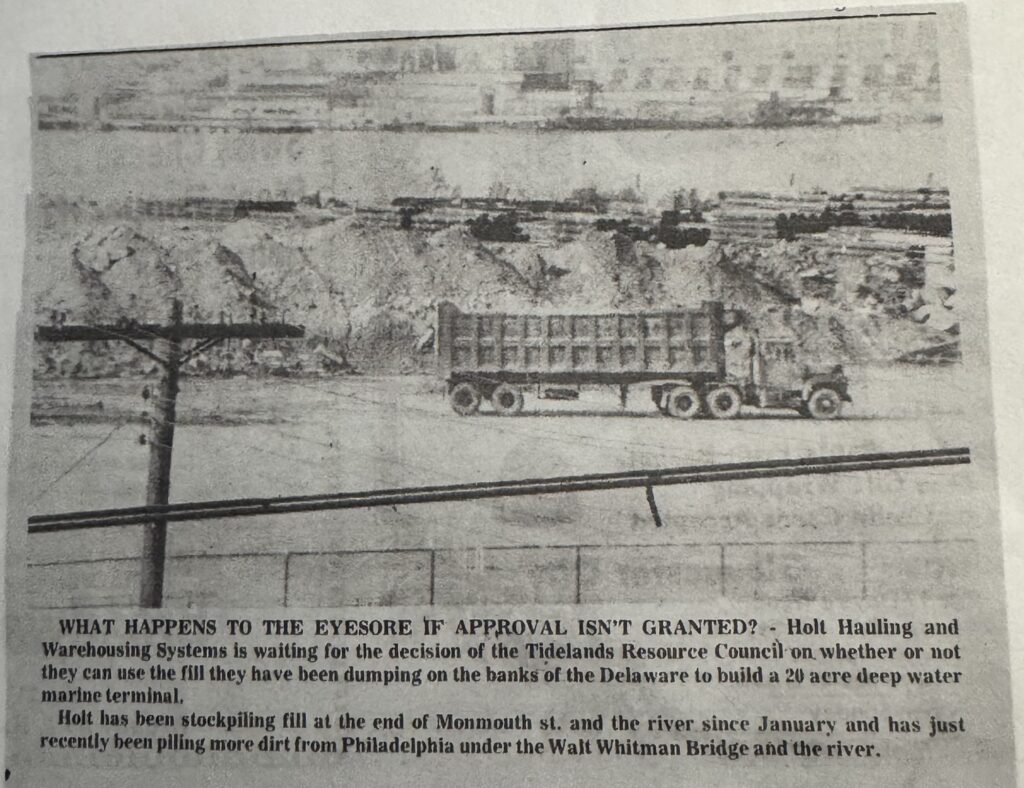
(Gloucester City News archives; photographer Tom Casey, November 4, 1982) —
Why the 1981 Case Matters Today
The connection between the 1981 wetlands violation and the current lease battle is direct and undeniable:
The land Holt filled illegally in 1981 is the same land they now claim to have “created” and therefore deserve to lease cheaply.
Holt’s long history of aggressive expansion—sometimes pushing past regulatory boundaries—helps explain why state oversight agencies are now scrutinizing the $1 lease.
The OSC’s intervention signals a shift: public agencies are no longer willing to accept decades‑old arrangements that favor private operators over taxpayers.
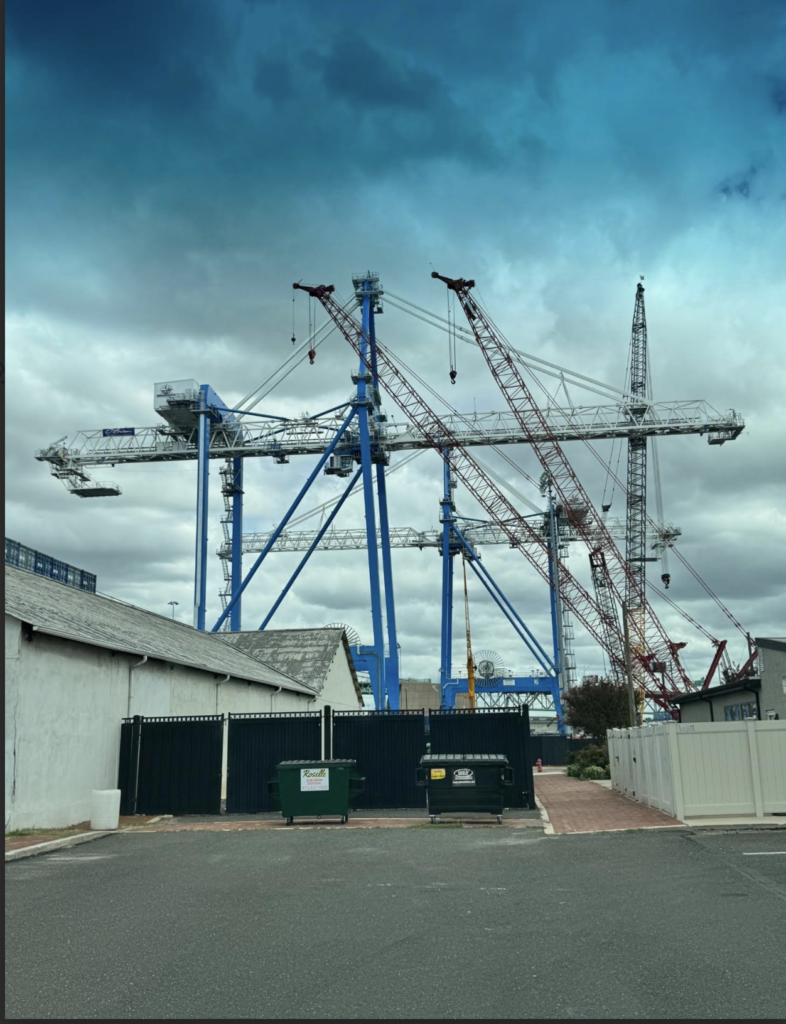
This recent photo taken at the foot of Monmouth Street shows cranes that are standing on land that was once covered by the Delaware River. Holt filled in the river in 1981.
The reporting by the Gloucester City News in the 1980s provides essential historical context. It shows that Holt’s relationship with the Gloucester City waterfront has always been complicated—marked by ambition, conflict, and a willingness to reshape the landscape to suit its operations. It also revealed that Holt wasn’t afraid of violating environmental rules if, in the end, he would benefit financially by doing so. When he ordered his employees to start filling in the swampland under the Walt Whitman Bridge before receiving the necessary permits, he said it was cheaper for him to pay the fines than sit around waiting for the approval of the permits needed to proceed with filling in the Delaware River.
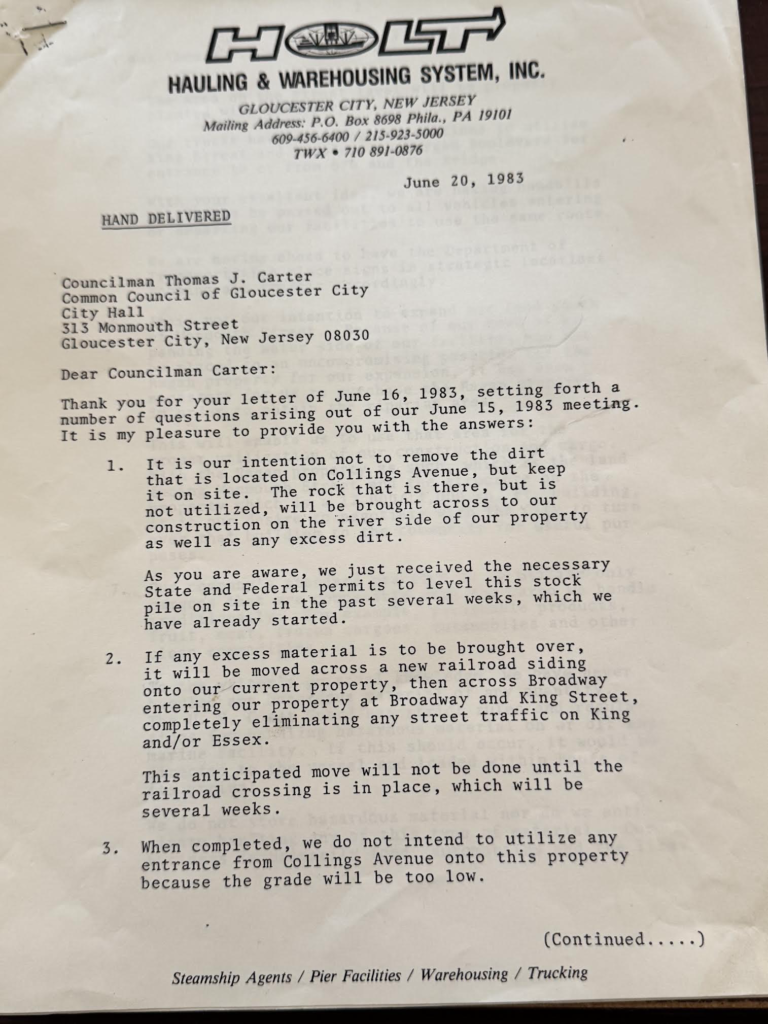
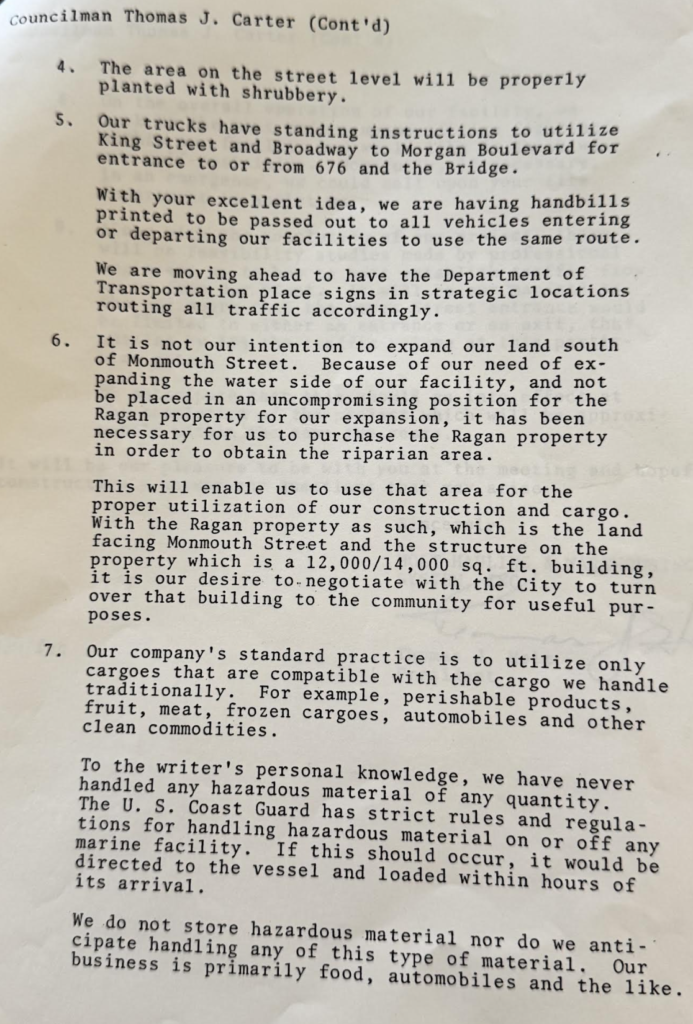
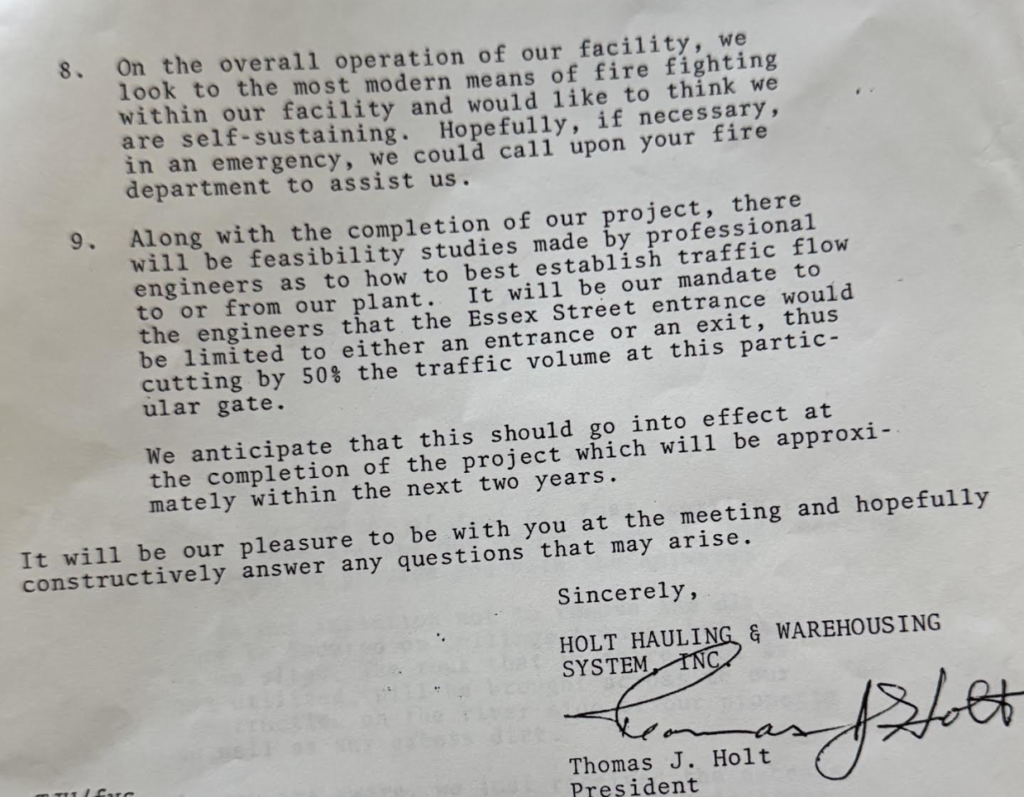
On June 20, 1983 Thomas J. Holt, the president of the Holt Hauling and Warehousing System, promised Gloucester City Councilman Thomas Carter that his company would not expand its marine terminal any further than the foot of Monmouth Street. According to a AI search Holt Logistics began leasing the former U.S. Coast Guard station at Freedom Pier in 1988 following the base’s closure. The building was was located a block from Monmouth Street. Subsequently, the building was restored and renovated to serve as their corporate headquarters in the early 2000s.
THE POWER OF THE HOLT FAMILY
AUGUST 2026-The Holt family’s influence over regional port operations surfaced again this week. According to reporting in The Philadelphia Inquirer, Holt Logistics successfully blocked Hanwha — the Korean shipbuilder currently operating on a 110‑acre site in South Philadelphia — from expanding into the Paulsboro Marine Terminal. Hanwha officials said the Paulsboro site would have solved their space constraints and positioned the company to compete for major U.S. Navy contracts. With the deal halted, Hanwha is now shifting its search to southern states along the Atlantic Coast.
HANWHA PLANNED A $5 BILLION SOUTH JERSEY INVESTMENT
Hanwha has pledged to invest $5 billion in U.S. shipbuilding once it secures a suitable location. The Paulsboro facility, previously used for offshore wind‑mill construction, became available after President Trump canceled the federal wind program, prompting the tenant to vacate last December. Hanwha agreed to assume the lease — until Holt Logistics intervened.
Holt refused to approve the arrangement and filed suit to block it. After months of lobbying and legal maneuvering, Hanwha abandoned its Paulsboro plans and is now entertaining offers from southern states eager to attract a portion of the company’s multibillion‑dollar investment.
Paulsboro Mayor John Giovannitti estimates that fewer than 50 workers are present at the port on a typical day. The borough sublets the terminal to Holt, which paid $1.6 million last year to operate the facility. Leo Holt, whose century‑old company manages terminals in Gloucester City and South Philadelphia, said he is not entirely opposed to manufacturing at Paulsboro — but only under conditions acceptable to Holt Logistics.
New Jersey taxpayers have already invested heavily in the Paulsboro port, borrowing and spending more than $500 million to build the wharf, highway ramps, and supporting infrastructure intended to attract large employers. Hanwha’s departure underscores how much control Holt continues to wield over the future of that publicly financed facility.
Some parts of this article were writted with the help of AI, which can produce inaccuracies.







 -
- -
- -
- -
- -
-