
Walk through enough fabrication shops and you start to notice a pattern: the air tells a story long before the paperwork does. You can smell cutting fluids, feel heat rising from a weld station, and sometimes catch that “metallic chalk” dryness that sits in your throat after a few minutes near grinding or polishing. Most people accept it as part of the job until filters clog early, housekeeping becomes a daily battle, or a “small” dust issue turns into a shutdown nobody planned for.
This is especially true in stores where aluminum is processed, and it quickly becomes a very serious subject, considering that very dangerous amounts are not about nuisance dust or clean rooms. If you want an accessible and informative guide to understanding the importance of this material and its specific uses, then read this resource about aluminum dust hazard. This provides an understanding of the specific properties of this metal and how this can be considered, especially later on.

Why Aluminum Dust Feels “Different” Than Other Dusts
Aluminum is everywhere because it’s light, workable, and strong for its weight. The downside is what happens when you turn solid stock into tiny particles. Milling, sanding, belt grinding, deburring, polishing operations, and even some additive-related activities can also produce finer material. The finer the material particles, the more they act like floating material rather than falling material. That changes everything.
Fine dust doesn’t just land neatly under the machine. It rides heat plumes, gets pulled into walkway drafts, and disappears into overhead structures. You might see clean floors and still have dust sitting on cable trays, ledges, lighting, beams, and inside electrical cabinets. Then one day vibration, maintenance work, or a door slam shakes it loose.
Aluminum dust also tends to be “energetic” in the wrong circumstances. In many plants, people think of combustible dust as something that happens in grain elevators or wood shops. Metal dust can be just as unforgiving. The risk isn’t a constant state of danger; it’s the combination of conditions that creates a bad day: suspended dust, confinement, an ignition source, and the right concentration. What makes this tricky is that plants often meet most of those conditions accidentally during normal operations—especially when housekeeping or collection design lags behind production reality.
The Hidden Places Dust Accumulates and Why They Matter
Dust management often fails in the quiet zones, not the loud ones. The grinding booth gets attention. The polishing station gets attention. The bag changeout gets attention. Meanwhile, dust is traveling.
A few common “inheritance zones” where dust builds up over time:
- Overhead structures and cable trays where the settled dust can be resuspended by vibration
- Inside areas that appear to be sealed, yet breathe through spaces, doors, and panels
- Near make-up air and exhaust imbalances, where airflow pushes dust into corners and behind equipment
- Forklift lanes where turbulence lifts settled dust back into the air
- Compressed air use areas, where blow-off turns cleanup into redistribution
None of these are exotic. They’re normal features of a working plant. The point is that dust doesn’t respect your process map. It follows airflow and routine behavior.
A subtle trap is “clean-looking compliance.” If your floor is mopped and the chips are collected, it can feel like you’ve handled the problem. Fine dust is a different animal. It can stay airborne long enough to move across the building, and it can settle in places that don’t get cleaned until a major outage. That’s when dust becomes legacy material: it’s there because it’s always been there.
If you want to be practical about it, treat dust like inventory. If it’s being created, it’s being stored somewhere unless you deliberately capture it. The question is whether you want it stored in a controlled vessel designed for that purpose, or stored on your building.
Capture Strategy That Works on Busy Production Days
The best dust plan survives real life: shift changes, rush orders, worn tooling, operators who move fast, and maintenance teams who have ten other fires to put out.
A solid strategy usually has three layers:
- Capture at the source
This is where good hood design matters. If the hood is too far, too small, or fights the operator’s workflow, dust escapes and the system ends up trying to clean the whole room. Capture needs to match how people actually use the station, including odd angles, part sizes, and the “I only need to do this for 30 seconds” tasks that happen all day. - Transport that stays stable
Ductwork is a system, not a set of pipes. If velocities drop in certain runs, dust can settle, build up, and become a maintenance problem. If velocities are too aggressive, you can increase wear. The right balance depends on the dust, the process, and the layout. What matters is consistency. - Collection that fits the dust behavior
In industrial environments, baghouse-style dust collectors are often used for dry dust capture where appropriate. The use of wet scrubbers should be considered in cases in which wet collection makes process and hazard sense. The selection is determined by the type of materials, how dust behaves, as well as how it is planned to be used after collection.
Here’s a simple, but plant-friendly, checklist that helps people stop guessing:
- Map the dust generators by task, not by machine name
- Watch airflow behavior with smoke testing during real production
- Track filter loading patterns to identify stations that overpower the system
- Document housekeeping routes and compare them to where dust actually settles
- Define a handling plan for collected dust so it doesn’t re-enter the workspace through careless dumping or open containers
The goal is boring reliability. If you can keep dust from becoming a roaming contaminant, you reduce more than risk. You improve product quality, reduce cleanup labor, and make maintenance schedules more predictable.
Baghouse or Wet Scrubber Thinking Without the Sales Talk
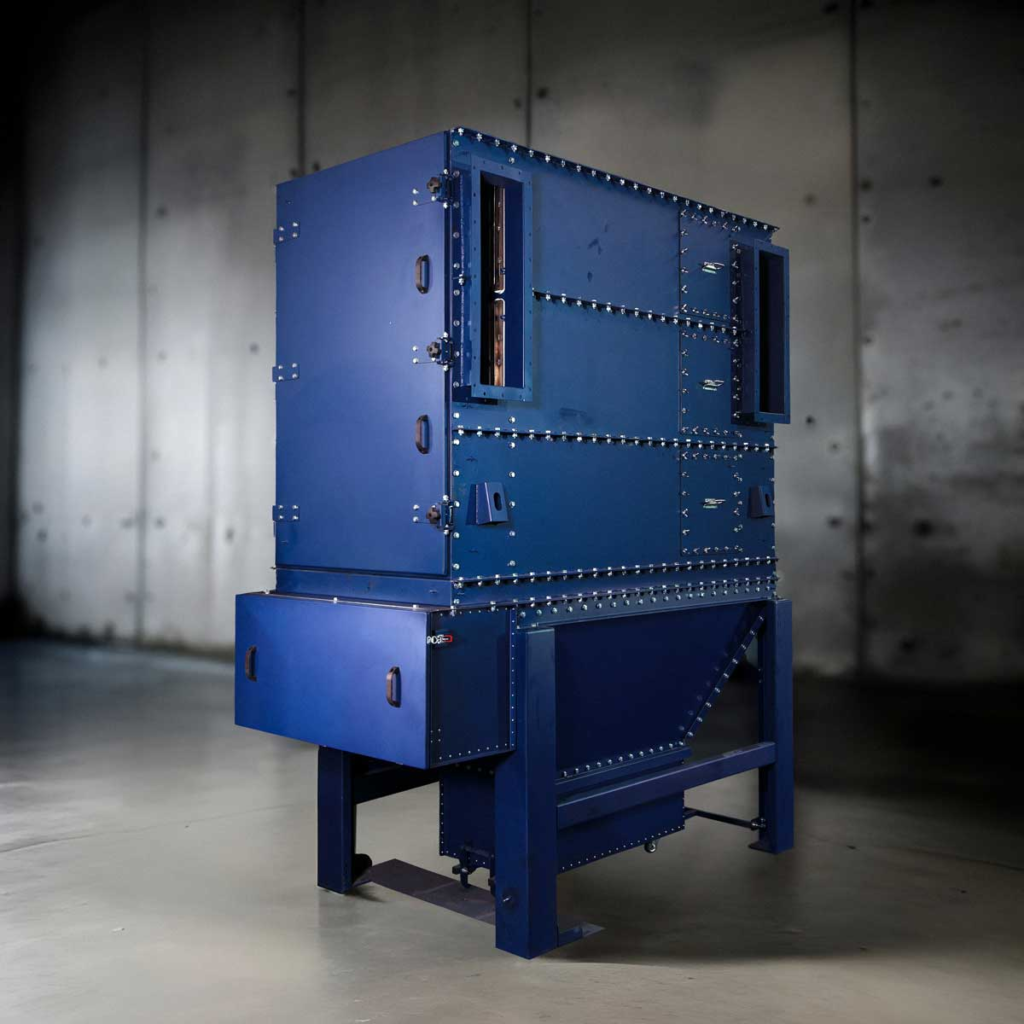
When people discuss collection equipment, the conversation often jumps straight to brands and sizes. It’s more useful to start with the dust’s “life cycle” in your plant.
Dry collection with baghouse-style systems often makes sense when:
- The dust is produced in significant volume and you need efficient capture at the source
- You can manage the collected material safely as a dry product
- You have a plan for spark control and safe handling where applicable
- You want flexible ducting to support multiple stations and future expansion
Wet collection with scrubber approaches may make sense when:
- The process naturally supports wet capture
- Keeping dust out of a dry collector and duct system reduces certain operational concerns
- You have strong water management practices and understand your disposal requirements
- Your workflow benefits from containing dust in a slurry rather than dry material
The trade-offs are operational, not theoretical. Dry systems focus attention on filter maintenance, dust discharge, and keeping the system stable. Wet systems shift attention to water quality, sludge handling, corrosion control, and consistent performance under changing loads. Either way, the equipment is only as good as your practices around it.
One of the biggest misconceptions is that a collector “solves” the problem by existing. Collection is a chain: capture, convey, separate, discharge, store, dispose. Weakness in any link turns into dust in the building or trouble in the equipment.
One way to approach this in practice is to ask three questions:
- Where do we want the dust to end up, physically as well as legally?
- What maintenance work could we realistically do on schedule?
- What happens during the worst week of the year, when production is heavy and staffing is thin?
If you answer truthfully, the best approach should become clear to you.
Small Operational Habits That Make a Big Difference
Many plants spend money on equipment upgrades while leaving daily behavior unchanged. Dust management rewards the opposite: small habits that keep the system’s “dust economy” under control.
A few habits that pay off quickly:
- Treat blow-off as a controlled operation. If compressed air is used, define where, when, and how, and what capture is running at the same time.
- Keep containers closed. Open bins and unsealed drums turn collected dust back into airborne material.
- Standardize cleaning tools. Vacuums rated for industrial dust collection are different from general shop vacs, and a single wrong tool can spread dust further than it removes.
- Audit after maintenance. When panels are opened and systems are serviced, dust gets disturbed. A short post-maintenance cleanup routine prevents “maintenance dust” from becoming a new baseline.
None of this is glamorous. It’s the kind of boring consistency that separates a shop that feels clean from one that actually stays clean.
A quick note on mindset
If you want a culture shift, stop calling dust “dirt.” Dirt is cosmetic. Dust is processed. Once people see it that way, they start thinking about capture like they think about scrap rate or downtime.
Clean Air Is a Production Asset
Industrial air filtration can be viewed strictly as a compliance consideration, and such a perspective forces industrial air filtration into the background. However, industrial air filtration should be viewed as protective for equipment, for product control, for cleaning hours, and for the dignity of the plant—where people can work without taking the shift home in their lungs and on their clothes away with them.
If your business involves an activity that produces aluminum dust, then the most valuable thing you can do is treat it as a particular, engineered problem that has a particular engineered solution. When you do that, you stop inheriting problems from the past and start running a cleaner, more stable business that is easier to scale.