
Department of Environmental Protection Acting Commissioner Ed Potosnak and DEP Forest Fire Service officials today dedicated the Veterans Fire Tower in Jackson Township to enhance wildfire protection in Monmouth and Ocean counties. The dedication of the tower, the first new such new structure in 78 years, comes as the state enters spring wildfire season, and supports the Sherrill Administration’s mission to deliver a government working for its people by protecting lives and property.
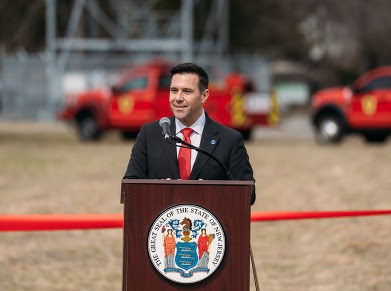
DEP Acting Commissioner Potosnak speaking at podium
In addition to the dedication, the Forest Fire Service also conducted a demonstration of its prescribed fire operations, which are critical to reducing forest fuels that increase wildfire dangers in densely populated areas of New Jersey. Prescribed fire operations are underway around the state. Peak wildfire season in New Jersey runs from mid-March through mid-May.
“Veterans Fire Tower will strengthen the Forest Fire Service’s ability to protect an area of Ocean and Monmouth counties especially prone to wildfire,” said Acting Commissioner Potosnak. “DEP is delivering this tower as part of a comprehensive strategy to reduce wildfire risk through public education and awareness, and prescribed fire operations as the Forest Fire Service enters peak wildfire season.”
Veterans Tower, part of a statewide network of 21 fire towers that are critical early detection systems for wildfires, stands at 133 feet tall and helps protect more than 516,000 residents and nearly 200,000 homes across Ocean and Monmouth counties.
Named for its location off East Veterans Highway in Jackson, Ocean County, the tower is dedicated to New Jersey veterans in recognition of the United States’ 250th anniversary this year.
Located at the New Jersey Forest Service’s Forest Resource Education Center and State Tree Nursery in Jackson, Veterans Fire Tower replaces the former Lakewood Fire Tower, which was located approximately five miles east in Lakewood, Ocean County.
“As New Jersey continues to see the effects of climate change, including an increase in the number of annual fire weather days, it is more important than ever to ensure we have eyes in the sky protecting New Jerseyans from wildfire,” said John Cecil, Assistant Commissioner for State Parks, Forests & Historic Sites. “Construction of the Veterans Fire Tower is one of several recent investments in the Forest Fire Service, along with additional funding for upgraded equipment and expanded staffing.”
“Having started my career as a fire observer in a tower and later serving as a field firewarden, I know how critical the information relayed from fire observers is to crews on the ground when every second counts to save lives and property,” said Bill Donnelly, Chief of the Forest Fire Service. “The Veterans Fire Tower serves an area of the state with a significant amount of wildland-urban interface, which is where human development is intertwined with the forest, making the tower a vital tool to keep the public safe.”
About Veterans Fire Tower
Fitzpatrick & Associates Inc. of Eatontown constructed the tower for approximately $2 million, which was funded through constitutionally dedicated Corporate Business Tax revenue in accordance with the Preserve New Jersey Act. Watch a video recapping the construction of Veterans Fire Tower.
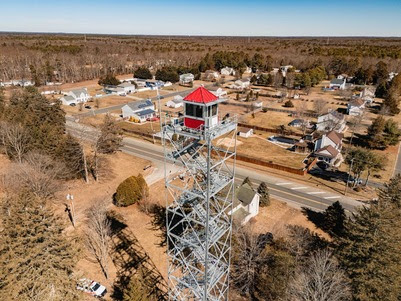
Veterans Fire Tower
“As we mark the 250th anniversary of our nation, it is especially meaningful to see this tower dedicated to New Jersey’s veterans who have committed their lives to protecting others,” said Vincent Solomeno, Commissioner of the New Jersey Department of Veterans Affairs. “The Veterans Fire Tower is both a practical investment in public safety and a powerful symbol of service. Just as our veterans have remained vigilant in defense of our country, this tower will stand watch over our communities, helping to safeguard lives, homes, and natural resources. We are proud to honor their legacy in a way that continues to serve New Jersey every day.”
Construction of the new tower became necessary after the Forest Fire Service’s 100-year lease for the Lakewood Fire Tower site expired in 2024. The new location offers improved wildfire detection coverage for the area, as views from the former Lakewood tower were partially obstructed by a nearby water tower.
Prior to Veterans Tower, the last fire tower to be constructed in New Jersey was the Medford Fire Tower in Medford, Burlington County, in 1948.
Importance of Fire Towers
The Forest Fire Service has relied on staffed fire towers since its inception in 1906. Fire towers, however, existed in the state before then, constructed by private landowners throughout the 19th century.
Fire towers are staffed whenever forests are dry enough to burn. Fire observers are trained to take weather readings, scan the horizon for signs of smoke, and interpret smoke and fire behavior. Working with nearby towers, they triangulate and pinpoint the locations of possible wildfires and dispatch resources to investigate. In many cases, fire tower observers dispatch resources to the source of smoke several minutes before the first 9-1-1 call from a passerby is received.
New Jersey has some of the most volatile forest fuels in the nation, particularly in the southern part of the state where shrub and tree types can fuel large and rapidly spreading fires. These fuels are comparable to the highly volatile chaparral shrublands found in California and southern Oregon.
The Forest Fire Service has determined that human observers remain the most effective means of early detection and the deployment of appropriate resources in New Jersey due to its dense population and extensive development within places where homes and businesses are located along the edges of forested areas.
In addition to the use of fire towers, the Forest Fire Service uses a variety of other resources and tools to detect wildfires, rapidly respond to them and create public awareness about safety. Most recently, the Forest Fire Service in 2025 launched the NJ Wildfire SMART (Safety, Mitigation, Awareness, Response, Training) initiative, a series of actions that emphasize steps and information resources for reducing wildfire risk and spread.
Prescribed Fire Operations Underway
The Forest Fire Service’s annual prescribed fire program is underway, aiming to reduce wildland fire fuels. In addition to reducing wildfire hazards, prescribed fire improves habitat for plants and animals, reduces damaging insects and ticks, and recycles nutrients into the soil.
Prescribed fire operations involve intentionally setting fires in forests or grasslands under carefully planned conditions to meet specific land management objectives.
Locations where prescribed fire operations are underway are available on the Prescribed Fire Notifications map at wildfire.nj.gov. Daily notifications are also posted on the Forest Fire Service’s Facebook, X (formerly Twitter) and Instagram accounts. Text and email alerts are available by signing up online.
This year, the Forest Fire Service plans to treat 25,000 acres of forests, grasslands and marshes with prescribed fire. Meeting that goal will depend on favorable weather conditions now through early April.
Following a prolonged drought in 2024, last year the Forest Fire Service was only able to treat 3,958 acres with prescribed fire, a record low over the past 25 years.
“Prescribed fire remains one of the most effective tools to reduce wildfire risk and maintain healthy forest ecosystems,” said Greg McLaughlin, Administrator for Forests & Natural Lands. “When conditions allow, these carefully planned burns help protect communities while supporting the long-term health of New Jersey’s forests.”
Most prescribed fire operations take place throughout the New Jersey Pinelands, an ecosystem adapted to and reliant on fire to thrive. Pitch pine, the dominant species of pine in New Jersey, have serotinous cones, meaning they remain closed until exposed to high heat from fire, at which point they release their seeds. Additionally, pitch pine trees can sprout new growth from their roots or stump, allowing them to quickly recover and colonize a burned area.
Motorists are reminded to use caution when approaching areas where prescribed fire operations are taking place, pay attention to reduced speed limits and be alert to the presence of Forest Fire Service vehicles, equipment and personnel that may be working in the area.
New Jerseyans are reminded that peak wildfire season often directly follows prescribed fire season. When in doubt about the source of smoke or whether a fire is part of a prescribed burning operation, call 1-877-WARN-DEP (1-877-927-6337) or 9-1-1.