
The Sherrill Administration today urged the public to continue voluntarily conserving water as the statewide Drought Warning remains in place entering the warmer months, a time when demand for water for lawns, landscaping and gardening increases across New Jersey.
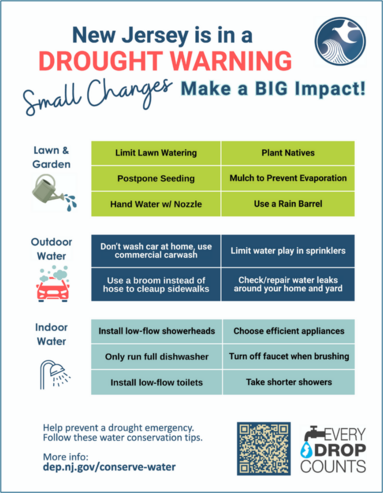
I urge everyone to join us in spreading awareness about the importance of conserving water.” “The Department of Environmental Protection continues to closely monitor drought indicators and water supplies across New Jersey to avoid the possibility of mandatory restrictions,” said DEP Acting Commissioner Ed Potosnak. “Simple steps such as limiting lawn watering to two days a week and hand-watering shrubs and flowers can go a long way in stretching water supplies.” “New Jersey is experiencing a chronic water supply drought, the scale of which we haven’t seen in more than twenty years,” added State Geologist Steven Domber. “The indicators that we track closely are showing persistently dry conditions. With uncertainty for rainfall in the coming months, we need residents to conserve water today, to ensure we have enough to sustain our needs over the summer.” Water Supply Indicators The DEP continues to closely monitor current water supply indicators, which include precipitation, stream flows, reservoir levels, ground water levels, and water demand, to keep the public, local governments, and water systems informed of conditions and potential future actions.
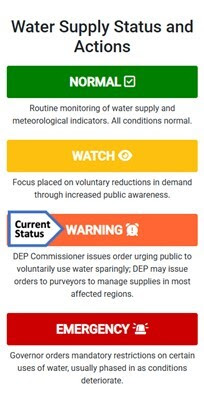
In addition, the DEP continues to coordinate with water systems to ensure they are using all available sources to increase supplies for the warmer months. (Municipalities or water utilities may require additional restrictions depending upon local water supply conditions.)The DEP uses a four-tiered system to keep the public apprised of water supply conditions: Normal, Watch, Warning and Emergency. Under the current Drought Warning, residents are strongly urged to voluntarily conserve water. If conditions do not improve, the next step could be the declaration of a Drought Emergency, which carries mandatory restrictions. The last statewide drought emergency was declared in March 2002 and lifted in January 2003. Drought Conditions by the Numbers New Jersey has experienced eight consecutive months of below-normal rainfall and remains under a drought warning issued Dec. 5, 2025. The state has experienced below normal precipitation for 20 of the last 24 months since September 2024.
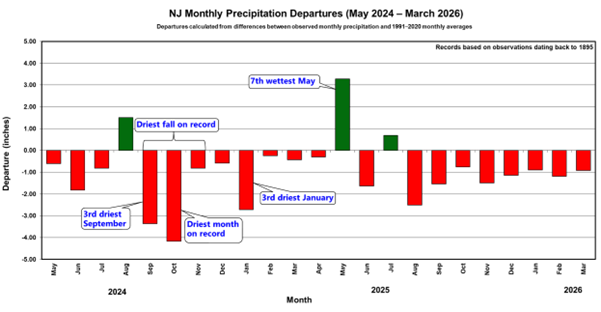
NJ Monthly Precipitation Departures – Office of the NJ State Climatologist
“Precipitation across New Jersey has been below normal for approximately 75% of the last 24 months,” said New Jersey State Climatologist David Robinson. “The typical wet weather that New Jersey has relied on to restore our water supplies over the winter and spring has not been fully realized.”
A relatively wet and snowy period in February and March resulted in improvement across all indicators used by the DEP to monitor drought conditions, particularly northern New Jersey’s reservoir systems. Click here for current reservoir trends. However, streamflow and groundwater remain well below normal levels.
During the past 90 days, precipitation has been up to 4 inches below normal in parts of the state. Even more concerning, all regions of the state are between 11 percent to 25 percent below normal precipitation over the past 180 days, with deficits reaching up to nearly 5 inches.
Resources
Tools put in place as a result of the drought warning declaration, including strong public education and outreach, have helped to preserve water supplies in New Jersey reservoir systems.
Visit dep.nj.gov/drought for weekly updates and sign up to receive weekly email updates on New Jersey’s drought status.
In addition:
- Residents and businesses can practice many common-sense conservation measures to reduce outdoor water use.
- For updated information about the status of New Jersey’s water supplies, visit nj.gov/drought
- For a list of Frequently Asked Questions about droughts, visit https://dep.nj.gov/drought/faq/
- For further information on water restrictions and conservation, visit nj.gov/drought/current-conditions/
- Organizations and government agencies may download the DEP’s Conserve Water Toolkit, which provides infographics, a flier, video, and social media resources that can be used to disseminate information about drought conditions and water conservation.
- The DEP urges municipalities to consider adopting a water conservation ordinance. Click her for a model ordinance.
A separate spring conservation outreach campaign has been launched ahead of peak irrigation season providing tips on how to reduce water usage when gardening, landscaping, and preparing lawns. For information on the campaign and toolkits, visit DEP’s Every Drop Counts website, and additionally share the information to spread awareness.