The Republican Study Committee (RSC) showcased the broad and growing bicameral support for the More Affordable Care Act introduced by Senator Rick Scott (R-FL) and RSC Chairman August Pfluger (TX-11). The legislation stops funneling billions to insurance companies and instead deposits federal subsidies directly into Trump Health Freedom Accounts that families control. Americans can shop across state lines, compare plans, and choose coverage that fits their needs while hospitals are required to post actual prices upfront so families see real costs before they buy.
Continue reading “Sen. Rick Scott, Chairman Pfluger’s More Affordable Care Act Wins Support”Category: GENERAL/POLITICAL NEWS
Assembly Consumer Affairs Committee Advances the “Tariff Transparency Act”
| Quijano, Bagolie bill would give consumers clear insight into how tariffs contribute to rising costs at the register (TRENTON) — Assemblywoman Annette Quijano’s legislation addressing a lack of clarity surrounding the drivers of inflation and rising consumer costs cleared the Assembly Consumer Affairs Committee today. Bill A5922, also known as the Tariff Transparency Act, would require retail establishments in New Jersey to disclose the portion of a product’s final price that is attributable to tariffs and other import taxes. Assemblywoman Rosy Bagolie also sponsored the bill. “As families across New Jersey struggle with skyrocketing prices on everyday goods, they deserve to know exactly why their grocery bill, clothing budget, or holiday shopping has become more expensive,” said Assemblywoman Quijano (D-Union). “This bill would ensure transparency and accountability, especially when the policies of the current federal administration are contributing to a cost-of-living crisis.” Under the proposed legislation, consumers would be clearly informed—at the point of sale display tag, on the online product page, on a printed receipt, or in a manner deemed appropriate by the Director of the Division of Consumer Affairs (DCA)—how much of the retail price stems from tariffs imposed at the federal level. The measure also calls for retailers and wholesalers to maintain documentation supporting these calculations and subjects all establishments to periodic compliance audits by the DCA. “When decisions are made at the federal level that cause prices to increase, working families feel it first, and they deserve to understand why,” said Assemblywoman Bagolie (D-Essex, Passaic). “New Jersey residents deserve clarity at the checkout counter, especially when tariff-driven costs are being passed along to them. This bill is about transparency and accountability to consumers, neither of which should ever be seen as a burden.” The bill would include exemptions for small businesses with under $500,000 in annual revenue and for products where the tariff impact is under 2% of the retail price. Full compliance would be phased in over a year, starting with voluntary participation before becoming mandatory for larger retailers. |
Trump Tariffs Work: Trade Deficit Plummets to Five-Year Low

The trade deficit has narrowed to its smallest since mid-2020, down more than 35% over last year — and more proof that President Donald J. Trump’s America First trade agenda is working.
Here’s what you need to know:
- U.S. exports are up 6% over last year — rising to their second-highest value on record — while Inflation-adjusted exports of consumer goods are the largest ever.
- The seasonally adjusted trade deficit with China has narrowed to its second-smallest since 2009.
- In the third quarter of 2025, real exports grew by a 4.1% annual rate and imports fell by around 5% — adding about 1% to real GDP growth.
- As President Trump delivers better terms for American workers, farmers, and manufacturers, November’s deficit was cut by more than half compared to the same month last year, fueled by soaring tariff revenues.
New legislation aims for faster labor contracts to combat corporate union-busting
| People’s World November 26, 2025 by Dom Shannon |
| New legislation aims for faster labor contracts to combat corporate union-busting |
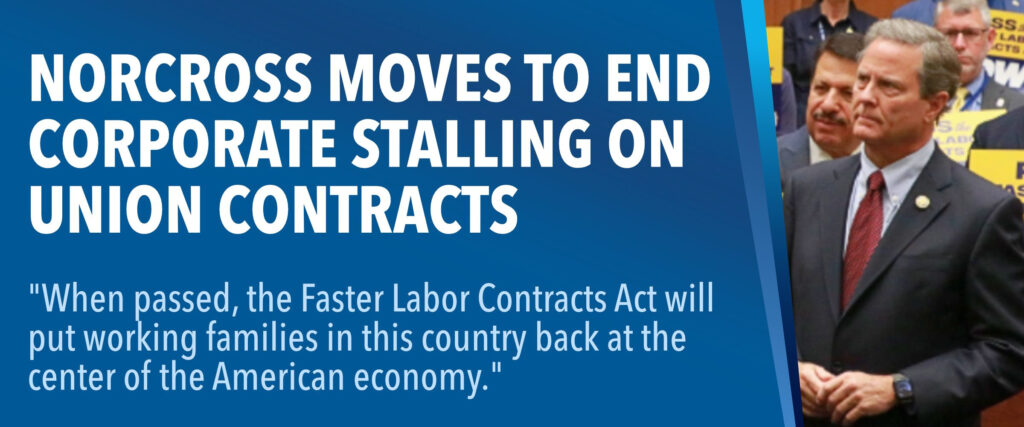
| The “right” to a union is a hollow promise if the bosses can simply run out the clock. This is the lesson being taught to the 11,000 unionized Starbucks workers who, years after their historic votes to organize a union, are still struggling for a first contract. This corporate stonewalling, led first by CEO Howard Schultz and then Brian Niccol, is a classic union-busting tactic. It exposes a fundamental truth that workers trying to organize their shops know all too well—the legal right to collective bargaining means very little without the power, or political will, to enforce it. A new bipartisan bill, however, aims to shift this balance of power. The Faster Labor Contracts Act (FLCA), introduced by Representative Donald Norcross (D-NJ) and Senator Josh Hawley (R-MO), would make these delay tactics much harder for corporate management. The FLCA would amend the National Labor Relations Act to impose a strict timeline on negotiations, mirroring a key provision from the larger Protecting the Right to Organize (PRO) Act. |
| READ MORE |
Domestic Violence Victims Would Receive More Protections Under Bills Advanced In Committee
Leaving a domestic violence situation can be both difficult and dangerous. Today, the Assembly Judiciary Committee advanced several bills aimed at easing domestic violence victims’ path to safety. The legislation would address the unjust penalties and sentencing imposed for crimes committed under duress, reinforce domestic violence restraining orders, and expand training of coercive control for judges and law enforcement officers. The bills advanced following moving testimony from women who lived through abuse and prevailed, but who still contend with the lasting aftermath.
Continue reading “Domestic Violence Victims Would Receive More Protections Under Bills Advanced In Committee “Verrelli Bill Strengthening Workers’ Rights Clears Assembly Committee

Assemblyman Anthony Verrelli’s bill to prohibit the use of non-compete clauses, with certain exceptions, and no-poach agreements cleared the Assembly Labor Committee today. Bill A5708 seeks to strengthen workers’ rights and encourage fair competition in the labor market.
“Workers deserve the ability to pursue new opportunities without being shackled by outdated and restrictive agreements,” said Assemblyman Verrelli (D-Hunterdon, Mercer), Chair of the Assembly Labor Committee. “By prohibiting non-compete clauses and no-poach agreements, we are standing up for workers’ rights, promoting a healthier labor market, and creating a level playing field for businesses across our state.”
Under the bill, no employer – whether public, private, or nonprofit – would be allowed to require, demand, or accept a non-compete agreement for any employee or other individual who provides services for, or on behalf of, the employer. Additionally, every contract restraining an individual from engaging in lawful professions, trades, or businesses after employment termination would to that extent be void.
The bill would include exceptions to ensure that legitimate business interests, such as trade secrets, are protected without restricting worker mobility. Similarly, non-compete agreements established during the sale of a business entity, its operating assets, or ownership interests are allowed. Existing non-compete agreements with senior executives would also remain valid if they meet specific requirements.
The bill would also explicitly ban no-poach agreements where employers agree not to hire each other’s employees or former employees.
A5708 would note that there must be no retaliation against workers who exercise their rights under this bill.
Assemblyman Verrelli, who has been a proud union member for 35 years, noted that legislation stems from a landmark finding from the Federal Trade Commission that non-compete clauses trap workers and hold back the economy.
Congressman Van Drew: This Gas Tax Increase Is a Punch in the Gut to New Jersey Families
Rep. Van Drew calls on Governor Murphy and Governor-elect Sherrill to reverse the upcoming gas tax hike. Washington, DC –Today, Congressman Van Drew released the following statement regarding the state’s outrageous gas tax hike to nearly 50 cents per gallon beginning January 1st.”New Jersey families are getting hit from every direction,” said Congressman Van Drew. “Thanks to state leadership, utility bills are up, delivery fees are up, and now they are raising the gas tax again. We already have one of the highest gas taxes in America. Raising it is the last thing working people need. This is a direct result of the policies that Governor Murphy signed into law, which make these tax hikes more likely year after year. They refuse to control their spending, so instead, they stick the bill on hardworking families. Let me be clear: talking about affordability means nothing if you stay silent when the state keeps raising taxes. Governor-elect Mikie Sherrill and Governor Murphy must reverse this hike immediately. People are tired of being punished for the state’s own failures, especially when the rest of the country is seeing gas prices go down.”
First Lady Melania Trump’s 2025 White House Christmas Theme – Home Is Where The Heart Is


First Lady Melania Trump’s 2025 White House Christmas theme, Home Is Where The Heart Is, illuminates the heartfelt character of America within the People’s House.
The First Lady’s creative inspiration is drawn from the joys, challenges, and frequent motion derived from motherhood and business. “The constant movement has taught me that home is not merely a physical space; rather, it is the warmth and comfort I carry within, regardless of my surroundings,” America’s First Lady reflects. “This Christmas, let’s celebrate the love we hold within ourselves, and share it with the world around us. After all, wherever we are, we can create a home filled with grace, radiance, and endless possibilities.”
Fostering the Future Red Room
First Lady Melania Trump appointed renowned designer, Hervé Pierre, to oversee the implementation of her creative vision. Blue butterflies illuminate the “Fostering the Future Red Room,” a transformational experience dedicated to the foster-care community, a cause the First Lady has championed since 2021. The striking color combination coupled with the butterflies symbolic meaning of transformation and renewal capture the essence of Christmas.
Mr. Pierre also created a limited-edition tour booklet—an artful keepsake that captures the magic of this year’s White House’s holiday theme for guests to treasure.
Continue reading “First Lady Melania Trump’s 2025 White House Christmas Theme – Home Is Where The Heart Is”Get Connected With Your Government

The Camden County Board of Commissioners and Congressman Donald Norcross are rescheduling Town Hall meetings with all levels of government soon. Please follow Congressman Norcross’ pages for current updates on virtual Town Halls as they become available. If you have any questions or need assistance until our next Town Hall Meeting, please submit them, and we will forward them to the appropriate level of government. Click Here to submit questions.
Continue reading “Get Connected With Your Government”Congressman Van Drew Urges Action on Alpha-gal Bill
Continue reading “Congressman Van Drew Urges Action on Alpha-gal Bill”
Washington, DC –Today, Congressman Van Drew released the following statement after reports confirmed the first documented death tied to alpha-gal syndrome (AGS), a serious allergic reaction triggered by a tick bite that causes a potentially life-threatening allergy to red meat and products containing alpha-gal.”This tragedy that happened right here in New Jersey is heartbreaking, and it shows exactly why Congress needs to take alpha-gal seriously,” said Congressman Van Drew.
“One bite from a lone star tick can make a person violently allergic to red meat and other products that contain alpha-gal. People can go into anaphylaxis from foods they have eaten their whole lives, and most have no idea what triggered it. It is estimated that hundreds of thousands of Americans have already developed AGS, and cases continue to rise rapidly as tick populations expand. We cannot wait for another tragedy before we act. We need research, we need awareness, and we need clear labeling so people know exactly what they are putting in their bodies. My bill, the Alpha-gal Allergen Inclusion Act, would designate alpha-gal as a major food allergen so Americans can clearly identify products that pose a risk. It is a simple, commonsense step that will save lives, and Congress should move on it immediately.”Click here to read more about H.R. 9382, the Alpha-gal Allergen Inclusion Act.