
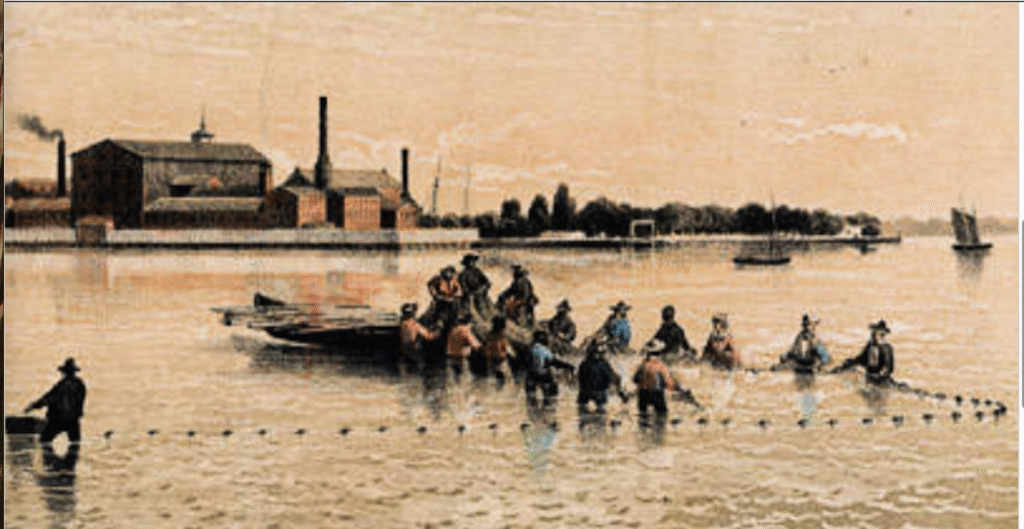
GLOUCESTER CITY, NJ(December 3, 2025)(CNBNews)–The men are shad fishing, on the Delaware River, in Gloucester City. In the distance is the Gloucester City Bleaching Mill. A bleaching mill is a facility, often part of a larger pulp or paper mill, that uses a series of chemical processes to whiten wood pulp by removing lignin. Historically, the term could also refer to an early textile mill that used sun and air to bleach cloth. In modern usage, it almost exclusively refers to a plant where pulp is treated with chemicals like chlorine dioxide or hydrogen peroxide to achieve the brightness and purity required for paper production. The
Gloucester City bleaching mill was part of the large Washington Mills complex, which began construction in the early 1840s. The specific bleaching house at the mill was in operation until it was destroyed by fire in 1859.
The
Washington Mills complex, owned by David S. Brown, included:
- Cotton mills
- Gingham mills
- Print works
- A bleaching house
Views from 1855 show the bleaching mills and smokestacks as part of the prominent industrial waterfront in Gloucester City. After the 1859 fire, the mill continued to operate in other capacities, and the mill complex was a major part of the town’s industry throughout the rest of the 19th century.