
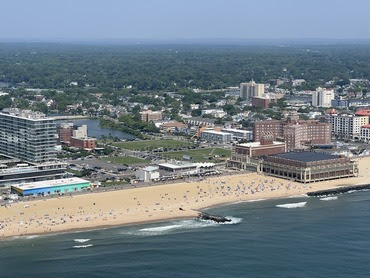
New Jersey’s beaches and ocean water quality are in excellent shape as the state kicks off what’s expected to be a banner summer tourism season with large numbers of visitors eager to celebrate the nation’s 250th birthday and FIFA World Cup activities, Department of Environmental Protection officials said during today’s annual State of the Shore event in Asbury Park.
New Jersey Chief Resilience Officer Nick Angarone was the keynote speaker at the event, held each year just before the Memorial Day weekend start to the peak summer tourism season. He was joined by DEP scientists and staff to discuss the work the state does to monitor water quality and protect coastal resources.
State of the Shore is sponsored by the New Jersey Sea Grant Consortium, made up of academic institutions and organizations from across the state dedicated to coastal and marine research, advancement of science-based policy, education and outreach.
“There’s nothing better than a summer at the Jersey Shore – and we’re ready,” DEP Commissioner Ed Potosnak said. “The DEP, along with our partners in local and county governments, will be hard at work throughout the season monitoring water quality as visitors create cherished memories while enjoying our beautiful coastline and lakes. We look forward to welcoming the world in this milestone year.”
“The annual State of the Shore event has heralded the start of the summer tourism season in New Jersey for more than two decades,” said DEP Chief Resilience Officer Angarone. “This summer promises to be a special one, so get out there and enjoy.”
“New Jersey Sea Grant Consortium is pleased to partner with the New Jersey Department of Environmental Protection for our annual State of the Shore event and looks forward to working with Commissioner Ed Potosnak to protect our coastline,” said New Jersey Sea Grant Consortium Executive Director Dr. Peter Rowe. “NJSGC is excited to bring in the summer season on the Jersey Shore with this event. NJSGC is proud to share this information on current and expected beach conditions for 2026 and the tropical storm outlook as well to the public and our beach communities.”
The Shore is the backbone of the state’s tourism economy, which hit nearly $52 billion and more than 124 million visitors in 2025. Expectations are even higher in this milestone year celebrating the 250th anniversary of the United States and an influx of World Cup visitors.
Since 1974, New Jersey’s Cooperative Coastal Monitoring Program has been closely monitoring and reporting on coastal water quality at public bathing beaches along the ocean, back bays and coastal rivers. the state has not experienced an ocean beach closing for exceeding bacterial standards since 2022.
This mission has expanded in recent years to include monitoring and reporting of harmful algal blooms in the state’s inland lakes to effectively manage the increasing presence of these blooms, which are increasing around the world in large part as a result of a changing climate.
State of the Lakes
Over the past weekend, DEP Chief Strategy Officer Kati Angarone helped kick off the summer season in northern New Jersey lake communities at their annual Lake Hopatcong Block Party in Hopatcong State Park, Morris County. Lake communities are a core component of New Jersey summer recreation and the state’s vibrant tourism economy, drawing visitors to state and local parks for picnicking, boating and relaxing.
“Lake Hopatcong isn’t just New Jersey’s largest lake – it’s a backyard for an entire region. Every summer, families return to its shores to swim, fish, boat, and simply exhale. That tradition is worth protecting, and it starts with the water,” said Kyle Richter, Executive Director of the Lake Hopatcong Foundation. “The Lake Hopatcong Foundation is proud to work alongside NJDEP to advance the science, funding, and on-the-ground projects that keep this lake healthy and open for everyone. When we invest in clean water, we invest in the communities, the local economy, and the way of life that makes inland New Jersey summers truly special.”
Easy Access Water Quality Information
The public may check njbeaches.org for advisories resulting from bacteria levels that exceed the state’s water quality standard, as well as any closures for Harmful Algal Blooms (HABs) at New Jersey’s freshwater public bathing beaches.
The DEP information provided at njbeaches.org is a partnership between the New Jersey Department of Health, local health authorities and DEP. The data covers more than 30 public freshwater beaches in Bergen, Burlington, Camden, Cumberland, Gloucester, Morris, Ocean, Passaic, Sussex, Warren, Hunterdon, Middlesex and Salem counties.
Earlier this month, DEP commenced weekly flyovers of waterbodies to check for HABs, enabling DEP to help local governments make informed decisions about how to enhance water quality. The weekly flyovers will continue through September.
Current HAB statuses are posted at (NJDEP Harmful Algal Bloom (HAB) Dashboard). Continuous Monitoring Buoys will be deployed at ten waterbodies including Manasquan Reservoir (Home Page | NJDEP DWM&S Continuous Data Monitoring Program).
Coastal Beach Conditions
New Jersey’s coastal beaches are in good condition heading into the summer, according to Dr. Jon K. Miller, who authors the annual State of the Shore Report for the New Jersey Sea Grant Consortium. Dr. Miller is also a Coastal Processes Specialist for New Jersey Sea Grant Consortium, and Director of the Coastal Engineering Group as well as a Research Associate Professor at the Stevens Institute of Technology in Hoboken, Hudson County.
“New Jersey’s beaches narrowly escaped disaster when the most memorable storm of the season – the Blizzard of 2026 – changed course, increasing snowfall totals, but minimizing the coastal erosion associated with the storm,” Dr. Miller said. “Thanks to this fortuitous turn of events, and what was otherwise an extraordinarily calm winter storm season, most New Jersey beaches remain in good shape heading into the summer season.”
Last fall, several minor to moderate storms impacted the coast, including existing erosion hot spots within Sea Bright in Monmouth County, and Ocean City and Strathmere in Cape May County.
Recently, the U.S. Army Corps of Engineers secured $99 million in federal funding that is being combined with state and local community funds to restore storm-impacted beach and dune systems in Cape May County.
- $28 million of that funding has been dedicated toward repairing engineered beaches and dunes in Strathmere, and in Sea Isle City in Cape May County. Construction in Sea Isle City is expected to commence in early June 2026; Strathmere work will begin in late June, after completion of construction in Sea Isle City;
- The remaining $71 million is allocated to projects in Ocean City, Avalon and Stone Harbor in Cape May County that are anticipated to commence mid-summer.
An additional $42 million in federal funding has been dedicated for periodic nourishment projects in Port Monmouth, Sea Bright and Monmouth Beach in Monmouth County. Work is expected to begin on these projects in late summer or early fall.
Coastal Water Monitoring
As part of its Cooperative Coastal Monitoring Program (CCMP), DEP partners with local health agencies to conduct weekly bacterial sampling of ocean, river and bay beaches from mid-May through September. The program also conducts daily surveillance flights of the coastline and lakes to check for any water quality concerns. Information about the status of public recreational beaches and water quality is available at njbeaches.org.
In addition to the CCMP, DEP operates an extensive water monitoring program. Each year, the Bureau of Marine Water Monitoring collects and analyzes more than 12,000 samples from over 1,600 locations spanning New Jersey’s coastal waters from Raritan Bay to Delaware Bay, including nearshore ocean and estuarine areas. This comprehensive data enables the Bureau to classify shellfish growing waters in compliance with the National Shellfish Sanitation Program, protecting public health and supporting the state’s shellfish industry.
New Jersey’s beaches are considered extraordinarily clean, with the last ocean beach closure occurring in 2022 after an unusually high 3 inches of rain.
In 2025, 3,346 ocean water quality samples collected and analyzed by the CCMP led to 11 advisories and zero closures due to exceedances of the bacterial standard. Five of the advisories occurred on June 9 in Wildwood Crest, Cape May County, after an overnight rainstorm, and four of the advisories were on July 21 after an early morning rainstorm. There were no precautionary beach closures in 2025 or floatable washup events.
Also in 2025, the CCMP collected and analyzed 301 bay water quality samples resulting in seven advisories and three closures due to exceedances of the bacterial standard at bay beaches. CCMP collected 116 river water quality samples that same year, resulting in five advisories at river beach stations and one closure.
For more information on the Cooperative Coastal Monitoring Program, visit a story map here.