
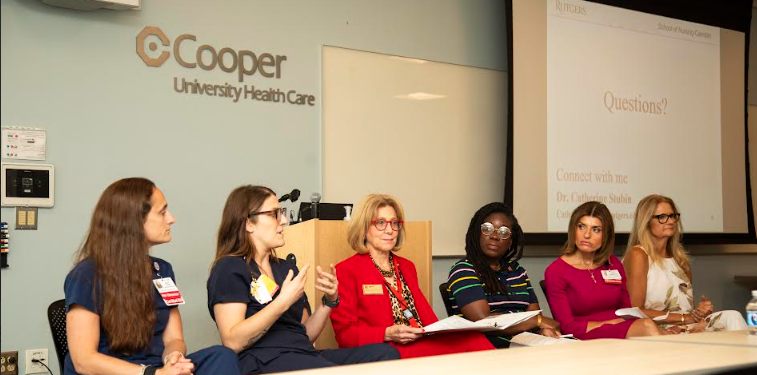
Nursing leaders, researchers, students, and health care professionals gathered on June 24, 2026, for Managing Stress and Preventing Burnout in the Future Nursing Workforce. The event featured a panel discussion hosted by Rutgers School of Nursing-Camden, the Senator Walter Rand Institute for Public Affairs, and Cooper University Health Care.
The event focused on the growing challenges of stress, trauma, and burnout in the nursing profession. The discussion highlighted innovative research aimed at supporting nurse well-being, strengthening workforce resilience, and promoting career longevity.
The panel of health care, academic, and policy leaders discussed findings from research conducted by Catherine Stubin, PhD, RN, CNE, CCRN of Rutgers School of Nursing-Camden and supported by the Walter Rand Institute as part of the Hillary Project. The initiative seeks to better understand the factors contributing to burnout among nurses and identify strategies to foster healthier work environments and improve workforce retention.
The Hillary Project was established in memory of Hillary Herskowitz, a Rutgers School of Nursing-Camden alumna whose tragic death was attributed to burnout during the COVID-19 pandemic. Through research, education, and advocacy, the project aims to address burnout, trauma, and stress within the nursing profession.
“This research confirms that nursing students are receiving strong clinical preparation, but it also highlights an important opportunity to better prepare future nurses for the emotional realities of the profession,” said Catherine A. Stubin, associate professor at Rutgers University School of Nursing–Camden and the lead faculty fellow for the report. “We have a responsibility to equip future nurses with the tools they need to navigate stress, prevent burnout, and sustain long, fulfilling careers. This research identifies practical strategies to embed resilience, wellness, and emotional preparedness throughout nursing education.”
“Nursing is a deeply meaningful profession, but it is also one that can be emotionally and physically demanding, and we must support nurses’ well-being from the very beginning of their careers,” said Kathy Devine, DrNP, RN, NEA-BC, senior vice president and chief nursing executive at Cooper. “Cooper is proud to join Rutgers School of Nursing–Camden and the Walter Rand Institute in advancing this important conversation and helping identify practical strategies to reduce burnout, strengthen resilience, and support the next generation of nurses.”
As health care organizations nationwide continue to face workforce challenges, participants emphasized the importance of collaborative efforts among academic institutions, health systems, policymakers, and community partners to support the next generation of nurses and ensure the delivery of safe, high-quality patient care.
About Cooper University Health Care
Cooper University Health Care is a leading academic health system affiliated with Cooper Medical School of Rowan University. Cooper, headquartered in Camden, New Jersey, has revenues of more than $3 billion and an A+ credit rating from both S&P and Fitch Ratings.
Cooper has nearly 14,000 team members, including more than 2,200 nurses, more than 1,200 employed physicians representing 95 specialties and subspecialties, and more than 700 advanced practice providers.
Cooper operates MD Anderson Cancer Center at Cooper as well as three hospitals – its 663-bed flagship Cooper University Hospital in Camden, its 229-bed Cooper University Hospital Cape Regional in Cape May Court House, and Children’s Regional Hospital in Camden.
Cooper University Hospital in Camden is the only Level 1 trauma center in South Jersey and the busiest in the region. The hospital has been recognized as a top-performing regional hospital by U.S. News & World Report’s Best Hospitals annual survey for six years.
More than 2.54 million patients visit Cooper’s facilities annually. Cooper’s ambulatory network encompasses three outpatient surgery centers, seven urgent care centers, a wound care center, and more than 130 physician, physical therapy, and radiology offices extending from the Delaware River to the New Jersey shore.
Cooper was named one of America’s Best Large Employers for 2026 by Forbes, ranking among the top 200 in the nation. Visit CooperHealth.org to learn more.
CAPTION: Nursing leaders, educators, researchers, students, and health care professionals gathered for “Managing Stress and Preventing Burnout in the Future Nursing Workforce,” hosted by Rutgers School of Nursing–Camden, the Senator Walter Rand Institute for Public Affairs, and Cooper University Health Care. The discussion focused on innovative approaches to strengthening resilience and supporting the future nursing workforce.
About the Senator Walter Rand Institute for Public Affairs
The Senator Walter Rand Institute for Public Affairs (WRI) at Rutgers–Camden has been a long-standing and trusted regional community partner for over 25 years. WRI honors former Senator Rand’s dedication to Southern New Jersey and exists to produce and highlight community-focused research and evaluation leading to sound public policy and practice in the region. With that as a foundation, WRI convenes and engages stakeholders in making the connections across research, policy, and practice in support of Camden City and Southern New Jersey residents. Using social science research methods, WRI specializes in transforming data into actionable information across a variety of areas, including workforce development, education, transportation, and public/population health. WRI reinforces and amplifies Rutgers’ research, teaching, and service goals by connecting the multidisciplinary expertise of faculty to regional problems, developing research and professional skills in students, and linking the resources of higher education to communities in Southern New Jersey.
About Rutgers University–Camden
Ranked among the Top 50 public institutions by U.S. News & World Report and named one of Washington Monthly’s “25 Best-in-Class Colleges,” Rutgers University–Camden provides an exceptional environment for intellectual growth, community engagement, and student success.
Located in Camden, NJ’s “eds and meds” district, the campus sits within a city rich in cultural and historic attractions, a vibrant arts community, leading healthcare institutions, and global corporate headquarters that support internships and experiential learning. Recognized as one of the safest campuses in the region, Rutgers–Camden offers a welcoming environment for undergraduate, graduate, and doctoral students, with easy access to Center City Philadelphia and the broader South Jersey region.
Home to approximately 6,000 students, Rutgers–Camden fosters a close-knit academic community while delivering the resources of a world-class research institution. The campus comprises four schools—the School of Arts & Sciences, School of Business, School of Nursing, and the Law School—and is part of the Rutgers University system. Designated an R2 research university and recognized with the Carnegie Community Engagement Classification, Rutgers–Camden is a national model for civically engaged urban institutions, contributing impactful scholarship and creative work on a global scale.