
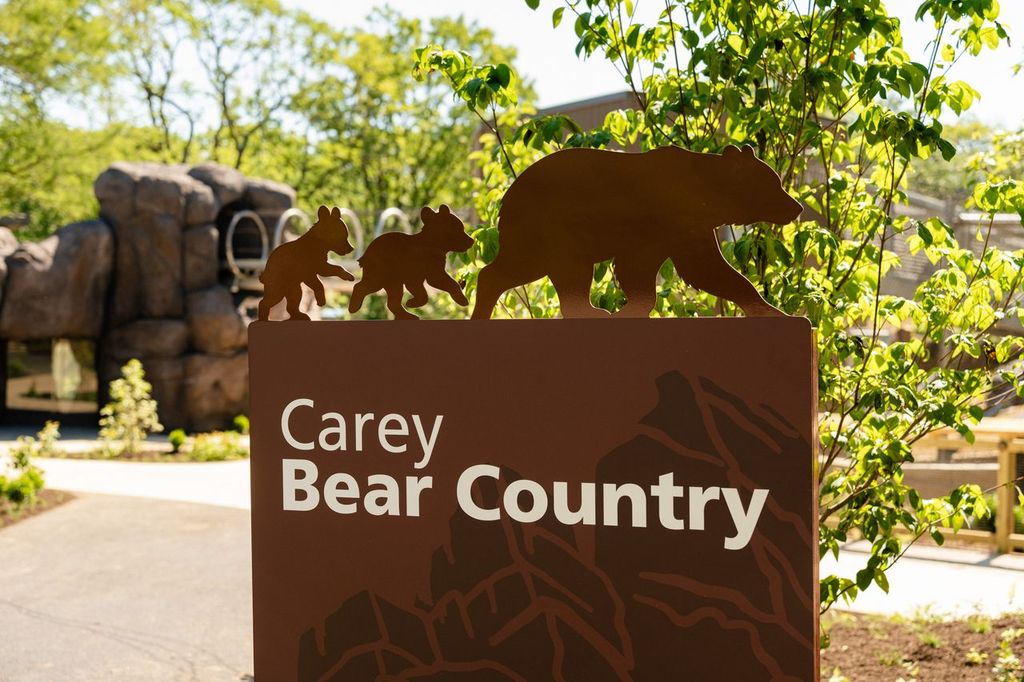
Philadelphia Zoo is thrilled to share that its new resident bears are now exploring the Zoo’s first Zoo360 trail for bears and spending time in a brand-new habitat built as a part of Francis J. Carey Bear Country. Gould & Potter Crossing, 60 feet long and 16 feet in the air, is the latest in the expansion of the Zoo360 trails at Philadelphia Zoo that began in 2011 and the first one the Zoo’s resident bears can use. Bhalu, Carey Bear Country is a $25 million state-of-the-art facility built with the highest standards of animal care in mind, making it one of the best in the country for vulnerable bears. Not only does Carey Bear Country enhance the Zoo’s animal care program, it creates a dynamic, memorable and educational experience for guests of all ages and backgrounds, and supports the Zoo’s conservation programs to protect these species in zoos and in the wild. Carey Bear Country is now home to Andean bears, Turbo and Alba, and sloth bear, Bhalu.
“Francis J. Carey Bear Country is enhancing the lives of our bears! They are now using our first ever Zoo360 trail for bears, the Gould & Potter Crossing,” said President & CEO Dr. Jo-Elle Mogerman. “At Philadelphia Zoo, our mission is to flourish as an urban oasis where people and animals thrive, transformative memories are made, and our passion for conservation helps save wildlife. When our guests see our bears walk over their heads, they will have a moment of awe they will remember for years to come.”
“We are so proud of our animal care specialists— they have done an extraordinary job helping our bears adjust to their new homes,” said Vice President of Animal Wellbeing Rachel Metz. “It is amazing to see our bears experience and thrive with all the improvements made to Carey Bear Country.”
Carey Bear Country is included in Zoo membership and general admission tickets. Throughout the exhibit, there are new ways for guests to get closer than ever before to the Zoo’s bears with cave-like glass viewing areas. Interactive, educational signage throughout the space tells the stories of Andean bears and sloth bears, the threats they face in the wild, and how the Zoo is making a difference in their conservation.
About Carey Bear Country
Carey Bear Country goes well beyond the standards for animal care set by the Association of Zoos and Aquariums. The exhibit features 60% more space for bears with the addition of a third bear habitat and improvements that mimic the natural spaces wild bears live in. New features include the Gould & Potter Crossing Zoo360 Trail for animal exploration; digging pits to increase food foraging opportunities; heated water features and pools for drinking and playing; 14 ft. tall climbing structures; indoor and outdoor behind-the-scenes denning space for cub rearing; and structural and landscape designs to support newborn and aging animals. These enhancements strengthen the Zoo’s commitment to the Association of Zoos and Aquariums Species Survival Plan and Saving Animals From Extinction Program.
As a part of the Zoo’s mission to be a destination where transformative memories are made, Carey Bear Country provides new opportunities for guests to connect with the animals. The upgrades include glass viewing areas to come nose-to-nose with bears; new areas for guests to watch the Zoo’s animal care specialists have training sessions with the bears; and new interactive educational signage to educate about the bears and their conservation stories. Construction also included seven brand-new gender-neutral restrooms, one family restroom and a dedicated nursing suite.
Meet the Bears
At its opening, Carey Bear Country is home to three bears: Andean bears Turbo and Alba and sloth bear Bhalu. Both species of bears face threats including habitat loss and degradation, human conflicts, and poaching and are listed as vulnerable by the International Union for Conservation of Nature.
Andean bears are the only bear species native to South America and live in the Andes Mountains. They have light, circular or semi-circular markings on their faces, which is why they are also called spectacled bears. They are excellent climbers and are known for building nests in trees to both eat and sleep. They eat fruits, berries and shrubs and eat the most plants of any other bear species.
Sloth Bears are found in the lowland forests of India, Nepal and Sri Lanka. They have long, dark shaggy fur with a distinct cream-colored “U” or “Y” shaped marking on their chests. They have flexible snouts, protruding upper and lower lips, and powerful lungs that allow them to dislodge and eat termites and ants that are 8-10 feet underground. They also eat eggs, insects, honeycombs, carrion, and various kinds of vegetation.
Fifteen-year old male Turbo and 11-year-old female Alba are a breeding pair of Andean bears who previously lived at San Diego Zoo. Together, they have had three cubs. Thirteen-year-old sloth bear Bhalu has lived at Philadelphia Zoo since 2015 and lived at Little Rock Zoo during construction before returning. Bhalu’s mate, Kayla, who also lived at Philadelphia Zoo since 2015, is currently raising her (and Bhalu’s) two new cubs at Little Rock Zoo. Kayla will return to Philadelphia once they are successfully weaned in about two years.
Bear Personalities
Turbo, male Andean bear
Birthday: December 30, 2010
Loves: Weaving plant material together to make large elaborate beds, playing with his mate Alba when she is receptive, smashing open his bones
Favorite Foods: Avocado and femur bones
Fun Fact: Loves to show off his strength and skills by throwing his enrichment bones to the ground to smash them open and get to the marrow
Alba, female Andean bear
Birthday: January 23, 2015
Loves: Making beds high in the climbing structures and then watching the world around her, learning how to take things apart, being an amazing mother
Favorite Foods: Avocado and mixed nuts
Fun Fact: She is a very intelligent bear that always keeps her animal care specialists on their toes!
Bhalu, male sloth bear
Birthday: January 20, 2013
Loves: Playing with enrichment toys that are paw sized so he can roll and throw them
Favorite food: Peanut butter and honey water
Fun Fact: Bhalu is a father to five offspring with his mate, Kayla.
Fast Facts about Carey Bear Country
· Francis J. Carey Bear Country is a $25 million state-of-the-art facility built with the highest standards for animal care in mind, making it one of the best in the country for vulnerable bears.
· This is the biggest new construction project at Philadelphia Zoo since the opening of KidZooU in 2013.
· The newly refreshed and upgraded spaces include the addition of a third bear habitat, dedicated behind-the-scenes indoor and outdoor den spaces to support breeding programs, and a brand-new Zoo360 trail – Gould and Potter Crossing – for the bears to explore, the first-ever for bears at Philadelphia Zoo.
· Carey Bear Country is home to three bears: Andean bears Turbo and Alba and sloth bear Bhalu.
· Andean bears are the only bear species native to South America. They have distinctive circular or semi-circular creamy white or yellowish markings (spectacles) on the face and around the eyes.
· Sloth bears are native to India, Nepal and Sri Lanka. They have long, dark shaggy fur with a distinct, cream-colored “U” or “Y” shaped marking on their chests.
· Carey Bear Country is open daily from 9:30am-5:00pm and is included in general admission or Zoo membership.
About Philadelphia Zoo
At Philadelphia Zoo, the Zoo moves around you! Pioneering Zoo360, a first-in-the-world system of animal exploration trails, Philadelphia Zoo has inspired more than 70 zoos around the globe to design new ways to invite animals to travel and roam through their own campuses. Passing through treetops, crossing over pathways and connecting habitats, Zoo360 provides Philadelphia Zoo’s beautiful big cats, playful lemurs, and lively monkeys innovative ways to explore and marvel at one another and our guests. Visit the all-new Carey Bear Country home to Andean and sloth bears, meet Mommy the Galapagos tortoise and her world-famous hatchlings at the Reptile & Amphibian House, our quickly-growing orangutan infant in PECO Primate Reserve, the Ankole cattle hillside, Amur tigers at Big Cat Falls, Victorian crown pigeons at McNeil Avian Center, and hippos, zebras and white rhino throughout African Plains. Share a space with critically endangered lemurs as you wander through Lemur Island, look up as you feed the world’s tallest animal at Giraffe Experience, or get up-close as you hand-serve colorful birds their meals at Wings of Asia. Philadelphia Zoo is one of the region’s foremost conservation and education organizations and home to endangered, and in some cases extinct, animals in the wild. At Philadelphia Zoo, our mission is to flourish as an urban oasis where people and animals thrive, transformative memories are made, and our passion for conservation helps save wildlife. Philadelphia Zoo is accredited by the Association of Zoos and Aquariums and is a non-smoking facility. For more information, visit philadelphiazoo.org. Facebook: PhiladelphiaZoo; Instagram: @philadelphiazoo; X (formerly Twitter): @phillyzoo; TikTok: @philadelphiazoo