
Written by Allen Houston
June 26 – 29, 2026 | 1,606 U.S. adult citizens
Overview
In this week’s Economist/YouGov poll:
- Half of Americans support eliminating health insurance companies and several other socialist policy proposals
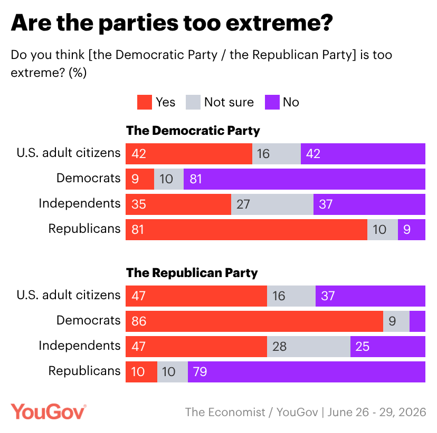
- More Independents say the Republican Party is too extreme than say the Democratic Party is
Plus polling on Trump’s priorities, the Kennedy Center, the Lincoln Memorial’s reflecting pool, same-sex marriage, transgender student athletes, and gas prices.
Socialist policies
Only 8% of Americans would describe themselves as socialists, according to this week’s Economist / YouGov Poll. That’s smaller than the shares who describe themselves with several other ideological adjectives offered in a poll question, including progressive (17%), liberal (23%), and conservative (34%). (Respondents were allowed to choose as many labels as they liked to describe themselves.)
Even though few Americans say they’re socialists, many policy proposals championed by democratic socialists draw significant support from Americans.
About half (52%) of Americans support eliminating private health insurance companies and replacing them with a national health plan in which all Americans get their health insurance from the federal government. Only 30%) oppose such a plan. Such a proposal would draw support from most Democrats (73% vs. 13% who oppose) and a majority of Independents (54% vs. 22%). Republicans are much less likely to support such a proposal, but only a bit more than half would oppose it (30% support vs. 54% who oppose). And while the vast majorities of self-described socialists (90%) and liberals (81%) support such a plan, it also draws support from a majority of moderates (55% vs. 29% who oppose) and nearly one-third of conservatives (30% vs. 55%). (The poll separately asks each week about Americans’ ideology and respondents can pick one of liberal, moderate, and conservative; it’s a slightly different way of asking that gets slightly different numbers.)
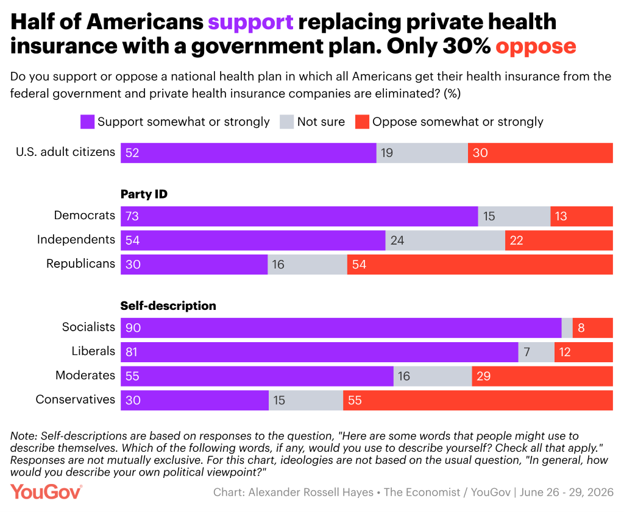
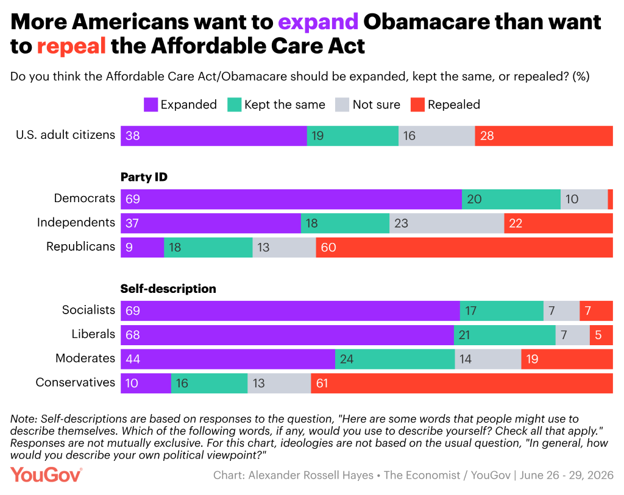
While eliminating insurance companies may sound like a radical change to healthcare, the share of Americans who want to replace private insurance with a government health plan (52%) is larger than the share who want to expand the existing Obamacare (the health-coverage system established by the Affordable Care Act) (38%). The share who favor repealing Obamacare (28%) is about as large as the share who oppose replacing private insurance with a government plan (30%).
Americans who support a national healthcare plan do not universally see expanding Obamacare as a step in the right direction. Only a little more than half (56%) of the Americans who support creating a national health plan also support expanding Obamacare. On the other hand, most Americans who support expanding Obamacare would also support a national health plan that replaces private insurance (77%).
Other proposals associated with democratic socialism also have widespread support from Americans. Majorities of Americans favor having the government cover the cost of college tuition for all students (55% vs. 34% who oppose) and think the government should build public housing (57% vs. 24% who think it should not). More broadly, slightly more Americans say they would rather have a bigger government providing more services than a smaller government providing fewer services (39% vs. 35%).
But despite the support of many Americans for certain socialist policy proposals, Americans have less positive views of socialism as a label. More Americans have an unfavorable opinion of socialism than a favorable one (39% vs. 32%) and more than twice as many Americans say that capitalism is the better economic system than socialism than say socialism is better (44% vs. 19%). Only 29% of Americans say they would ever vote for a candidate who identified as a democratic socialist while nearly half (45%) never would.
Congress, the parties, and politicians
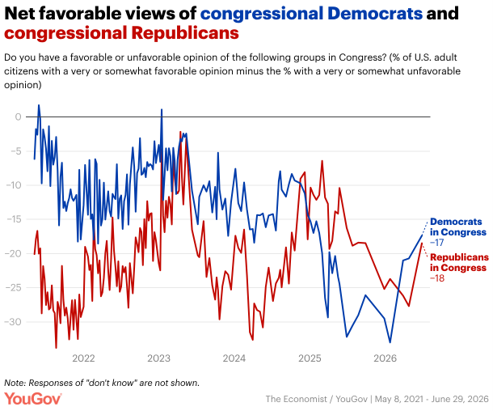
The latest Economist/YouGov Poll shows that Americans’ opinions of both congressional Democrats and congressional Republicans have improved since earlier in 2026, when both groups were at or near five-year lows. Americans’ net favorability of Democrats in Congress has risen to -17 from -33 in January, while that of Republicans in Congress has risen to -18 from -24. (Net favorability is the percentage who view each group very or somewhat favorably minus the percentage who view each one unfavorably.) The two parties in Congress are now viewed negatively at about the same level.
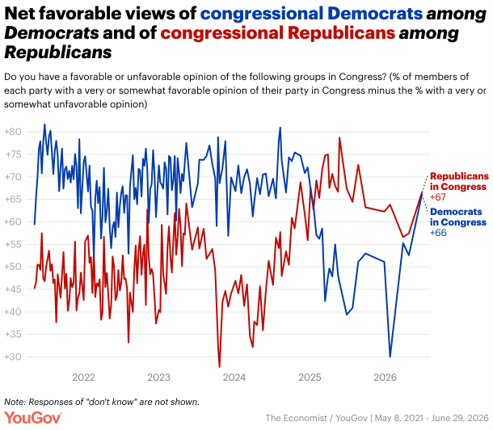
Among Americans who identify with each party, views of their party in Congress have also improved: Net favorability of Democrats in Congress among Democrats rose to +66 from +30 in January. While congressional Republicans’ ratings among their own party identifiers never sunk to the low that Democrats’ did this year, their net favorability has rebounded to +67 among Republicans from a low of +57 in March.
Americans are somewhat more likely to view the Republican Party as too extreme than the Democratic Party: 47% say the Republican Party is too extreme, compared with 42% who say the same about the Democratic Party. Vast majorities of Democrats and Republicans view the other party as too extreme: 86% of Democrats say the Republican Party is too extreme and 81% of Republicans say the Democratic Party is too extreme. Independents are divided, but are more likely to say the Republican Party is too extreme than to say the Democratic Party is (47% vs. 35%). Few members of each party — only 9% of Democrats and 10% of Republicans — believe their own party is too extreme.
Among the political figures asked about in this week’s poll, Bernie Sanders has the highest net favorability among Americans overall, at +6 (46% view him favorably and 40% view him unfavorably). Sanders is viewed very positively by Democrats (+71) and very negatively by Republicans (-67).
Zohran Mamdani and Alexandria Ocasio-Cortez have similar partisan profiles: slightly negative overall, very positive among Democrats, and very negative among Republicans. By comparison, Graham Platner is less well-liked overall (-12) and is viewed only modestly favorably among Democrats (+13), while Republicans view him negatively (-39); 60% of Americans don’t know what they think of him.
Rand Paul and Ted Cruz are viewed favorably among Republicans, but are unpopular among Americans overall. Cruz is particularly polarizing, with a +48 net favorability among Republicans and -69 among Democrats.
Quick Takes
- 60% of Americans say Donald Trump hasn’t paid attention to the country’s most important problems, twice as many as the 29% who say he has had the right priorities
- 54% of Americans strongly or somewhat approve of removing Donald Trump’s name from the John F. Kennedy Center for the Performing Arts; 24% disapprove
- More Americans disapprove than approve of Trump’s renovation of the reflecting pool at the Lincoln Memorial (49% vs. 31%)
- 27% of Americans think vandals are responsible for recent problems with the reflecting pool; 43% say they are not and 31% are not sure
- A majority (54%) of Americans think that same-sex marriage should be legal; 33% say it should not be legal
- Nearly two-thirds (64%) of Americans strongly or somewhat oppose allowing transgender student athletes to play on sports teams that match their gender identity, rather than the sex they were assigned at birth; 18% support allowing them to do so
- Americans are divided in their perception of how gas prices are changing where they live: 40% say prices are going up a lot or a little and 41% say they’re going down. More Democrats say prices are going up than down (50% vs. 32%); fewer Republicans say they’re going up than down (30% vs. 55%)
Related surveys
All YouGov America public surveys
YouGov survey team