
Did you know the Delaware Department of Natural Resources and Environmental Control can help you save potentially hundreds of dollars on your energy bills annually while protecting your home from the elements and keeping you more comfortable?
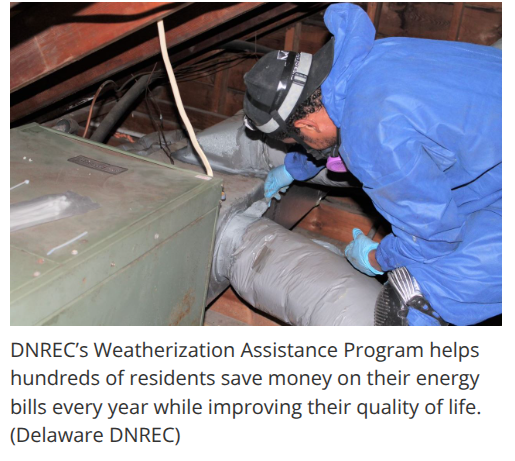
DNREC’s Weatherization Assistance Program has for years helped lower-income households reduce their electricity, heating and water heating costs, lowering their bill from 10% to 40% or even more. And the best part is it comes at no cost to income-verified applicants.
Essentially, the program connects Delawareans with certified contractors and energy specialists who will walk through their residence, determine ways they can save energy and then make improvements like adding insulation to their homes, weatherstripping doors and sealing HVAC ducts. These changes help keep the air conditioning in during summer and the heat in during winter, while steps like utilizing more efficient light bulbs save energy.
So, how exactly does the program work and how might you be able to benefit?
First, you must meet the eligibility criteria based on income. The program is only open to households that do not exceed that threshold, which varies slightly from year to year. To check if you come in under the income limit, visit de.gov/wap.
The program covers houses of all kind, including single-family detached homes, row homes, mobile homes and even homes divided into multiple units. Apartment complexes, however, are not included — at least at the moment.
Most applicants are homeowners, but renters are eligible too, though the landlord for the property must give their approval.
Someone who is interested and meets the aforementioned criteria would then contact the Energy Coordinating Agency, a nonprofit focused on residential energy efficiency that works closely with DNREC to operate the Weatherization Assistance Program.
An individual can initiate the process by calling ECA or filling out a form on its website. The nonprofit then works on scheduling a home energy audit if the person is eligible.
During the audit, a certified energy specialist tours the residence to identify deficiencies in insulation levels and the sealing-out of exterior air. These areas of need might include little or no insulation in attics and crawlspaces, poorly insulated pipes, cracks in the structure and broken windows.
The auditor will also seek to learn about the residents’ energy usage habits to recommend changes they can make in their daily life, such as turning off lights, TVs and space heaters when not in use. Many high-energy users are unaware they are using energy inefficiently, so education alone can often save some money for billpayers.
Because of program guidelines from the U.S. Department of Energy, applicants are prioritized based on need, poverty level and whether the residence includes small children or people with disabilities. However, DNREC has traditionally been able to serve everyone who meets the eligibility guidelines without too long a wait.
After what’s known as the pre-weatherization process is completed, thus removing barriers to weatherization, a certified home energy efficiency installer who’s been closely vetted is hired. This might be a specialty energy efficiency repair company or an insulator, depending on the needs. A plumber or electrician may also be hired if pipe leaks are identified or if the home needs more ventilation to improve indoor air quality, respectively.
There are strict guidelines around this aspect to ensure these individuals and companies stick within the program and don’t push unnecessary repairs. DNREC uses a trained quality control monitor to help guarantee taxpayer dollars are spent responsibly, effectively and efficiently.
Many of the applicants learn about the program via word of mouth, particularly through the Low Income Home Energy Assistance Program, but DNREC is developing an outreach and marketing program to spread the word around the state more effectively.
There’s no preference based on geographic location, although historically roughly half the applicants tend to reside in mobile homes, which are more common in Sussex County.
As you might expect, participants are generally thrilled to see their energy bills lowered by dramatic amounts. Many are even shocked at the money they can save.
New Castle resident Donald Christie benefited from the Weatherization Assistance Program a few years ago. He received smoke and carbon monoxide detectors for his family’s safety (a top priority of the program), new insulation in his attic and an exhaust fan in the bathroom to remove moisture and air contaminants, while also having work done on his crawlspace to ensure outside air didn’t leak into the home.
Like so many of the folks who are accepted, Christie was impressed with the professionalism, thoroughness and quick response of the DNREC Weatherization Assistance Program staff and contractors.
“It meant the world to me. I’m still in awe over it, and I’m so grateful,” he said.
DNREC is able to proactively braid in funding from many sources to leverage dollars and tackle more needs, enabling the Department to better address deficiencies that might otherwise be obstacles.
This can be particularly beneficial for homes in decent shape with residents who don’t waste a lot of energy, as these participants might see smaller savings in the first year or two. Fixes that fall into this bucket include minor roof patching, dealing with moisture in a basement or crawlspace and addressing water and gas pipe leaks.
Program implementers are able to meet additional demand and are hoping to increase awareness of the Weatherization Assistance Program to serve even more households than the 250 to 400 it reaches annually.
The program was initially housed in the Delaware Department of Health and Social Services but was transferred to DNREC in 2012. Now going on 50 years, it’s still running strong and has helped more than 3,000 households since 2013.
“I think it’s a model of how programs should be run nationwide,” said Mathew Himmelein, the monitor for Delaware’s Weatherization Assistance Program.
Visit de.gov/wap or call the DNREC State Energy Office at 302-735-3480 to learn more.
 -
 -
 -
 -
 -