
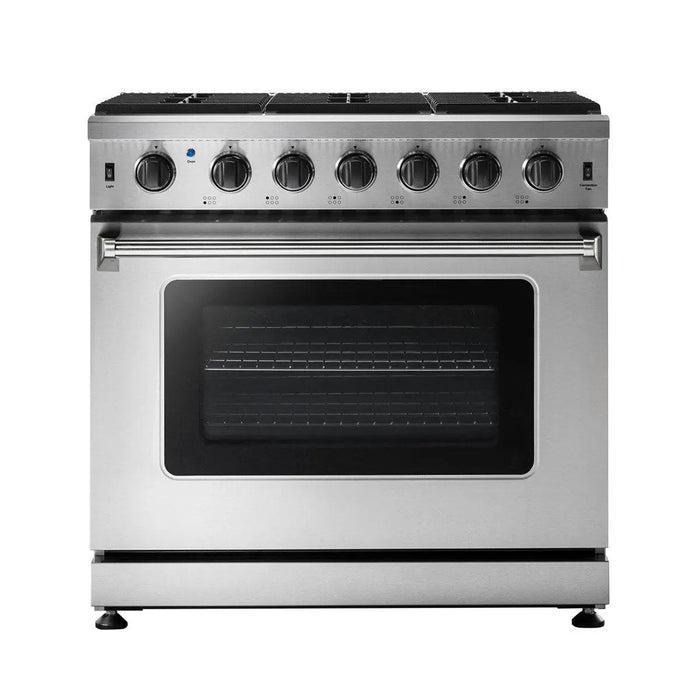
Canadian kitchens take their heaviest load as the cold months arrive and cooking moves indoors for good: stock on the back burner for hours, a roast in the oven, four pans going at once on a holiday afternoon. That is the week a range is actually tested.
The number people shop on is the top of the burner output. A freestanding gas convection range rated from 9,000 to 18,500 BTU is describing something more useful than its maximum, because the span between those two figures is what decides whether one gas stove can both sear and simmer.
What a Burner Has to Do at Both Ends
Searing Needs Concentrated Heat
Browning requires surface temperatures above the point where water boils away faster than it arrives. That takes high output delivered into a small area, and a burner that cannot get a heavy pan there will stew the food instead of browning it.
Simmering Is the Harder Problem
Holding a sauce just below a boil needs very low, very stable heat. Most burners on a gas stove fail here rather than at the top end, because a flame turned down far enough to simmer is also close to the point where it lifts off the port and goes out.
Turndown Ratio Explained Plainly
The ratio between a burner’s highest and lowest stable output is its turndown. A burner running 18,500 down to 9,000 has a narrow range; one that drops to a genuine low simmer has a wide one, and that span is rarely advertised.
Why One Burner Cannot Do Both Well
Designing a port pattern for maximum output and for stable minimum output pulls in opposite directions. This is why a four-burner top usually mixes sizes, and why the useful question is which burner does what rather than what the top figure is.
How the Burner and Grate Work Together
Sealed Tops Versus Open Burners
A sealed top is a continuous surface with the burner set into it, so spills stay on top and wipe away. Open burners drop debris into a tray below, which cleans less easily but lets more air reach the flame.
Grate Height Sets the Flame Gap
The distance between flame and pan bottom determines how much of the heat lands on the pan rather than around it. Continuous cast grates also let a pan slide between burners without lifting, which matters more in daily use than it sounds.
Cast Iron Against Coated Steel
Cast iron grates hold heat and stay put under a heavy pan, and they also rust if left wet. Coated steel is lighter and easier to clean while being more likely to flex, and the choice shows up after a few years rather than on day one.
Pan Size Against Burner Size
A small pan on a large burner sends most of the flame up its sides and wastes it. Matching the two is the cheapest efficiency gain in any kitchen, and it is also what stops handles from charring.
The Oven Below Shares the Same Gas Line
Supply Has to Serve Both
The cooktop and the oven draw from one gas supply, and the total connected load is what the line and regulator are sized against. A range that performs when the oven is cold can behave differently with the oven calling for heat.
The Fan Trades Radiation for Flow
A fan moves air through the cavity so that heat reaches food by flow rather than by radiation alone, which is what makes it a convection oven rather than a conventional one. In practice that means more even browning and a lower effective temperature for the same result, which is why recipes are adjusted downward.
Glass and Heat Retention
A multi-layer glass door keeps cavity heat in while leaving the food visible, and the layer count is a real specification rather than a styling choice. Each pane added cuts radiant loss through the largest cold surface the cavity has.
Cavity Size Against Footprint
A thirty-six inch exterior width does not translate directly into oven capacity, because the burner assembly and insulation both take depth. The figure worth comparing is interior cubic feet, since that determines whether two full sheet pans fit side by side.
Installation and the Things That Get Missed
Propane Needs a Conversion
Natural gas and propane burn at different pressures and need different orifices. A range installed on propane without the conversion kit runs badly at best, and this is the single most common installation problem on rural properties.
Clearances and Ventilation
Side clearances to combustible cabinetry are specified by the manufacturer and are not negotiable. A range of this output also needs real extraction above it, because combustion products and moisture both end up in the room otherwise.
Leveling and Door Alignment
A range sitting out of level will cook unevenly and its door will not seal. The adjustable feet exist for the floor it lands on, and skipping that step produces complaints that get blamed on the appliance.
The Anti-Tip Bracket Is Not Optional
A freestanding range will tip forward if enough weight lands on an open door, and the bracket that prevents it is fastened to the floor or wall behind. It arrives in the box and it is the component most often left there.
Safe Practice in a Working Kitchen
Four habits cover most of the risk.
- Keep a lid nearby for any pan of oil
- Turn pot handles inward over the cooktop
- Never warm a room with the oven
- Confirm burners are fully off after cooking
The flame on a gas burner also consumes oxygen and produces moisture and combustion byproducts in the room. A commercial gas range installed in a home needs the extraction to match it, and that requirement scales with output rather than with the size of the kitchen.
Where Home Ranges Are Heading
Ranges borrowing commercial features have moved out of specialty showrooms and into ordinary kitchens over the past several years. Continuous cast grates, sealed tops and convection fans now appear together at prices that would once have bought a basic unit with none of them.
The other shift is in what gets published. Low-end simmer output is starting to appear beside maximum BTU, which lets a buyer compare the figure that actually determines whether a sauce can be held for an hour.
For anyone replacing a range, the test is whether it can hold a low simmer and still sear, since almost every unit on the floor can do the second one. On TMG Industrial product pages the burner output appears as a range rather than a single figure, alongside oven capacity and the convection specification, so a gas stove can be judged on the end that actually gets used.
 -
 -
 -
 -
 -