
UPDATED
William E. Cleary Sr. |CNBNews
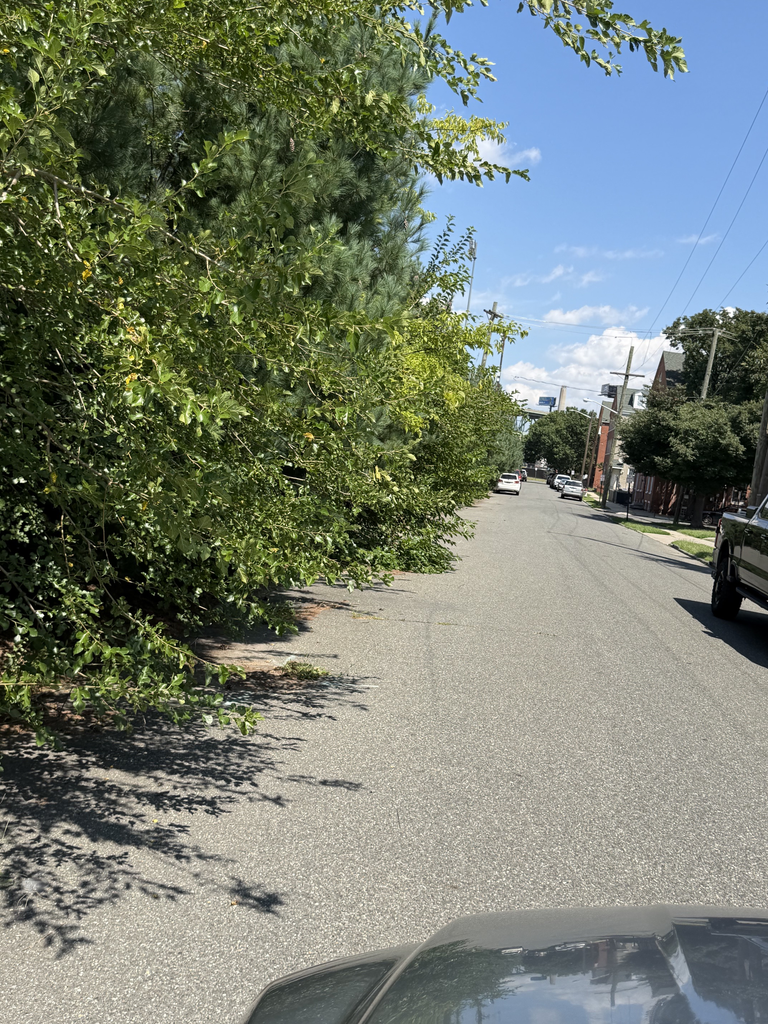
Why has the Gloucester City Housing Office allowed this to happen?–The present head of the department, Bill Gallagher, is being paid $75,000 plus to enforce the city’s property ordinances. Decades ago, the Holt family planted a row of evergreens along the Ellis Street corridor that runs parallel with the marine terminal. Today, branches from those trees have not only engulfed the pedestrian sidewalk but have gotten so large that they have swallowed up parts of Ellis Street narrowing the width of road. Parking is at a premium in that area and those same trees are blocking cars from parking next to the curb. If the trees were placed behind the fence that would not have happened. Another improvement that would make a big difference is a sound deflection walls along Ellis Street similar to the ones you see on state and federal highways.
Constructing engineered acoustic walls directly along the terminal borders helps intercept low-frequency industrial noise. When integrated with vegetative buffers, these structures force airborne dust and diesel exhaust upward, away from ground-level residential areas.
******
Impacts and Mitigation Strategies for the Delaware River Port Communities
The continuous expansion of global supply chains has placed increased operational demands on major maritime facilities along the Delaware River, notably the terminal networks operated by Holt Logistics Corp. across Camden City, Gloucester City, and Paulsboro in New Jersey, and South Philadelphia. While seaports serve as critical economic engines for the region, their immediate proximity to residential neighborhoods introduces severe environmental, public health, logistical, and infrastructure challenges for the surrounding communities.
1. Localized Environmental and Public Health Risks
Air Quality and Emissions Burden
The operation of container marine terminals relies heavily on diesel-powered equipment, including drayage trucks, container cranes, yard tractors, and cargo ships. These sources emit significant volumes of fine particulate matter (\(\text{PM}_{2.5}\)), nitrogen oxides (\(\text{NO}_{x}\)), and sulfur oxides (\(\text{SO}_{x}\)). In fence-line residential zones, prolonged exposure to these pollutants leads to disproportionately elevated rates of respiratory ailments, cardiovascular disease, and pediatric asthma.
Noise, Vibration, and Light Pollution
Unlike standard commercial enterprises, modern marine terminals often run 24/7 logistical cycles. The accompanying industrial activity—such as metal container clanging, backup safety alarms, vessel horns, and low-frequency engine rumbles—creates chronic noise pollution that disrupts sleep patterns and elevates community stress levels. Furthermore, the structural vibrations generated by heavy freight trains and fully laden multi-axle trucks can over time degrade the physical foundations of nearby historic or residential properties. Overnight operations also require high-intensity floodlighting, causing persistent light spillover that directly degrades the quality of life in neighboring residential blocks.
Infrastructure Degradation and Traffic Congestion
The influx of hundreds of daily commercial vehicles significantly strains local municipal infrastructure. Heavy truck traffic accelerates the physical wear and tear of residential roadways, resulting in potholes and frequent, disruptive road construction. In dense urban neighborhoods, routing heavy freight through local streets creates systemic gridlock, slows emergency response times, and heightens safety hazards for pedestrians in school zones and residential corridors.
2. Community Advocacy and Regulatory Recourse
Faced with localized industrial burdens, port-adjacent communities utilize multiple strategies to protect public health and advocate for environmental justice.
Citizen Science and Environmental Monitoring
Neighborhood groups increasingly deploy localized, low-cost air monitoring networks to track ambient pollution levels in real time. This independent data gathering provides community coalitions with verifiable empirical evidence of localized pollution spikes. These findings are used to challenge industrial compliance records and lobby municipal environmental protection agencies for stricter regulatory oversight.
Contractual Accountability and Good Neighbor Agreements
Communities frequently organize to negotiate legally binding community benefit agreements directly with terminal operators and port authorities. These frameworks allow residents to secure enforceable operational concessions, such as mandatory nighttime truck curfews, designated heavy-vehicle routes that avoid residential streets, and commitments to phase in zero-emission cargo-handling equipment.
3. Structural and Ecological Buffer Zone Strategies
Urban planning paradigms highlight the necessity of establishing multi-layered physical, ecological, and structural buffers to separate high-intensity maritime operations from residential property lines.
Vegetative Barriers and Greenways
- Tiered Bioshields: Planting dense, multi-tiered rows of native evergreen trees and thick shrubs along terminal perimeters serves as a natural air filter. The dense foliage physically traps airborne particulate matter on leaf surfaces before it disperses into residential zones.
- Public Greenways: Converting the immediate boundary zones into public parks or waterfront paths establishes an intentional physical setback distance, allowing air pollution concentrations to naturally dilute before reaching residential areas.
Engineered Acoustic and Structural Barriers
Low-Impact Transition Zones: Transitioning the zoning of land immediately adjacent to the terminal gates for low-impact commercial usage—such as office space, indoor logistics, or solar arrays—creates a physical shield between active container yards and residential homes.SOURCE: AI contributed to this article. If you see a mistake contact wecleary@cnbnews.com