
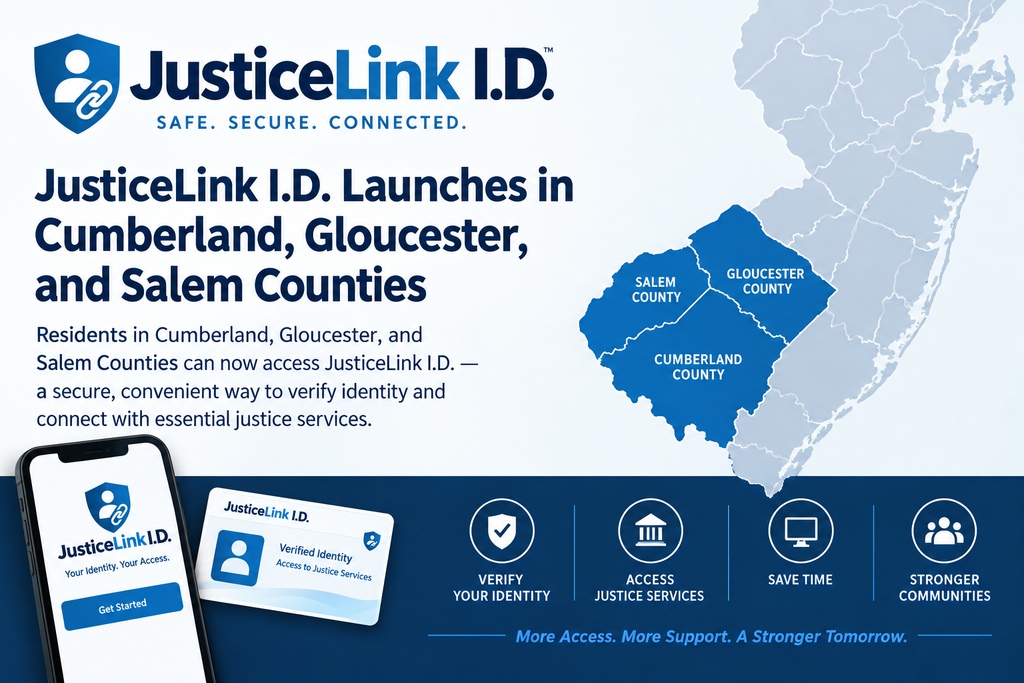
Regional initiative connects eligible justice-involved individuals with mental health treatment, case management, and essential support services.
BRIDGETON, NJ – Gloucester County Prosecutor Andrew B. Johns along with Cumberland County Prosecutor Jennifer Webb-McRae, Salem County Prosecutor Kristin Telsey, and the Superior Court of New Jersey Vicinage XV, announced today the launch of JusticeLink I.D. (Identify. Divert.), a regional mental health diversion program designed to connect eligible individuals in the criminal justice system with behavioral health treatment and other community-based services.
The program, serving Cumberland, Salem, and Gloucester counties, provides a voluntary pathway for eligible individuals charges with certain criminal offenses
The County of Gloucester complies with all state and federal rules and regulations against discrimination in admission to, access to, or operations of its programs, services, and activities. In addition, County encourages participation of people with disabilities in its programs and activities and offers special services to all residents 60 years of age and older. Inquiries regarding compliance may be directed to the County’s ADA Coordinator at (856) 384-6842/ New Jersey Relay Service 711.
whose serious mental illness, or co-occurring mental illness and substance use disorder, is determined to be substantially related to the alleged offense.
Rather than relying solely on traditional prosecution, JusticeLink I.D. seeks to address underlying behavioral health needs through a structured, court-supervised program that connects participants with treatment, case management, and other services while maintaining accountability and promoting public safety.
“JusticeLink I.D. recognized that, in some cases, a person’s involvement with the criminal justice system is closely connected to an untreated behavioral health condition,” Prosecutor Johns said. “By bringing the courts, prosecutors, defense counsel, probation, treatment providers, and community partners together, we can create a more coordinated approach that addresses those underlying needs while maintaining accountability and protecting our communities.”
The program used a two-step eligibility process. Individuals must first undergo a legal eligibility review conducted by the Prosecutor’s Office where their charges are filed. If legally eligible, the Superior Court will order a comprehensive clinical assessment by a contracted licensed mental health provider to evaluate whether the applicant has a qualifying serious mental illness, such as schizophrenia, bipolar disorder, major depressive disorder, post-traumatic stress disorder (PTSD), or another qualifying mental health condition recognized in the Diagnostic and Statistical Manual of Mental Disorders (DSM). The evaluation also considers co occurring substance use disorders and whether the individual’s behavioral health condition contributed to the alleged criminal conduct.
Eligible participants may be connected to a range of individualized services based on their needs, including mental health treatment, psychiatric care, medication management, substance use treatment, housing assistance, medical care, benefits navigation, peer recovery support, transportation, and case management.
Participants are supervised by a multidisciplinary Mental Health Diversion Team led by the Superior Court. The team includes representatives from the Prosecutor’s Office, Public Defenders Office, specially trained Mental Health Probation Officers, contracted mental health providers, and other treatment professionals. The team works collaboratively to monitor progress, address barriers to treatment, and adjust as needed.
2
Participation generally lasts between one and two years, depending on an individual’s needs and progress. During the initial phase, participants appear before the Court regularly for monitoring. As participants demonstrate stability and compliance with the program, the frequency of court appearances may be reduced with judicial approval.
Upon successful completion of the program’s requirements, participants may receive significant legal benefits, including dismissal of their criminal charges with prejudice and automatic expungement.
“JusticeLink I.D. represents the kind of collaboration that is necessary when we are dealing with the intersection of mental health and the criminal justice system,” Johns said. “No single agency can address all the challenges an individual may be facing. This program gives us an opportunity to connect people with the treatment and resources they need while continuing to focus on accountability and public safety.”
The program is funded through a grant provided by the New Jersey Office of the Attorney General, Office of Alternative Community Response, as part of the state’s continued investment in innovative, evidence-based approaches to behavioral health outcomes, reduce recidivism, and strengthen public safety.
The launch was announced Friday, Sept. 18, at the Cumberland County Courthouse in Bridgeton. Assignment Judge Benjamin Telsey provided opening remarks, followed by an overview of the program from Prosecutors Webb-McRae, Johns, and Telsey, Deputy Public Defender Margaret Butler, and other leaders involved in the initiative.