
Cleary’s Notebook News
GLOUCESTER CITY, NJ — The Gloucester City School District is celebrating a series of academic achievements while confronting significant financial challenges tied to state funding limitations and rising operational costs, according to a year-end report released by Superintendent Sean Gorman.
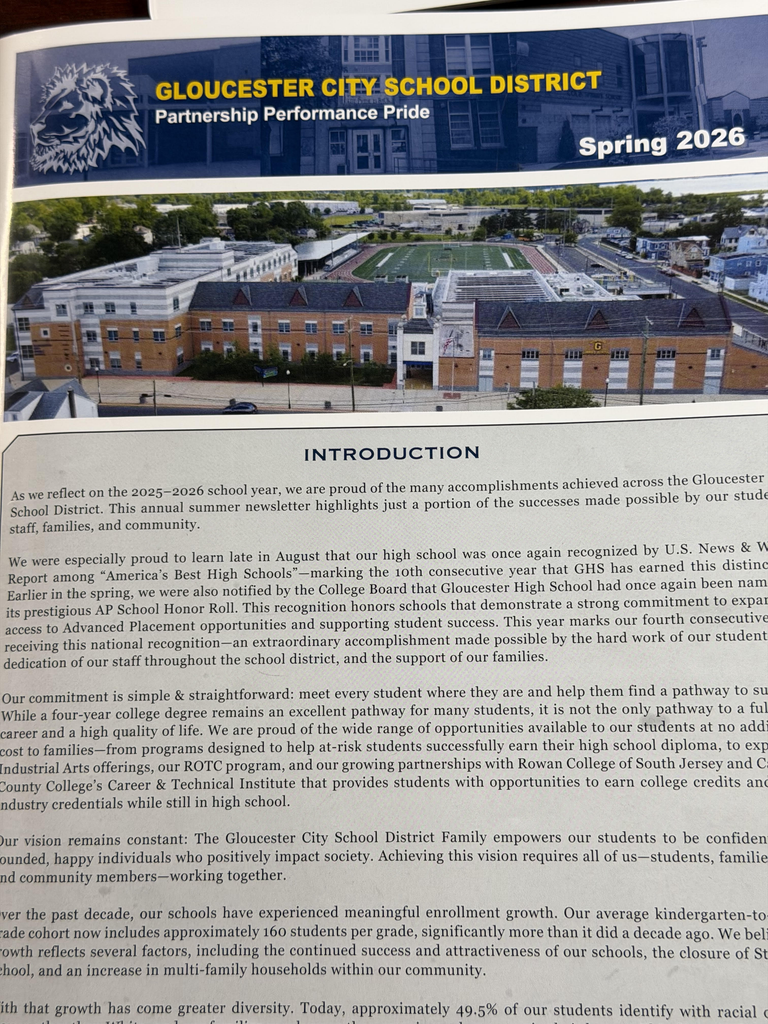
In the district’s annual spring-summer newsletter, school officials highlighted student accomplishments, continued enrollment growth, and national recognition earned by Gloucester City High School during the 2025-26 school year.
Among the district’s most notable achievements, Gloucester City High School was once again recognized by U.S. News & World Report as one of America’s Best High Schools, marking the tenth consecutive year the school has received the distinction. The high school also earned placement on the College Board’s AP School Honor Roll for the fourth consecutive year, recognizing efforts to expand Advanced Placement opportunities and support student success.
District leaders emphasized their commitment to providing multiple pathways to post-secondary success. In addition to traditional college-preparation programs, Gloucester students have access to career and technical education opportunities through partnerships with Rowan College of South Jersey and Camden County College’s Career & Technical Institute. The district also offers Industrial Arts and ROTC programs designed to help students develop workforce skills and industry credentials while still in high school.
Enrollment Growth and Diversity
According to the report, district enrollment has increased significantly over the past decade. Gloucester City’s kindergarten-through-eighth-grade classes now average approximately 160 students per grade level, a notable increase from enrollment levels ten years ago.
Officials attribute the growth to several factors, including the continued appeal of district schools, the closure of St. Mary’s School, and an increase in multi-family housing within the city.
The district also reported growing diversity among its student population. Approximately 49.5 percent of students identify as members of racial or ethnic minority groups, while families within the district collectively speak more than ten primary languages.
Phone-Free School Initiative
One of the most significant changes implemented during the past school year was the district-wide transition to a phone-free school day.
School officials reported that limiting student access to personal electronic devices during instructional hours has helped improve student engagement, increase peer interaction, and strengthen school culture.
The district stated that the initiative allows students to focus more fully on learning while reducing distractions during the school day.
Funding Concerns Continue
Despite academic successes, district officials expressed growing concern over the financial outlook facing Gloucester City schools.
For the second consecutive year, the district’s annual increase in state aid was limited to six percent under New Jersey’s school funding formula. According to the report, Gloucester City has received more than $5 million less in state aid than administrators believe the School Funding Reform Act formula would otherwise provide.
At the same time, district expenses continue to rise, including salaries and benefits, transportation costs, tuition for out-of-district placements, technology expenditures, and facility maintenance.
Officials noted that Gloucester High School, which opened in 1960, and Cold Springs School, which opened in 1995, require ongoing investment to maintain safe and effective learning environments. The district also cited deteriorating athletic fields behind the high school as an area requiring long-term improvements.
Budget Gap Addressed
Superintendent Gorman reported that the district faced a significant budget deficit while developing its 2026-27 spending plan, the first such challenge in nearly a decade.
District administrators, the business office, and the Board of Education ultimately closed the budget gap without eliminating existing programs or staff positions.
The report also highlighted the challenges facing former Abbott districts such as Gloucester City, which have a more limited ability to generate local tax revenue than wealthier New Jersey communities.
According to district officials, a two-percent increase in Gloucester City’s school tax levy generates approximately $140,000 in additional revenue. In contrast, a similar tax increase in a wealthier district can generate close to $1 million.
Looking Ahead
Despite ongoing financial pressures, district leaders said they remain committed to preserving educational opportunities while maintaining fiscal responsibility. The district was able to limit the increase in the average local school tax bill to approximately $2.48 per month this year.
Officials cautioned, however, that maintaining that level of support may become increasingly difficult if state funding constraints and rising costs continue in future years.
“The Gloucester City School District Family empowers our students to be confident, well-rounded, and productive members of society,” the report states. “Achieving this vision requires students, families, staff, and community members working together.”
Source: Gloucester City School District Summer Newsletter, Superintendent Sean Gorman. Republished with permission.
CNBNews Note: Copilot assisted with the above article; it is an AI and may make mistakes.
 -
 -
 -
 -
 -