William E. Cleary Sr. | CNBNews
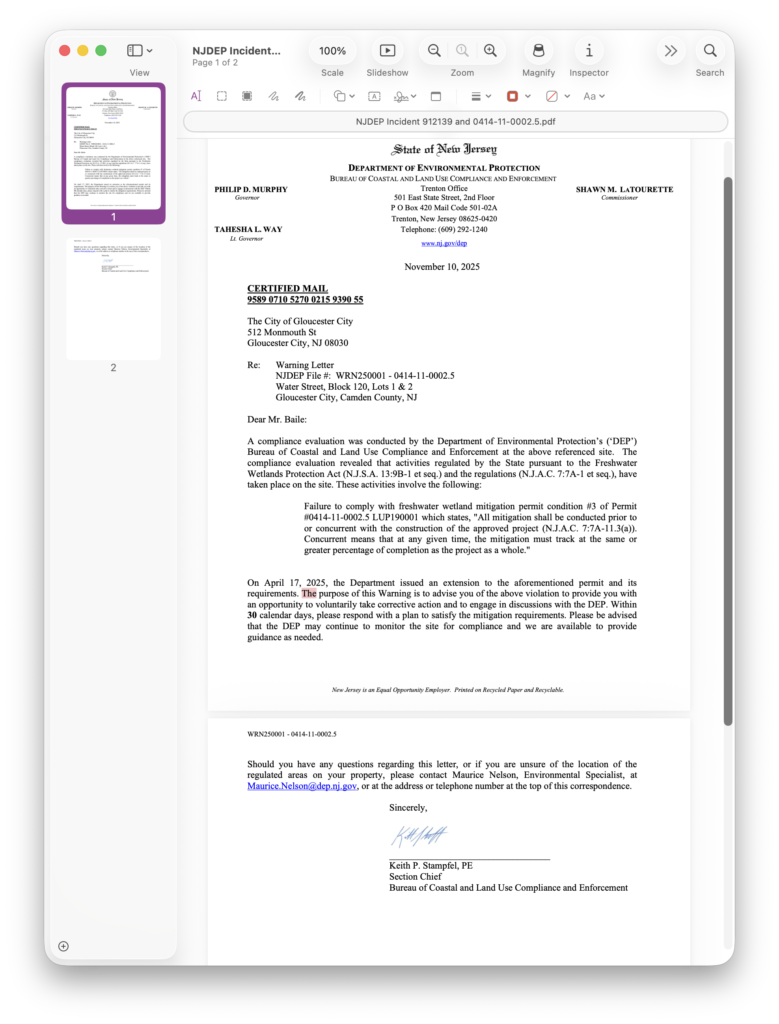
GLOUCESTER CITY, NJ (August 13, 2026)— The New Jersey Department of Environmental Protection (NJDEP) has issued an official Warning Letter to Gloucester City, putting local officials on a ticking clock over significant environmental violations at a controversial waterfront property. The state’s action comes as the city finds itself tangled in parallel legal and financial crises over the future of its Southport redevelopment zone.
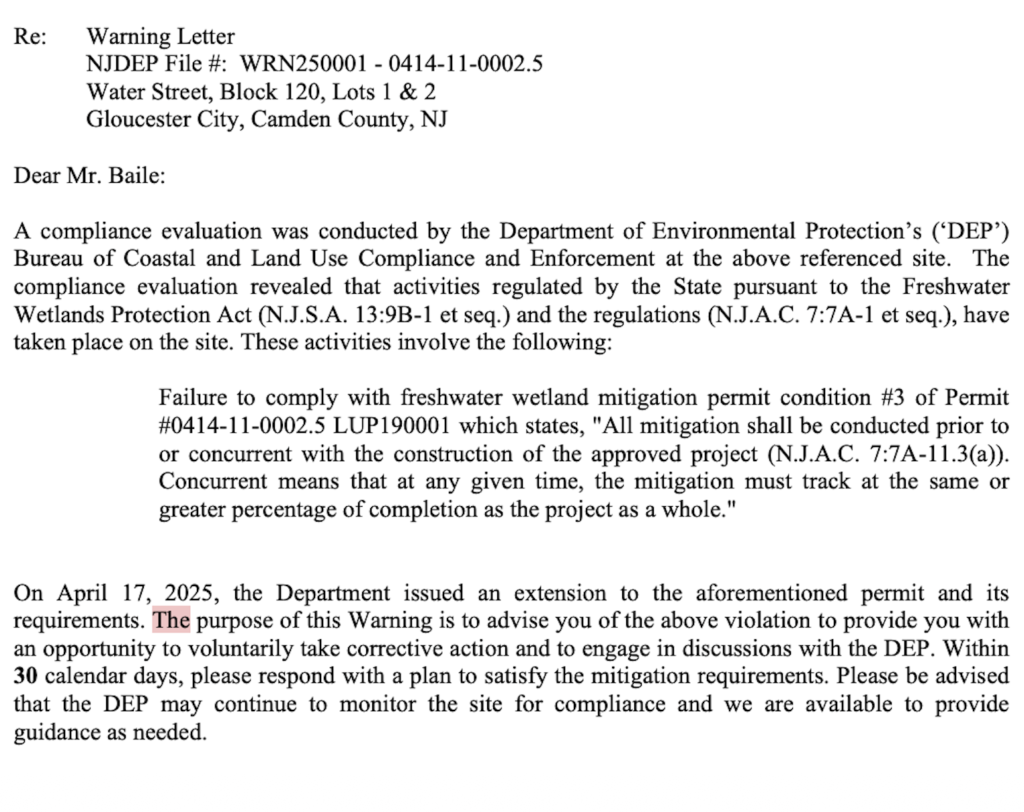
According to state records, a compliance evaluation by the NJDEP’s Bureau of Coastal and Land Use Compliance and Enforcement revealed that the city completely bypassed critical environmental obligations at 850 Water Street (Block 120, Lot 2). To rectify the violation, the state is ordering the city to purchase $2.6 million in wetland mitigation credits.
The Timeline of the Violation
State environmental rules dictate that local infrastructure development cannot come at the permanent cost of South Jersey’s natural ecosystems. Under New Jersey Administrative Code (N.J.A.C. 7:7A-11.3(a)), developers are bound to a strict timeline when modifying protected environments: any required wetland mitigation must be built or restored prior to or alongside the main construction.
State regulations require that environmental restoration track at the exact same or greater percentage of completion as the construction project itself. The state asserts that Gloucester City continued its build-out on Water Street while neglecting to advance the necessary environmental counter-balances, violating Condition #3 of Permit #0414-11-0002.5 LUP190001.
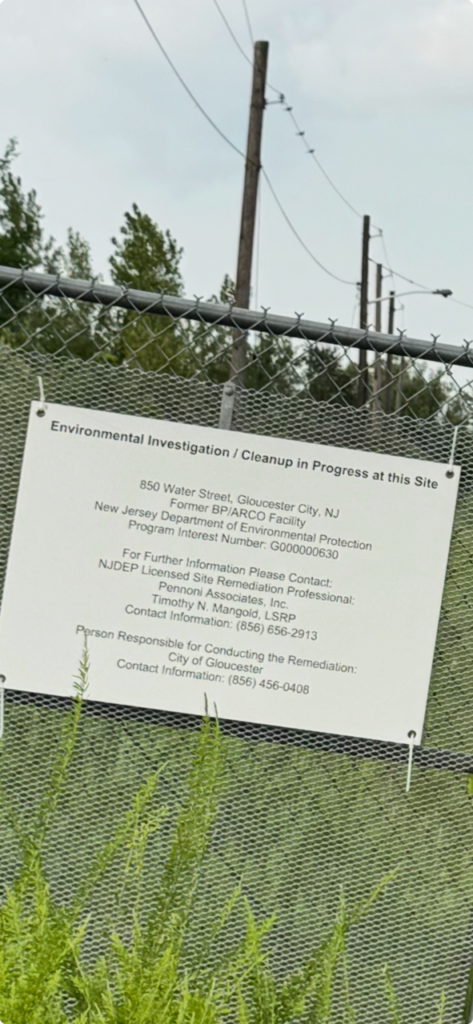
ATLANTIC RICHFIELD/ARCO was located at 850 Water Street 50 years ago. Across from that company was NJ Zinc, also known as Gloucester Titanium, and Gulf and Western.
The state had previously granted the city an extended grace period to rectify the matter, which expired on April 17, 2025. Because that deadline passed without a resolution, the state escalated the enforcement action under file number WRN250001.
Historical Context: From Oil Terminal to Brownfield
The 9-acre parcel at 850 Water Street holds deep historical weight for the Gloucester City waterfront. Situated in the city’s industrial Southport area, this parcel was home decades ago to the Atlantic Richfield Company (ARCO) / BP oil terminal site.
Following the cessation of oil operations, the territory sat vacant for over 30 years as a highly contaminated industrial brownfield, locked in stagnant, unproductive conditions due to heavy environmental liabilities. The entire 121-acre Southport district was heavily plagued by modern industrial hazards, including metals, PCBs, PAHs, and radiological contamination.
In 2008, the NJDEP officially designated Southport as a Brownfield Development Area (BDA), allowing the city to clean up, cap, and safely reconstruct the defunct industrial shoreline. A landmark three-party settlement agreement between Gloucester City, BP/ARCO, and the NJDEP eventually cleared the way for remediation and groundwater cleanup.
Broken Contracts and a $10.5 Million Lawsuit
The Cannabis Connection: High Stakes on Water Street
Public records reveal the high-stakes battle over 850 Water Street was about much more than organic waste compost. In 2019, Gloucester City leadership passed Resolution R123-2019 and companion measures to deliberately alter the Southport zoning rules.
Their goal was to clear the path for a massive, vertically licensed medical marijuana cultivate-and-retail facility directly on Block 120, Lot 2. D’Antonio’s firm sought to sublease the territory to cannabis operators. When the city tore up the contracts, it didn’t just kill a recycling facility—it extinguished a multi-million dollar cannabis enterprise, supercharging the current $10.5 million civil suit again
With the industrial scars of the ARCO era slowly being erased, the city aggressively sought out redevelopment partners. The original vision for 850 Water Street was centered on a groundbreaking green energy initiative: a world-class, fully enclosed organics recycling and composting facility designed to transform regional food waste into renewable energy and high-quality compost.
The city initially partnered with Gloucester City Organic Recycling, LLC (GCOR), an entity spearheaded by environmental entrepreneur Rocco D’Antonio. D’Antonio’s waste-to-energy firm, operating under the project banner Oren, spent substantial time remediating the site, pulling out contaminated debris tanks and raising the entire 10-acre site four feet out of the floodplain to clear the path for groundbreaking.
However, the relationship between the municipality and the redeveloper completely soured. Citing contractual breaches, failures to act, and conflicts of interest, the Gloucester City Mayor and Common Council terminated their agreements with GCOR and formally cut ties with all entities owned by D’Antonio.
The messy breakup triggered severe legal retaliation. Believing the city wrongfully broke its contract, D’Antonio filed a massive $10.5 million lawsuit against Gloucester City. That major litigation is currently working its way through the New Jersey court system, hanging over municipal administrators as a catastrophic secondary financial threat.
Sourcing the Credits: A Public Expense
The $2.6 million credit demand introduces an immediate hurdle for local leaders. When a project impacts a delicate local wetland ecosystem, the law requires that an equivalent portion of nature be built, enhanced, or protected elsewhere. Because Gloucester City failed to perform this remediation work directly on or near the Water Street property, the state allows the purchase of third-party “credits” as a fallback.
These credits are managed by approved regional Wetland Mitigation Banks—dedicated parcels of land where private environmental firms or state agencies have already successfully restored expansive wetland tracts. Sourcing these credits is difficult, as there are currently no active, privately run freshwater wetland mitigation banks physically located within the borders of Camden County.
State mitigation tracking relies heavily on Watershed Management Areas (WMAs) rather than county lines. To satisfy the mandate, Gloucester City must secure credits from a facility whose approved service area covers WMA 18 (Lower Delaware), such as the regional Oldmans Creek Mitigation Bank operating nearby in Salem County.
If regional private credits are entirely sold out, the city will have no choice but to pay into the state’s In-Lieu Fee Program, sending millions in public funds directly to the state’s Freshwater Wetlands Mitigation Council to fund state-managed restoration programs far away from Gloucester City. Because the city is a public entity, a $2.6 million mandate—compounded by the defense costs of a $10.5 million developer lawsuit—represents a severe blow that could deeply strain the local municipal budget.
NJDEP Considering Daily Fines Against Gcity
The clock is officially running for Gloucester City Mayor Dayl Baile and his city council. The state’s warning letter mandated that the city must respond with a definitive, actionable compliance plan to satisfy the outstanding mitigation requirements within 30 calendar days of the notice.
Inquiries regarding the enforcement file are currently being routed through NJDEP Environmental Specialist Maurice Nelson. City leaders have not yet publicly detailed whether they intend to absorb the multi-million dollar credit purchase, appeal the state’s calculations, or how the ongoing litigation with Oren and Rocco D’Antonio will impact the final layout of the Southport waterfront.
According to our source, The $2.6 million is not a fine. It is the cost of wetland credits the City would need to purchase from wetland banks (private companies) to satisfy their permit obligations.
Allegedly, the City has been claiming they didn’t have the funds which was not true. They have been sitting on $2.75 million to do this work since they passed Bond Ordinance 2012-003 on February 16, 2012, specifically to do the work.
Both the NJDEP and the Army Corp of Engineers know the City is not being truthful as they have all the City’s documents Including former mayor Spencer’s testimony that they were aware they needed to do the work and confirmed they always had the money.
*****