
William E. Cleary Sr. | Cleary’s Notebook News
GLOUCESTER CITY, NJ (September 16, 2026)–This past April, Sweetie, my three-year-old English Labrador Retriever, and I added an evening walk to our daily routine. Including our morning walk, we average between three and four miles each day. With the waning days of summer upon us, those walks will soon be limited by winter weather until spring returns.
Because we walk so much, encountering an aggressive dog every now and then is not unusual.
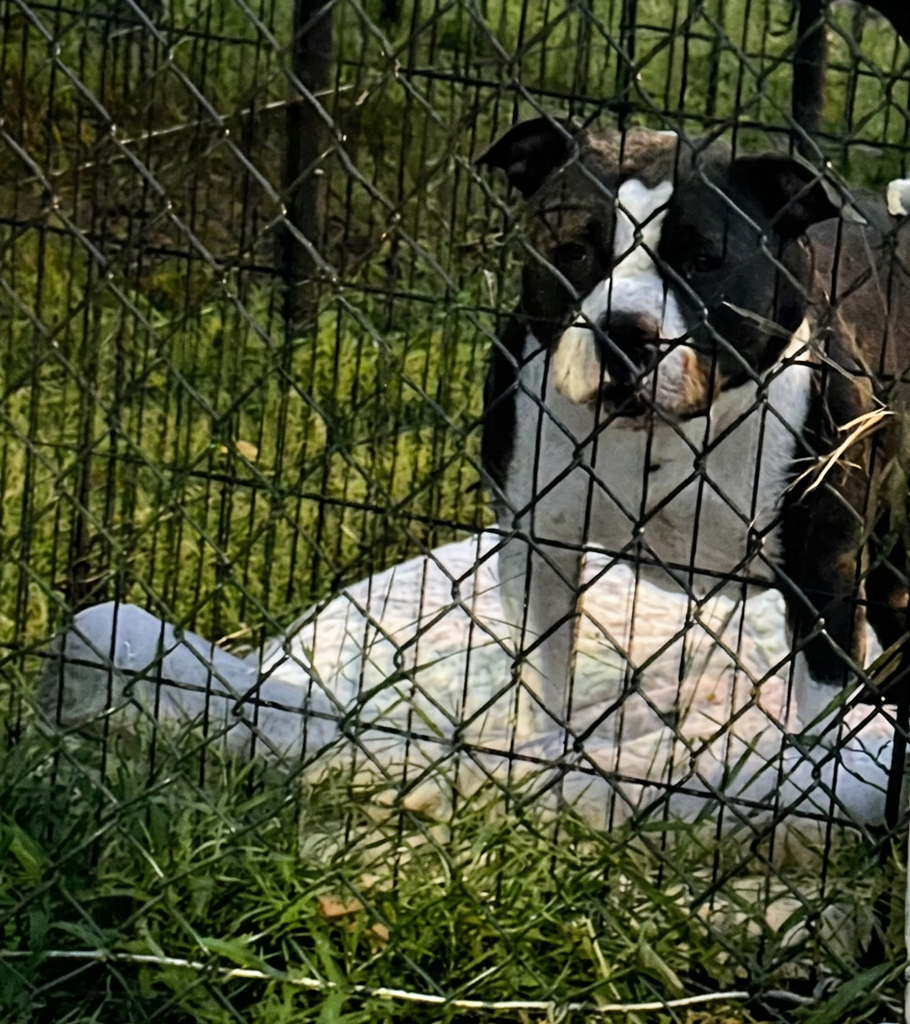
Last night, for example, a hostile mixed-breed dog charged at us on Stites Avenue near Powell Street. The dog appeared to be part pit bull: short and stocky, with a wide head and muscular build.
Sweetie and I were walking west on Powell Street toward Broadway when we heard a dog barking. As we approached the corner, we found a large broken tree branch blocking the sidewalk. To continue our walk, we had to step into the street.
That is when we saw the dog.
It was black and white, with short legs, a broad chest, and a large head. Standing behind a chain-link fence, it barked loudly as we passed. Sweetie and I turned left onto Stites Avenue. Since the dog was confined to the yard and safely behind the fence, neither of us paid much attention to it.
I had seen this dog once before, back in July. It was lying in the corner of the yard on the Powell Street side of the property, confined to a small wire pen with no roof. I remember wondering whether the dog even had enough room to turn around comfortably.
Tuesday night, the dog raced back and forth along the four-foot fence, barking the entire time. Then, without warning, it shoved its head under the bottom of the fence, wiggled free, and escaped the yard.
It headed straight for us.
Sweetie, who was rescued by Connie and me from a breeding farm in Lancaster, Pennsylvania, immediately got behind me. She is still afraid of her own shadow, so I was not expecting much assistance from her. The attacking dog tried several times to reach her by going around me, but each time I turned and blocked it with my walking staff.
Sweetie wanted nothing more than to run. I tightened my grip on her leash and pulled her closer. She stayed directly behind me, peeking at the dog from between my legs.
The entire time, I was yelling at the top of my lungs, “Get back! Get back!”
I held Sweetie’s leash in my left hand and my five-foot walking staff in my right. The dog lunged at me, and I swung the staff, narrowly missing its head.
It lunged again.
This time, the staff slipped from my hand and fell to the ground.
As I continued yelling, I bent down to retrieve it. Suddenly, I found myself eye-level with the attacking dog while still holding Sweetie’s leash. I was huffing and puffying do to my lung ailments. And my heart was pounding in my chest at a rapid pace.
I immediately realized how foolish that move had been.
For a split second, I had taken my eyes off the dog. While reaching for the staff, I left myself vulnerable. Lying in bed later that night, I kept replaying that moment in my head. It would have taken only an instant for the dog to bite me or knock me to the ground.
Fortunately, that didn’t happen.
What the dog didn’t know was that many years ago, when I was hired by the Postal Service, I received training on how to deal with aggressive dogs. During our instruction at the United States Postal Service training academy, we learned techniques for protecting ourselves in exactly these types of situations.
Today, I spoke with a neighbor who told me that his Belgian Malinois was attacked and killed by a pit bull. According to him, he had previously complained to police about another neighbor who allegedly keeps 13 dogs inside his home. He said the owner can often be seen struggling to control the dogs while walking them through the neighborhood.
Gloucester City has an ordinance limiting residents to three dogs per household. If that information is accurate, it raises questions about why the ordinance is not being enforced.
The fact that someone could allegedly keep 13 dogs in a residential home without intervention is difficult to understand.