
The turtle squirms, waving its tiny legs and head in the air as if to say, “Put me down!” After a minute, the woman holding it obliges, releasing it into the marsh along with two of its compatriots. One of them scurries into the grass and muck, while the other two just sit there, perhaps unsure of what to do with their freedom. But after a few minutes, they too scramble away to begin a new life in the wetland. In the coming years, they will grow to maturity and hopefully mate, all the while being tracked by dedicated biologists.
These are bog turtles, the smallest turtle species in North America, and they have just been released into the wild after hatching and being raised at the Brandywine Zoo for a year.
The Delaware Department of Natural Resources and Environmental Control has been monitoring the state’s bog turtle population since 1992 and started a recovery program in 2022. As part of that initiative, transmitters are placed on the turtles to allow DNREC to track the population. At the same time, eggs are collected and taken to the zoo, where they and the subsequent hatchlings are carefully cared for.
Historically, Delaware was home to populations of bog turtles at roughly 20 different sites, but by the turn of the millennium, only about five wetland environments contained the species. Today, they can be found at just two locations.
Both sites are in northern New Castle, with the exact location known to DNREC biologists but kept secret to protect the turtles from poachers and well-meaning admirers. There are only around 20 adult bog turtles in Delaware, meaning the species, which is listed as threatened by the federal government and as a species of greatest conservation need by Delaware, is at risk of dying out in the First State absent human intervention. Fortunately, DNREC is up to the task.
In 2019, there were 21 bog turtles, both adults and juveniles, in the wild. Just seven years later, that number is up to 80. And there are still another 40 babies being raised at the zoo before they’re ready to be released in 2027 or 2028.
The long-term goal, according to Dr. Nathan Nazdrowicz, the DNREC Division of Fish and Wildlife’s herpetologist, is to have five separate sites with 40 adults each in about 20 years. Nazdrowicz is hoping to release a few turtles at a third location next year — a sign of the project’s progress so far.
Some sites that were historically home to turtles do not have any currently but would be able to support a population if members of the species were re-introduced there.
Native to the Eastern United State, bog turtles expanded their range during colonialism as clearcutting enabled them to spread. But, while this initially helped the species, a later transition from using land for farming to development proved detrimental, and populations began declining.
Currently, the species is basically split into two populations: one around western North Carolina and eastern Tennessee and the other centered on eastern Pennsylvania, northeastern Maryland, northern Delaware, parts of New Jersey and the Hudson Valley and around Lake Ontario in New York.
Bog turtles, which reach a maximum size of about 4 inches, like shallow wetlands that allow them to spend time both on land and submerged in the mud. They prefer spots without many trees that can block out the sun and hinder plants like tussock sedges and rushes that turtles use to rest or lay eggs in.
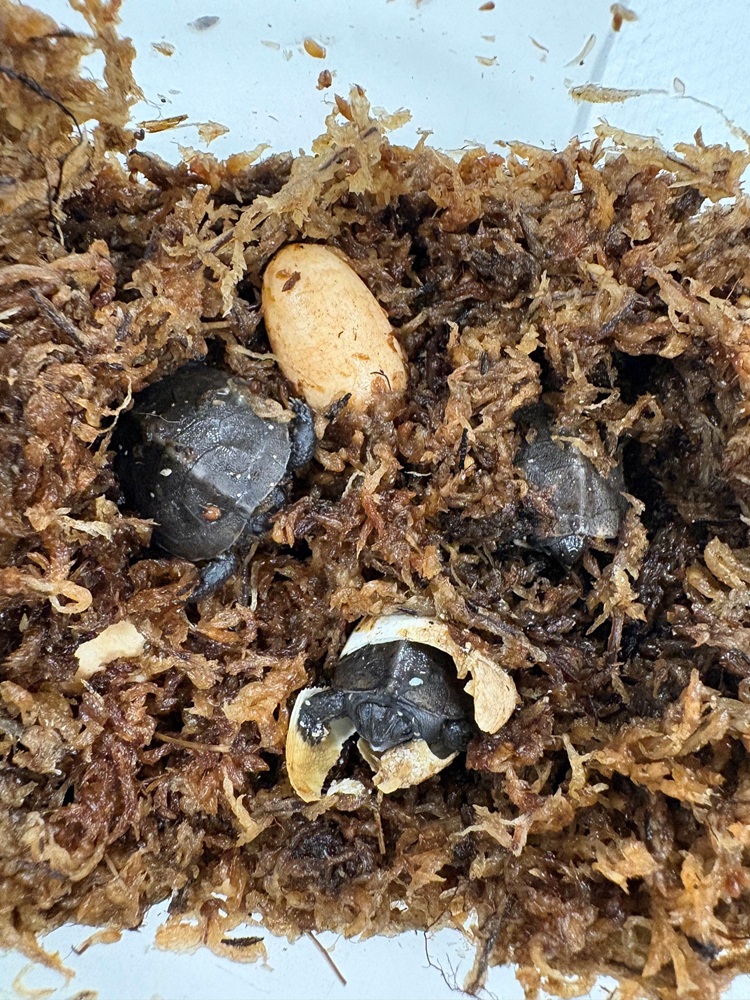
In June, females lay clutches of about five eggs, which then hatch in August or September. Come November, it’s hibernation time, with bog turtles burying themselves in muck, under tree roots or in muskrat burrows before re-emerging around April as spring dawns.
Bog turtles are omnivorous, relying on aquatic plants, seeds, berries, earthworms, slugs and insects. Mostly a dark brown to black color, they have yellow-orange patches by their ears, as well as similar flecks of color elsewhere on their head, neck, limbs or shell.
While they can live around 50 years, they do face threats in the form of raccoons, snakes, birds, shrews and snapping turtles, as well as diseases like mycoplasmosis, ranavirus and the herpes virus. Sadly, a few of the young turtles released back into the wild by DNREC have been eaten by raccoons, though the majority are thriving.
Humans also can be harmful to the species’ population: Bog turtles are popular on the black market, and encroaching development limits the number of places they can live in the wild.
But DNREC is working hard to bolster the population, including controlling predators, using cameras to keep a close eye on the two sites where turtles live and planting native plants in hopes of counteracting invasive flora. And, of course, young turtles are kept at the zoo after they hatch. Of the eggs collected, about three-quarters end up hatching — a total of 137 so far.
At the zoo, the juveniles live in what might pass for luxury for a bog turtle. Zoo staff check on them every single day, providing tasty meals of black worms, gel diet and frozen blood worms. Once a youngling reaches 6 centimeters in length, which generally happens about a year after hatching, it’s time to be sent out into the wild.
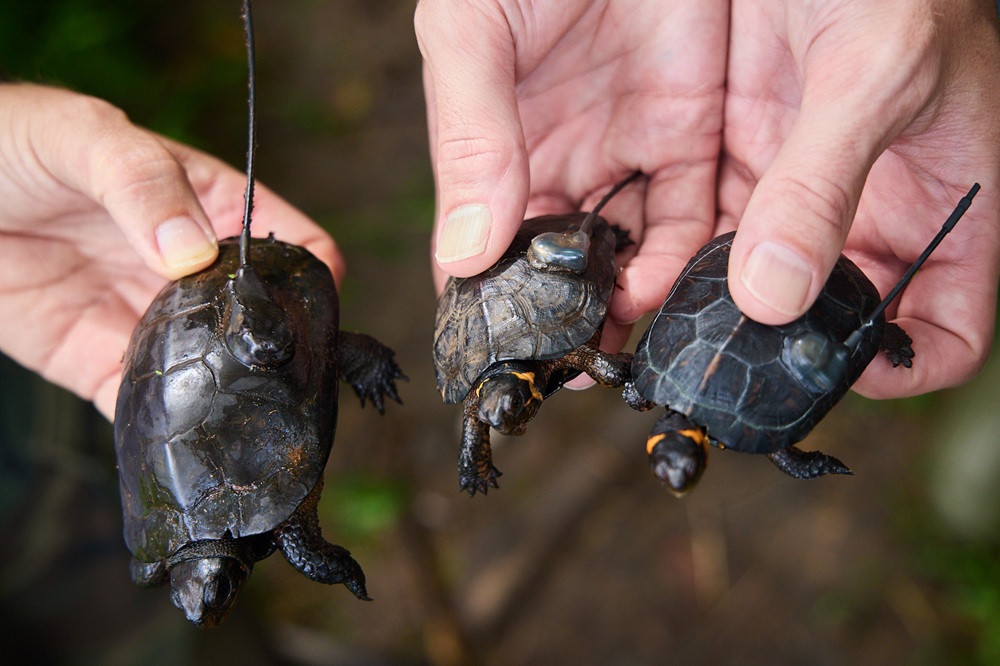
But first, biologists use epoxy to attach a transmitter to its shell, being careful about where it’s placed so the shell doesn’t become deformed as the turtle grows. After a turtle has been tagged, it can be found again with the aid of a tracking device. Basically a large antenna that searches for radio signals within roughly one-third of a mile, the tool enables biologists to better monitor the species, including locating any eggs. Each turtle’s transmitter will be replaced with a new one after the battery, which has a life of a year, runs out.
DNREC biological aide Maya Walker visits the wild turtles almost every day, braving the mud, foliage and potentially rain to check up on the little reptiles and ensure the population remains stable. Each turtle is carefully weighed, measured and examined for disease or injury. So far, so good, DNREC biologists are pleased to report.
Although the turtles are identified by numbers rather than names, one of them has been christened Patterson in honor of DNREC Secretary Greg Patterson, who’s become enthralled by the project. Despite some concern brought on by teasing from DNREC colleagues, the secretary was able to confirm his namesake is thriving and even hold him during an August visit. No word on whether there’s a resemblance.