
Cleary’s Notebook News

ILA, TEAMSTERS & AND HOLT BATTLE FOR THE GLOUCESTER TERMINAL
Gloucester City, NJ (October 11, 2026) – In 1994, the Holt family tried to dramatically lower operating costs at their newly expanded Gloucester Marine Terminal in South Jersey. At the time, Master Contract wages for ILA dockworkers were significantly higher, and the union imposed strict work rules. According to the SocialistWorker.org newspaper, Holt bypassed the ILA entirely and signed a collective bargaining agreement with Teamsters Local 676, a New Jersey-based union that primarily represents truck drivers and warehouse workers, not deep-sea dockworkers. Under this new setup, Holt paid Teamster workers roughly $15 per hour to unload cargo and fruit ships. This wage was roughly half of the total compensation and benefits package the ILA required at the time.
When Thomas Holt Sr. quietly signed a deal with Teamsters Local 676 to unload the Scandinavian Reefer at the Gloucester Marine Terminal, word instantly leaked across the river. To the International Longshoremen’s Association (ILA), this wasn’t just a lost contract; it was an act of war that threatened to break their decades-long monopoly on the Delaware River ports.

Within hours, hundreds of furious deep-sea longshoremen descended on the Gloucester gates and set up an aggressive, densely packed picket line.
Holt argued that the Gloucester City facility operated primarily as a “warehouse and distribution center,” not a traditional marine terminal, and that this legally justified using warehouse-oriented Teamster labor over deep-sea longshoremen.
A TEXTBOOK “UNION BUSTING” MOVE
The ILA viewed Holt’s actions as an existential threat—a textbook “union-busting” move designed to depress wages across all North Atlantic ports. The ILA mobilized thousands of workers and launched angry, heavily manned picket lines outside the Gloucester City terminal. Longshoremen from Philadelphia and South Jersey blocked entrances, leading to tense standoffs with Teamsters who crossed the lines to unload ships. The dispute created severe friction between the two massive international unions. ILA leadership warned that if Teamsters Local 676 accepted half-wages to do longshore work, employers would eventually find non-union labor to work for even less.
THE GLOUCESTER CITY NEWS WAS THERE
In the fall of 1994, nearly a thousand longshoremen stood at the intersection of North Broadway and Essex Street blocking the gates into Holt’s terminal. They waited for members of the Teamsters Union, Local 676, who were scheduled to begin work that day. As the editor and owner of the Gloucester City News, I was there to interview the Longshoremen and to document what would happen when the Teamsters entered the terminal.
Jim E. Ferry Sr., a personal friend, owned Ferry’s Seafood Restaurant a few blocks away at 300 North Broadway. Longshoremen often ate there and stopped after work for a beer. Ferry was an officer of Teamsters Local 676. As I spoke with a member of the ILA, the crowd of men gathered around me grew larger. Someone said that they blamed Ferry for what was happening. Why! I asked. No one answered.
A couple of weeks later, Ferry said that the Longshoremen no longer frequented his restaurant. Other tavern owners in the City I spoke with said the turmoil at the docks hurt them too.
ILA members all said that Tommy Holt was a scab. They said that by lowering the wage to $15, he was trying to bust their union.
Moments later, activity flared up. The crowd of longshoremen rushed toward the terminal entrance gate. The scene was total bedlam. I was caught in the middle, pushed toward the terminal gates.
Because the terminal sat right on the border of intense local jurisdictions, the Camden County Sheriff’s Department was mobilized to maintain order and keep the port’s gates clear so commerce could move. That moment captured the sheer hostility of the 1990s waterfront labor wars, turning Holt’s corporate cost-cutting maneuver into a volatile, physical standoff.
.
- Sheriff’s officers deployed mounted units on horseback to physically push back the surging crowd of longshoremen. Alongside the mounted police, officers utilized trained German Shepherds on tight leashes. The barking K-9 units were stationed right at the perimeter, serving as a high-intensity deterrent to keep protesters from breaching the gates or rushing the vehicles.
- As Teamster members and independent warehouse workers drove toward the gates to begin the $15-an-hour shifting work, they had to run a terrifying gauntlet.
- The anger boiled over. Members of the ILA picket line began shouting “scabs” and hurling rocks, bricks, and debris at the incoming vehicles. The Teamsters pressed on the gas to get past the furious crowd and into the safety of the heavily guarded Holt property, and windows shattered, and cars were dented.
As soon as the first vehicle drove through the gate, rocks and bottles started flying through the air towards the Teamsters and the Sheriff’s officers who were trying to keep the longshoremen from blocking the gates. Two officers on horseback reared their horses into the air, nearly hitting some longshoremen standing nearby when they came back down. The canine units rushed forward towards the union picket lines, forcing men to flee back from the gate. Several trucks with Teamsters riding in the beds of the pickups passed by me. They looked terrified.
The ILA shut down the ports of New York and New Jersey on October 1, 2024, over wages. That walkout ended three days after a tentative agreement was reached. Harold Daggett, President of the International Longshoremen’s Association, led the union that day. Dock workers demanded better wages and protection against automation. #linkinbio
NBC New York· 2024-10-1
THE STRIKE PAID OFF, 62 PERCENT WAGE HIKE
- New 6-Year Contract: On January 8, 2025, the ILA and USMX reached a full tentative agreement on a new six-year Master Contract just ahead of the January 15 deadline, averting a second strike. [1]
- Ratification: On February 25, 2025, ILA rank-and-file members overwhelmingly ratified the agreement with nearly 99% in favor. [1]
- Terms: The final six-year contract runs retroactively from October 1, 2024, through September 30, 2030, incorporates the 62% wage increase, enhances benefits, and establishes agreed-upon guardrails regarding port automation. [1]
The AFL-CIO Intervention and “Dockworkers Union No. 1”
Because both the ILA and the International Brotherhood of Teamsters belonged to the AFL-CIO, the overarching labor federation was forced to step in to arbitrate the jurisdictional dispute.
- The Holt Counter-Move: Refusing to capitulate to the ILA, Thomas Holt Sr. circumvented the AFL-CIO ruling. He helped the displaced Gloucester City terminal workers break away from the Teamsters entirely to form an independent, unaffiliated company union called Dockworkers Union No 1.
- The AFL-CIO ruled decisively in favor of the ILA, stating that the Teamsters were violating anti-raiding rules by taking traditional longshore work. The federation ordered Teamsters Local 676 to withdraw from the pier. Source SocialistWorker.org
- By operating under this independent union, Holt kept the ILA off the Gloucester City docks for years, while paying wages and benefits well below standard North Atlantic ILA contract rates. As a result of this aggressive labor strategy, the Holt family could offer drastically lower stevedoring rates to international fruit and cargo shippers, helping them build the regional import monopoly they still hold today.
The 1996 Packer Avenue Strike
Just two years after using the independent “Dockworkers Union No. 1” to secure lower-wage labor at the Gloucester City terminal, Holt Sr. decided to bring the same aggressive playbook across the river to Philadelphia. In 1996, Holt abruptly pulled out of the local employers’ bargaining group, the Philadelphia Marine Trade Association (PMTA). He aimed to force major work-rule and wage concessions from the ILA at the massive Packer Avenue Marine Terminal.
Remembering the gauntlet at Gloucester City, the ILA refused to budge. They launched a fierce three-week strike that completely paralyzed Packer Avenue. The shutdown of Philadelphia’s primary container terminal cost millions of dollars and eventually forced Holt to capitulate, rejoin the PMTA, and sign the ILA Master Contract.
THE HOLT FAMILY’S DECADE-LONG UNION FEUD ERUPTS
Sixteen years later, on October 1, 2010, the Holt family’s decades-long union feud reached its climax. By then, Thomas Holt Sr.’s son, Leo Holt, ran the terminal operations.
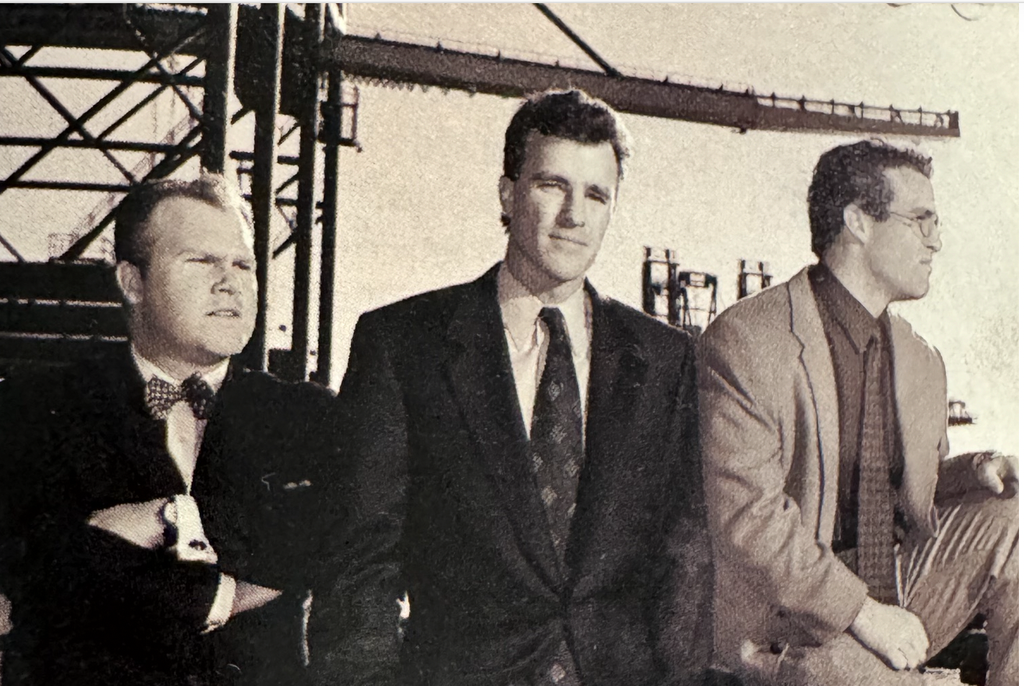
Source: 1999 photo courtesy of the Philadelphia Magazine
(L. to R.) Leo Holt, 34, Tom Holt Jr., and Michael Holt, 25. At the time, Leo was in charge of Marketing, Tom was the head of operations, and Michael was learning the ropes. According to a Philadelphia Magazine article, the $200 million Gloucester City terminal with two more container cranes and two million square feet of warehouse space was worth $200 million. Gloucester City is Holt’s headquarters. In 1998, he moved his offices into an impressive structure that looks like the White House on the Delaware. Actually, it is the former Coast Guard building.
In September of that year, the Holts convinced food giant Del Monte Fresh Produce Co. to pull its massive banana and pineapple import business out of the ILA-staffed Port of Wilmington, Delaware. They moved the entire operation upriver to their expanded Gloucester City terminal. By shifting the work to the lower-wage, non-union operation, 200 ILA longshoremen instantly lost their livelihoods. The shift could cost ILA Local 1291 in Philadelphia 200-300 jobs. Other non-ILA and non-union operations on the Delaware River were already dragging down conditions on the Philadelphia docks and elsewhere.
THE BATTLE BETWEEN HOLT AND ILA INTENSIFIES
LABORNOTES, the voice of union activists, reported that the conflict stems from Del Monte’s announcement that it will move its banana-and-pineapple importing operation to a non-ILA pier across the river from Philadelphia, controlled by Holt Logistics, on October 1.
The Holt Family is advertising positions paying as little as $8.50 an hour with few benefits, while at the ILA port in Philadelphia, union members working break-bulk cargo, like Del Monte’s fruit, earn $17 to $24.50 an hour.
The ILA self-imposed cuts of up to $5 million in wages to try to convince Del Monte not to leave, but the company claimed it needed the larger capacity at the Holt pier.
SHIPPING OWNERS FEAR WILDCAT STRIKE TO SPREAD?
Royce Adams, a Local 1291 member in Philadelphia, said he expected the wildcat wave to spread south to the Texas and Florida ports where much of Del Monte’s fruit is offloaded. A port in Manatee, Florida, fought off a Del Monte bid to go non-union in 2003, but accepted a tiered wage and benefit structure that divides younger workers from older.
Philadelphia ILA members dumped pineapples into the Delaware River on Labor Day to protest Del Monte’s plans to undercut conditions, according to Labor N
The ILA’s response was historic. Rather than just picketing locally, ILA Local 1291 organized a massive wildcat job action. The strike spread like wildfire up the East Coast. The shipping bosses panicked, secured a federal restraining order, and threatened the union with $1 million-a-day fines. While the courts eventually forced the men back to work, the shutdown’s sheer power forced a truce. The Holts eventually had to find a modern equilibrium with the ILA to keep the massive Packer Avenue and Paulsboro operations running smoothly.
We have been writing about grand development proposals for Gloucester City’s waterfront since 1980. During a 1981 interview with Thomas Holt Sr. he said he would develop the city’s waterfront, and he would do it in record time. All the City has to do is ask for my help.
Al, who can make mistakes, contributed to this article
RELATED: