The American College of Cardiology has again recognized Cooper University Hospital for its expertise and commitment to treating patients undergoing transcatheter valve repair and replacement procedures. Cooper earned Transcatheter Valve Recertification following an evaluation of its multidisciplinary team structure, formalized training, shared decision-making practices, and registry performance. Cooper has been certified since 2020.
New Jersey Blood Services (NJBS) today announced an unprecedented second blood emergency this summer after the regional blood supply fell to its lowest level since the COVID-19 pandemic.
Just weeks after declaring a blood emergency around Memorial Day, NJBS is once again urgently calling on the public to donate blood. This unprecedented second blood emergency is due to a combination of factors, including extreme heat, severe storms, prolonged power outages, and ongoing storm cleanup, all of which have significantly reduced donor turnout.
The U.S. Department of Agriculture’s Food Safety and Inspection Service (FSIS) is issuing a public health alert for a beef jerky product due to misbranding and undeclared allergen. The product contains wheat, a known allergen, which is not declared on the product label. A recall was not requested because the product is no longer available for purchase.
The FDA has received an increasing number of reports of pets accidentally overdosing on Apoquel Chewable (oclacitinib chewable tablets), a flavored chewable medicine approved only for dogs. Learn how to help keep your pets safe.
A new AI model called COMPASS uses tumor gene expression data to predict which patients will respond to cancer immunotherapy drugs called immune checkpoint inhibitors.
Analyzing past data from 16 clinical cohorts, COMPASS predicted ICI response 8.5 percent more accurately than the best existing approach.
If validated in clinical trials, the tool could lead to better precision medicine and cancer drug development.
Newswise — Cancer immunotherapy drugs known as immune checkpoint inhibitors (ICIs) can be miracle drugs for cancer patients, curing some and turning deadly disease into a manageable chronic condition in others. But these drugs work for only a subset of patients, with few indications why — a knowledge gap that has detrimental effects on patient prognosis, clinical trial recruitment, and research that could lead to new therapies.
Nursing leaders, researchers, students, and health care professionals gathered on June 24, 2026, for Managing Stress and Preventing Burnout in the Future Nursing Workforce. The event featured a panel discussion hosted by Rutgers School of Nursing-Camden, the Senator Walter Rand Institute for Public Affairs, and Cooper University Health Care.
Using marijuana just once or twice a month is associated with worse school performance and emotional distress for teens, according to a large national study of adolescents led by Ryan Sultán, an assistant professor of clinical psychiatry at Columbia University Vagelos College of Physicians and Surgeons. The more frequently teens used cannabis, the more likely they were to report emotional distress and other social and academic problems.
“While previous studies have focused on the effects of frequent cannabis use among teens, our study found that any amount of cannabis use at all may put kids at risk of falling behind in school, and the kids using most often may have the greatest risk,” says Sultán, who studies adolescent substance use and is also a child and adolescent psychiatrist with Columbia and the Center for Youth Mental Health at NewYork-Presbyterian. “A few ‘harmless’ joints can snowball into real academic consequences. Teens using it regularly often struggle to focus, miss school, and may lose interest in their future plans.”
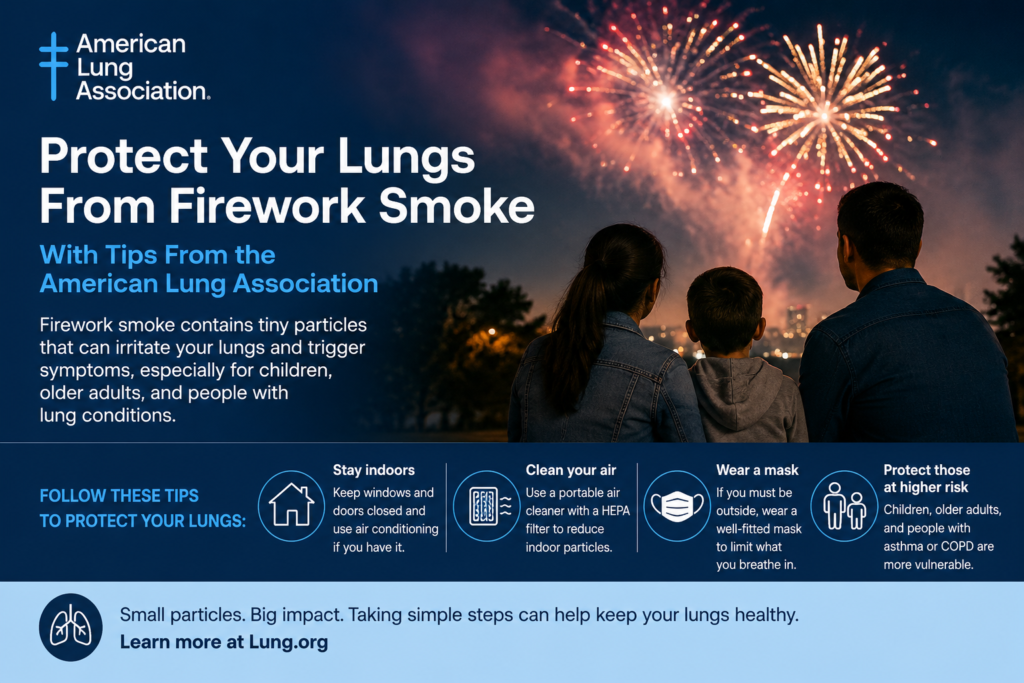
Fireworks are a summertime staple and an iconic element of Independence Day celebrations. However, many people don’t realize that the resulting smoke is hazardous. The American Lung Association is educating the public on the risks associated with firework smoke and sharing tips to enjoy these spectacular displays more safely.
When fireworks explode, they release irritating gases and harmful metals, including carbon monoxide, aluminum and cadmium, into the air. Firework smoke also contains tiny particles, known as particulate matter (PM), which can irritate the lungs, trigger asthma attacks and cause other respiratory symptoms. It’s also important to note that particulate matter levels tend to be elevated not only during the fireworks, but for hours or even days afterward. The amount of pollution depends on how big the fireworks are, how long they last, and the weather conditions at the time. Breathing in firework smoke is unhealthy for everyone, but children, older adults, those who are pregnant and individuals with lung or heart disease are especially vulnerable.
Virtua Health, South Jersey’s largest health system, has appointed two accomplished physicians to senior vice president roles. Drs. Eric Sztejman and Sam Weiner will expand their leadership roles across the not-for-profit health system, while continuing to provide expert care to their patients.
Eric Sztejman, MD, MMM, is now senior vice president of acute care services. In this role, he partners with clinical and administrative leaders to advance quality outcomes, strengthen operational performance, and support the ongoing expansion and evolution of acute care offerings across the health system.
The New Jersey Department of Environmental Protection has issued a code orange air quality alert Wednesday for Southwestern New Jersey. A code orange air quality alert means that air pollution concentrations within the region may become unhealthy for sensitive groups. Sensitive groups include children…people suffering from asthma… heart disease or other lung diseases…and the elderly. The effects of air pollution can be minimized by avoiding strenuous activity or exercise outdoors. For more information on ground-level ozone and fine particles…visit http://www.state.nj.us/dep/






 -
 -
 -
 -
 -