First Full Day of the 2026 Iditarod Trail Sled Dog Race

Image courtesy of https://www.adn.com/newsletter/

Hi, ADN Iditarod fans,

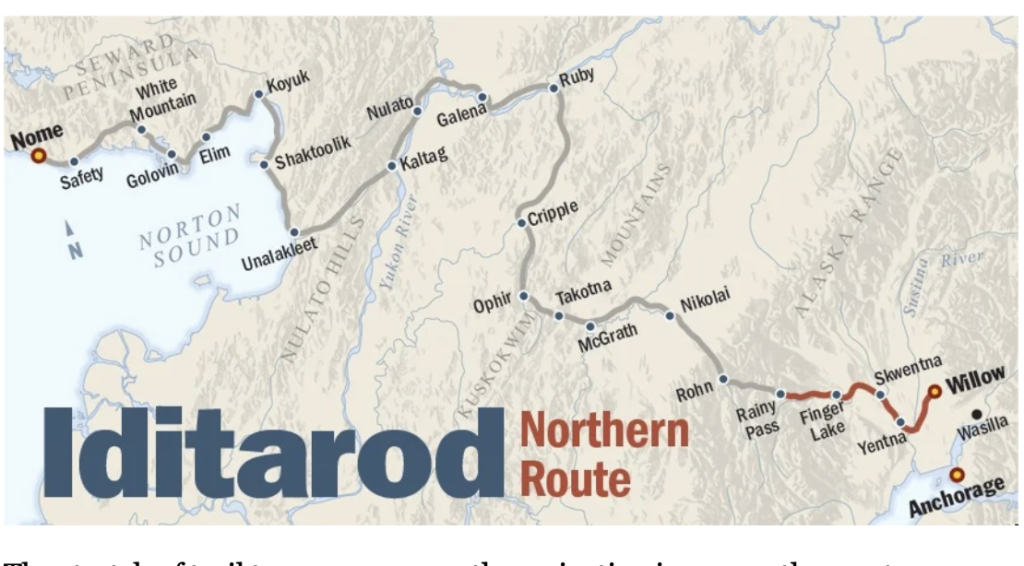
It’s the first full day of the 2026 Iditarod Trail Sled Dog Race, as mushers and their sled dog teams ascend into the Alaska Range after departing Willow in the race restart on Sunday afternoon.

As of Monday afternoon, top competitors had reached the checkpoint of Rainy Pass, led by defending champion Jessie Holmes who arrived there shortly after noon. He was followed over the next few hours by several top teams, including Matt Hall, who finished second last year, Paige Drobny, who finished third in 2025, and Travis Beals of Seward.

The stretch of trail teams are currently navigating is among the most technically challenging of the entire route. There are several ice bridges that cross open creeks, plus a 200-foot downhill section into the notorious Dalzell Gorge.
No teams had scratched from the race as of Monday.
This year’s field has no shortage of tough competition. There are four previous winners, including Holmes, and a host of perennial contenders who have regularly finished in the top 10.
[54th Iditarod officially begins, with stiff competition at the top]
“Everybody who’s been in the top 10 before, been in the top five, everybody has a shot at winning. Everyone shows up here very hungry to do well,” 2019 winner Pete Kaiser of Bethel said ahead of the race.
Mille Porsild of Denmark, Wade Marrs of Willow, Drobny and Hall, among others, are angling for strong finishes this year.
Defending Iditarod champion Jessie Holmes drives his dog during the restart of the Iditarod Trail Sled Dog Race in Willow on Sunday. (Bill Roth / ADN)
This year’s smaller field of 37 mushers reflects a trend of declining participation in the race over the last several years. Costs to run the Iditarod— both as a musher and from an organizational standpoint — have ballooned, making the race more challenging than ever.
Iditarod CEO Rob Urbach said costs have doubled in the past three years. The organization continues to pursue new income sources (with this year’s inaugural Expedition Class being an example) and is working to stay solvent while making the race viable for a new generation of mushers.
But it’s not easy. For mushers, training, transportation, gear, drop bags and more add up quickly, putting the total cost anywhere from $10,000 to $20,000. Some, like veteran musher Gabe Dunham, have ongoing concerns about how long they can sustain a race career. 

On the organization side, the situation is much the same. Line items like fuel, insurance, aviation costs and the hundreds of bales of straw for dogs to rest on at trail checkpoints have gone up in price, according to Urbach.
The Iditarod’s new Expedition Class program, which allows mushers to run the race noncompetitively and under a different set of rules, is one of the organization’s efforts to seek new streams of revenue. As the first musher in this category, billionaire businessman Kjell Inge Røkke contributed more than $300,000 to this year’s race. That helped lower the entry costs for mushers and also increased the race purse.

continue to read https://www.adn.com/newsletter/

Delaware River Basin Commission (DRBC) News

The Delaware River Basin Commission (DRBC) and member agencies of the Delaware River Basin Fish and Wildlife Management Cooperative (Delaware Department of Natural Resources and Environmental Control, Pennsylvania Fish and Boat Commission, New Jersey Division of Fish and Wildlife, the New York State Department of Environmental Conservation, the United States Fish and Wildlife Service and NOAA Fisheries, collectively Co-op) today announce the implementation of the 2026 Delaware River Creel Survey.

Continue reading “Delaware River Basin Commission (DRBC) News” →

NOAA Fisheries Announces a Comment Period Extension

NOAA Fisheries announces a comment period extension on a proposed rule to revise the commercial Atlantic blacknose shark and recreational Atlantic shark fisheries management measures.

What will it do?

The comment period for this proposed rule is being extended through May 29, 2026.  This will provide the public additional time to understand the proposed measures and additional opportunity for public comment. A full description of the proposed management measures can be found in the proposed rule which was published on January 5, 2026. The full range of alternatives considered can be found in the draft environmental assessment. The proposed measures are summarized below.

Read more: NOAA Fisheries Announces a Comment Period Extension

In commercial shark fisheries:

  • Remove the blacknose shark management boundary in the Atlantic region
  • Modify the commercial retention limit for blacknose sharks in the Atlantic region
  • Remove commercial management group quota linkages

In recreational shark fisheries:

  • Revise the recreational minimum size limits for Atlantic sharks 
  • Revise the recreational retention limits for Atlantic sharks

Who is affected?

  • Any commercial or recreational shark fisher in the northwestern Atlantic Ocean, including the Gulf of America and Caribbean Sea
  • Any dealer who buys or sells sharks or shark products in these areas

Comments

NOAA Fisheries will accept public comments through May 29, 2026.

Learn More

Spring Pond Trout Season to Open With Youth-Only Day March 7

DNREC has set Delaware’s 2026 downstate pond trout season to open Saturday, March 7 for youth anglers under age 16 only, with the regular downstate trout season for all anglers opening a half-hour before sunrise on Sunday, March 8.

CNB HUNTING NEWS: Maryland Hunters Harvest Over 70,000 Deer 

Statewide harvest is 7.2% lower than the 5-year average

Maryland deer hunters harvested 71,649 deer during the combined archery, firearms, and muzzleloader seasons, from Sept. 5, 2025 through Feb. 4, 2026.

The statewide harvest reported to the Maryland Department of Natural Resources included 29,814 antlered and 37,925 antlerless white-tailed deer, and 1,874 antlered and 2,036 antlerless sika deer. The harvest was 14.9% lower than the 2024-2025 total of 84,201 deer and 7.2% lower than the previous 5-year average of 77,221.

The deer harvest fluctuates annually due to changes in hunter effort, weather conditions, availability of natural food sources such as acorns, disease outbreaks, and the population size prior to hunting season. Multiple counties in central and southern Maryland experienced an outbreak of epizootic hemorrhagic disease during late summer and fall. This likely reduced local deer populations and may have contributed to the lower harvests in those areas. The 2025 outbreak is not expected to have long-term consequences for local deer populations.

Continue reading “CNB HUNTING NEWS: Maryland Hunters Harvest Over 70,000 Deer “ →

CNB HUNTING NEWS: DNR Seeks Public Input 

Comment period includes migratory game bird season proposal for the coming season

The Maryland Department of Natural Resources is accepting public comment on proposed changes to the 2026-2028 hunting and trapping seasons and the proposed 2026-2027 Migratory Game Bird Seasons and Bag Limits. 

The public can view the proposed regulations and comment online, as well as view and comment on the proposed migratory game bird seasons and bag limits now through February 28. 

“We thank our many stakeholders who have worked with us on the latest set of regulatory proposals,” said Wildlife and Heritage Service Director Karina Stonesifer. “Public input is essential to setting our regulations and we look forward to receiving comments to help us further refine and finalize these actions.”

Continue reading “CNB HUNTING NEWS: DNR Seeks Public Input “ →

Quota Transfer: Atlantic Bluefin Tuna Longline Category Fishery

NOAA Fisheries has transferred 30.8 metric tons (mt) of Atlantic bluefin tuna quota from the Reserve category to the Longline category. The resulting adjusted quotas are:

  • Longline category = 240.1 mt
  • Reserve category = 7.4 mt

Each eligible Individual Bluefin Quota (IBQ) shareholder will receive 893 lbs (0.4 mt) of IBQ. IBQ shareholders can expect for individual accounts to be updated shortly. 

The adjusted Longline and Reserve quotas will remain in effect for the remainder of the 2026 fishing year or until otherwise adjusted. Note that NOAA Fisheries intends to take separate rulemaking action as soon as possible in 2026 to consider modifying the baseline Atlantic bluefin tuna quota consistent with the quota adopted at the 2025 International Commission for the Conservation of Atlantic Tunas annual meeting.

Who is affected?

This action applies to Atlantic Tunas Longline category limited access permit holders.

DNREC Reopens Indian River Bay to Clamming and Shellfish Harvesting After Millsboro Sewage Release

DNREC has reopened the Indian River Bay to clamming and shellfish harvest after a mandatory 21-day closure that followed a Jan. 15 wastewater release from the town of Millsboro’s sewage system.

Closure: Atlantic Bluefin Tuna Angling Category Southern Area Trophy Fishery

FISHERY: Angling Category Southern Area Trophy Bluefin Tuna (the southern area is defined as the area south of 39°18’N. lat. (off Great Egg Inlet, NJ), outside of the Gulf of America). More information on this area can be found in the Amendment 13 Compliance Guide. Please note, that the Angling category fishery for school, large school, or small medium bluefin tuna (27 to <73”) remains open in all areas except for the Gulf of America, which is designated as bluefin tuna spawning grounds and where NOAA Fisheries does not allow targeted fishing for bluefin tuna.

The Angling category bluefin tuna trophy fisheries for the Gulf of America, Southern New England, and Gulf of Maine areas remain open. CLOSED: January 13, 2026, 11:30 pm – December 31, 2026 REASON FOR CLOSURE: Based on the best available landings information, the southern area trophy subquota has been reached and exceeded. PERMITS AFFECTED: Highly Migratory Species Angling category permitted vessels and Highly Migratory Species Charter/Headboat permitted vessels fishing recreationally in the southern area (defined above). Recreational fishermen aboard vessels with an Atlantic Highly Migratory Species Angling category or Highly Migratory Species Charter/Headboat permit (while fishing recreationally) may not retain, possess, or land large medium or giant Atlantic bluefin tuna (i.e., measuring 73 inches curved fork length or greater) in the southern area from 11:30 p.m. January 13, 2026, through December 31, 2026. COMMERCIAL: Not affected by this closure. Learn More


Registration Deadline Jan. 21 for the 2026 Delaware Wetlands Conference

The Department of Natural Resources and Environmental Control is proud to present DNREC’s largest biennial Delaware Wetlands Conference to date, on Jan. 27 and 28, 2026 at the Chase Center on the Riverfront in Wilmington, Del.

Featuring more than 65 sponsors and exhibitors, and 75 presentations between speakers and posters, the 2026 conference put on by the DNREC Division of Watershed Stewardship will provide a breadth of learning and networking opportunities. This is DNREC’s largest professional conference and is funded solely by sponsorships and nonprofit exhibitor support, as well as ticket sales.

Continue reading “Registration Deadline Jan. 21 for the 2026 Delaware Wetlands Conference” →